Need help?
Do you have a question about the Aiwa XP-V520 and is the answer not in the manual?
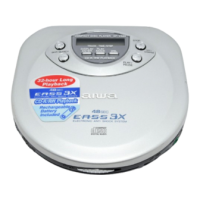
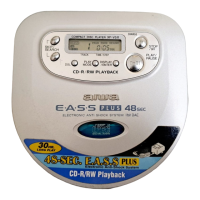
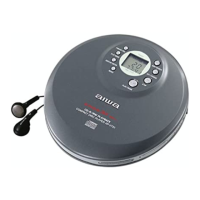
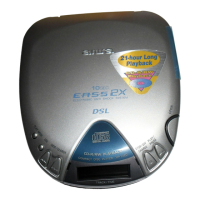
This document serves as a service manual for several models of AIWA compact disc players, specifically the XP-V520, XP-V521, XP-V522, XP-V5210, and XP-V5260C. It provides detailed information for servicing these devices, including a comprehensive parts list and schematic diagrams.
The primary function of these devices is to play compact discs. As portable CD players, they are designed for personal audio enjoyment on the go. Users can insert a standard compact disc into the player, and the device will read the digital audio data, converting it into an analog signal that can be heard through headphones or connected to an external audio system. The manual indicates the use of a BASIC CD MECHANISM, specifically models DA23LN and DA23LH, which are core components responsible for disc rotation, laser tracking, and data retrieval.
Usage features are implied through the parts list and schematic diagrams. The presence of an "ACCESSORY" section listing headphones (HP-M062, HP-M061) suggests that these players are primarily intended for use with personal listening devices. The inclusion of an "AC ADAPTOR" (AC-D603ENC, AC-D603UNC) indicates that the players can be powered by an external power source, allowing for extended listening sessions without relying solely on batteries. The "BAT" (battery) and "BAT-CONTACT" parts further confirm battery-powered portability, with some models (XP-V522) specifically listing "BAT, NB-305 NC (2PSC)" which implies rechargeable battery support.
The "KEY" unit, with components like "C-SW, TACT EVQ-PQH-B55" and various resistors, points to a tactile button interface for controlling playback. The "LCD" (LCD801 AHC-5 REFLEX) and "PANEL, DISPLAY" indicate a visual interface for displaying information such as track number, playback time, and possibly other status indicators. The schematic diagram for the front panel (SCHEMATIC DIAGRAM-2 (FRONT)) explicitly shows controls for "PLAY," "STOP," "DSL" (likely a digital sound level or bass boost feature), "MODE," "ENT" (enter), "F-SKP" (fast skip), and "B-SKP" (back skip), which are standard playback controls for a portable CD player. The "EASS" (Electronic Anti-Shock System) feature, mentioned in the parts list, is a crucial usage feature for portable CD players, designed to prevent audio interruptions caused by movement or vibrations during playback. This enhances the user experience, especially when the device is used during activities like walking or commuting.
Maintenance features are extensively covered in this service manual. The "PARTS LIST" is meticulously detailed, categorizing components by unit name (e.g., AUDIO, CHARGE, DRIVER, MICON, SERVO, OTHERS, PACKING, PLATE, POWER SUPPLY, PRINTED DU, PWB, R.SENSOR, SCREW, VIB) and providing part codes, descriptions, and model applicability. This detailed breakdown is essential for technicians to identify and order specific replacement parts. Components are further marked with "C" for safety parts, "S" and "O" for spare parts stocked at service centers, and "X" and "R" for components not designated as spare parts for after-sales service, providing clear guidance on part availability for repairs.
The "SCHEMATIC DIAGRAMS" (MAIN and FRONT) are critical maintenance tools, illustrating the internal circuitry and interconnections of the device. These diagrams allow technicians to trace signal paths, diagnose electrical faults, and understand the functional relationships between different components. For instance, the "MAIN" schematic shows the "POWER CONTROLLER," "CD MECHANISM," and various integrated circuits (ICs) like the "AN8746SA" (DRIVER IC) and "MN101C439-AJ" (MICON IC), which are central to the player's operation. The "FRONT" schematic details the LCD display and control buttons, aiding in troubleshooting user interface issues.
The manual also includes a "Revision Publishing" note, indicating that it should be replaced with updated versions when issued. This highlights the ongoing nature of product support and the importance of using the most current documentation for accurate maintenance. The comprehensive nature of the parts list, combined with the schematic diagrams, ensures that service personnel have all the necessary information to perform repairs, replace faulty components, and maintain the functionality of these AIWA compact disc players. The inclusion of specific mechanisms like DA23LN and DA23LH also suggests a modular design, which can simplify repairs by allowing for the replacement of entire sub-assemblies rather than individual, microscopic components.
 General
| Type | Portable CD Player |
|---|---|
| Digital Output | No |
| Frequency Response | 20Hz - 20kHz |
| Playback Formats | CD |
| Power Source | AC adapter or batteries |
| Disc format | CD |
| Power supply | DC 4.5V |
| Headphone Output | Yes (stereo mini jack) |
| Anti-Skip Protection | Yes |
| Channels | Stereo |
| Dynamic Range | 85dB |
| Total Harmonic Distortion | 0.05% |
| Power Requirements | DC 4.5V |


 To Next Page