Need help?
Do you have a question about the AL-KO 3004 and is the answer not in the manual?
Ensure handbrake is on, unscrew nuts, remove front bolt, and use dowel to push out rear bolt.
Slide stabiliser onto overrun, align holes, insert bolts, screw nuts, and tighten to 86Nm.
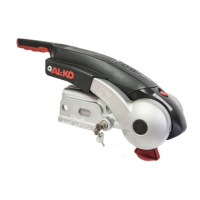
The provided manual describes the installation process for the AL-KO AKS 3004 Stabiliser, a device designed to enhance the stability of a caravan or trailer when coupled to a towing vehicle. This guide is applicable to both the original red and newer black versions of the AKS 3004 Stabiliser.
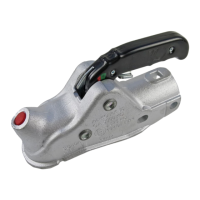
The AL-KO AKS 3004 Stabiliser is a coupling head that replaces the standard coupling head on a caravan or trailer. Its primary function is to provide superior driving stability by actively counteracting snaking and pitching movements that can occur during towing. This is achieved through friction pads that apply pressure to the towball, creating a damping effect that reduces lateral and vertical oscillations. By minimizing these movements, the stabiliser significantly improves towing safety and comfort, especially at higher speeds or in windy conditions. It helps to keep the caravan or trailer tracking smoothly behind the towing vehicle, reducing driver fatigue and increasing confidence.
While the manual focuses on installation, it implicitly highlights a key technical specification: the tightening torque for the new bolts. Both new bolts supplied with the stabiliser must be tightened to 86 Nm using a torque wrench. This precise torque setting is crucial for ensuring the secure and safe attachment of the stabiliser to the overrun device, and for the proper functioning of the unit. The stabiliser is designed to fit onto the overrun device of a caravan or trailer, replacing the existing coupling head. The design accommodates two bolts for secure mounting. The inclusion of a washer with one of the new bolts suggests a specific design for load distribution or to prevent loosening in that particular position. The stabiliser's internal mechanism, involving friction pads, is designed to interact with a standard towball, providing the necessary damping action.
The AKS 3004 Stabiliser is a "fit and forget" type of device once installed. Its operation is automatic, engaging as soon as the caravan or trailer is coupled to the towball. There are no active controls for the user to manipulate during towing, making its use seamless. The stabiliser is designed to be a direct replacement for the existing coupling head, meaning that the fundamental coupling and uncoupling procedures remain largely the same, with the added benefit of enhanced stability. The manual emphasizes the importance of ensuring the handbrake is on before commencing installation, which is a standard safety procedure for any work involving a caravan or trailer. The fact that the guide is suitable for both red (original) and black (new) versions indicates a consistent design and installation process across different aesthetic iterations of the product.
While the manual does not explicitly detail ongoing maintenance, the installation process provides some insights. The requirement to replace existing bolts with new ones supplied with the stabiliser suggests that these components are integral to the stabiliser's performance and safety. The precise torque setting for the bolts implies that periodic checks of these bolts for tightness might be a recommended maintenance practice, although not explicitly stated in this installation guide. The friction pads within the stabiliser are wear components and would eventually require inspection and replacement, though this manual does not cover that aspect. The overall design, as inferred from the installation, suggests a robust unit built for durability, with the main "maintenance" being the correct initial installation to ensure optimal performance and safety. The process of removing the old coupling head and installing the new stabiliser involves basic tools like a hammer and a torque wrench, indicating that routine checks or minor adjustments, if needed, would likely be straightforward.


 To Next Page
 General