The OmniSwitch 6450 series comprises stackable Gigabit Ethernet LAN switches designed for various network applications, from classrooms and workgroups to small enterprises. These switches are available in 10-port, 24-port, and 48-port models, with some offering Power over Ethernet (PoE) capabilities and optional upgrades for 10 Gigabit Ethernet (GigE) stacking and uplinks.
Function Description
The OmniSwitch 6450 switches serve as network devices that provide Ethernet connectivity. They can operate as individual standalone units or be linked together to form a single virtual chassis, known as a stack, to expand switching capacity and enhance resiliency. PoE-enabled models deliver inline power directly from their Ethernet ports to Powered Devices (PDs) like IP phones and wireless access points, reducing the need for conventional power sources. Some models also support IEEE 1588 Precision Time Protocol (PTP) for synchronizing clocks across a network, achieving sub-microsecond accuracy suitable for measurement and control systems.
Important Technical Specifications
The OmniSwitch 6450 series offers various configurations:
-
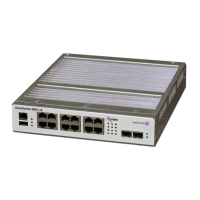
10-Port Models (OS6450-10/10L, OS6450-P10/P10L, OS6450-P10S):
- OS6450-10/10L: Provides eight 10/100/1000BaseT Ethernet ports (or upgradeable 10/100BaseT for 'L' models), two combo ports (10/100/1000BaseT or 100FX/1000X SFP), and two non-combo SFP ports. Includes an internal AC power supply and features a fanless design.
- OS6450-P10/P10L: Offers eight 10/100/1000BaseT Power Over Ethernet (802.3at) ports (or upgradeable 10/100BaseT for 'L' models), two combo ports, and two non-combo SFP ports. Includes an internal AC power supply.
- OS6450-P10S: Features eight 10/100/1000BaseT Power Over Ethernet ports, with ports 1-4 supporting HPoE (~75W) and ports 5-8 supporting 802.3at (up to 30W). It has two fixed SFP ports and an internal AC power supply. The maximum PoE power budget is 280W. This model also supports IEEE 1588 PTP.
- General 10-Port Specifications (OS6450-10):
- Flash memory: 128 MB
- RAM: 256 MB SDRAM
- Chassis dimensions: 8.50 inches (21.5 cm) width, 1.73 inches (4.40 cm) height, 11.50 inches (29.21 cm) depth.
- Weight: 3.66 lbs (1.66 kg).
- Operating temperature: 0°C to +45°C.
- Internal AC power supply: 100-240 VAC, 50-60 Hz, 30W max output (12.0 VDC, 2.5 A).
- Remote Stacking Support: Not supported.
-
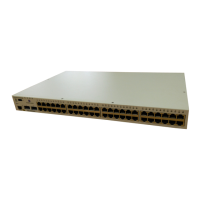
24-Port Models (OS6450-24/24L, OS6450-P24/P24L, OS6450-U24/U24S):
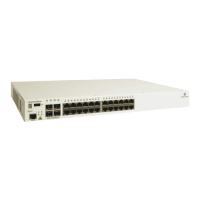
- OS6450-24/24L: Provides 24 10/100/1000BaseT ports (or upgradeable 10/100BaseT for 'L' models), two fixed SFP+ ports, and one expansion slot for optional stacking or uplink modules. Features a fanless design and internal AC power with optional internal AC or DC backup power.
- OS6450-P24/P24L: Offers 24 PoE 10/100/1000BaseT ports (or upgradeable 10/100BaseT for 'L' models), two fixed SFP+ ports, and one expansion slot. Includes four fans and internal AC power with optional external AC backup power (installed on a separate 1 RU tray).
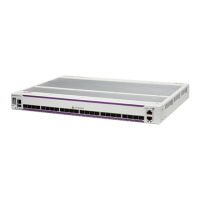
- OS6450-U24: Provides 22 SFP ports, two RJ45/SFP combo ports, two fixed SFP+ ports, and one expansion slot for two optional SFP+ stacking/expansion ports.
- OS6450-U24S: Similar to OS6450-U24, but also supports IEEE 1588 PTP. When PTP is enabled, it operates as a standalone device and cannot be part of a stack.
- General 24-Port Specifications (OS6450-24):
- Flash memory: 128 MB
- RAM: 256 MB SDRAM
- Chassis dimensions: 17.32 inches (44.00 cm) width, 1.73 inches (4.40 cm) height, 12.3 inches (31.24 cm) depth.
- Weight: 9 lbs (4.08 kg).
- Operating temperature: 0°C to +45°C.
- Internal AC power supply: 100-240 VAC, 50-60 Hz, 65W max output (12.0 VDC, 5.4 A).
- Remote Stacking Support: Supported.
-
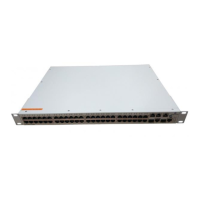
48-Port Models (OS6450-48/48L, OS6450-P48/P48L):
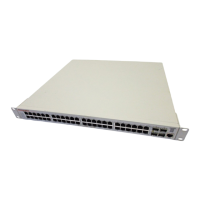
- OS6450-48/48L: Provides 48 10/100/1000BaseT ports (or upgradeable 10/100BaseT for 'L' models), two fixed SFP+ ports, and one expansion slot. Includes three fans and internal AC power with optional internal AC or DC backup power.
- OS6450-P48/P48L: Offers 48 PoE 10/100/1000BaseT ports (or upgradeable 10/100BaseT for 'L' models), two fixed SFP+ ports, and one expansion slot. Includes four fans and internal AC power with optional external AC backup power (installed on a separate 1 RU tray).
- General 48-Port Specifications (OS6450-48):
- Flash memory: 128 MB
- RAM: 256 MB SDRAM
- Chassis dimensions: 17.32 inches (44.00 cm) width, 1.73 inches (4.40 cm) height, 15.40 inches (39.10 cm) depth.
- Weight: 12 lbs (5.44 kg).
- Operating temperature: 0°C to +45°C.
- Internal AC power supply: 100-240 VAC, 50-60 Hz, 90W max output (12.0 VDC, 7.5 A).
- Remote Stacking Support: Supported.
-
Expansion Modules:
- OS6450-GNI-C2: Two RJ45 Gigabit ports, for 24- and 48-port switches.
- OS6450-GNI-U2: Two SFP Gigabit transceivers, for 24- and 48-port switches.
- OS6450-XNI-U2: Two SFP+ 10 Gigabit ports, for 24- and 48-port switches (stacking module). Uplink mode not supported.
-
Internal Backup Power Supplies (for 24/48/U24 models):
- PS-90W-AC: 90W AC power supply (90-264 VAC input, 12.0 VDC output, 7.5 A).
- PS-90W-DC: 90W DC power supply (-48 to -60 VDC input, 12.0 VDC output, 7.5 A).
-
External Backup Power Supplies (for PoE models):
- PS-550W-AC-P: 550W AC PoE power supply (100-240 VAC input, 140W system output, 410W PoE output).
- PS-900AC-P: 900W AC PoE power supply (90-265 VAC input, 126W system output, 780W PoE output).
Usage Features
- Stacking: OmniSwitch 6450 switches can be configured into a stack (virtual chassis) to expand switching capacity and provide enhanced resiliency. Stacking cables connect switches in an A-B pattern, with redundant connections for failover. The OS6450-10 models support stacking with other OS6450-10 switches (max 4 switches), while other models support stacking with OS6450-XNI-U2 modules (max 8 switches).
- Roles within a Stack: Switches in a stack are assigned primary management, secondary management, or idle roles. The primary manages software and configuration, the secondary acts as a backup, and idle modules handle traffic.
- Dynamic Slot Number Assignment: For new switches without preconfigured slot information, the system automatically assigns unique slot numbers based on MAC address and physical location in the stack.
- Manual Slot Number Assignment: Users can manually assign slot numbers to modules in a stack, which is useful for reordering the stack topology.
- Power over Ethernet (PoE): PoE-enabled models deliver power to attached devices. PoE ports can be configured with priority levels (low, high, critical) to manage power distribution during budget deficits.
- Priority Disconnect: This feature determines whether an incoming PD will be granted or denied power when the PoE budget is insufficient, based on port priority and physical port number.
- Console Port: An RJ-45 console port provides CLI access for configuration and management, with default serial connection settings (9600 baud, no parity, 8 data bits, 1 stop bit, no flow control).
- USB Port: High-speed USB 2.0 port for various functions.
- LED Status Indicators: Front panel LEDs provide visual status information on hardware, software, power, link integrity, and data flow.
Maintenance Features
- Software Rollback: Allows the switch to revert to a prior "last known good" software version in case of system software problems, utilizing resilient directory structures (
/flash/working and /flash/certified).
- Hot Swapping: Enables adding, removing, or replacing components (switches in a virtual chassis stack, 1G/10G uplink modules, power supply connector cables, transceivers, backup power supplies) without powering off the switch or disrupting operations. Hot swapping is primarily for idle and pass-through modules.
- Hardware Monitoring: Built-in sensors automatically monitor operations and send traps for errors (e.g., over-threshold temperature). Users can also use CLI commands (
show chassis, show temperature, show power, show fan, show module, show ni, show cmm) to access current hardware status.
- Redundant Stacking Cable Connection: Ensures data flow throughout the stack even if a stacking link or module fails, providing dual redundancy.
- Stack Split Detection (SSP): Prevents network disruptions from duplicate MAC/IP addresses if a stack splits due to link or element failure. It puts front-panel ports of sub-stacks into an operationally down state and provides mechanisms for manual or automatic recovery.
- Software Synchronization: During a full reload, the primary management module automatically distributes its system and configuration software to all other switches in the stack, ensuring consistency and effective redundancy.
- Backup Power Supplies: Fully operational backup power supplies can share the load with the primary supply and automatically take over if the primary fails, without disrupting the switch.
- Earthing: Proper earthing is required to avoid shock hazards, using specified grounding lugs and copper conductors.
- Airflow Recommendations: Minimum clearances at the front, back, and sides of the chassis are recommended to ensure proper airflow and prevent overheating.

 Need help?
 General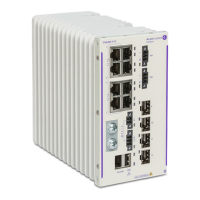


 To Next Page