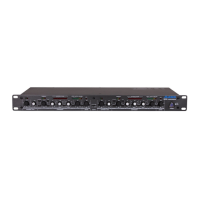
3.22 3630 Gate Detector
The purpose of the gate detector is to vary the audio VCA control signals according to the
front panel settings for the noise gate. In accomplishing this, it must override the compressor
detector when the gate itself is in the closed position, yet still allow the compressor detector to
function during the release portion of the noise gates normal cycle. It’s also worth noting here
the economy of parts used by the Alesis Engineers. Instead of leaving some sections of a quad
comparator unused, and needing to add at least a dual op amp to each channel, they instead
opted to use the comparators in a linear mode. Since we are only using the audio signal for
amplitude detection purposes at this point, the degradation of the audio signal caused by using
these parts is not an issue.
The circuit begins with audio signal input via the side chain jack J3. This signal is A.C.
coupled via C24, and provided with some gain by U4 pins 8, 9, and 10. The signal is then
buffered (U9 pins 10, 11, 13, 8, 9, and 14) and filtered (C44) prior to entering the threshold
detector.
The threshold detector consists of a simple level detector with hysteresis (U9 pins 6, 7,
and 1). It’s threshold level is set by R124. This signal is then rectified (D9, D10) and filtered
(R89, C45) to further shape the control signal as well as prevent the system from reacting too
quickly (i.e. causing the gate to “chatter” when the audio level and threshold level are roughly
equivalent).
Immediately following the threshold detector is the rate circuit, whose main components
consist of U9 pins 5, 6, and 7, Q1, C20, and R125. While the gate is in the open position, the
base of Q1 is held at -15V (turning it on) forcing the voltage across C20 to stay low (about 0.7V).
As soon as the threshold is exceeded and the gate is closed, the base of Q1 jumps to +10V
(turning it off) and allowing C20 to charge at a rate determined by the rate potentiometer (R125).
The signal is finally buffered and mixed with the output of the compression detector via
D5, R32, R30 and C19. Note that D5 helps prevent component damage under conditions when
the compression detector signal and gate detector signal combined might cause excessive
reverse currents.
3.30 LED Displays
While there is an obvious difference between the sensitivities of the LED bar graph
displays of the 3630 and the NanoCompressor, they both use the same basic circuit to generate
it. Here we will use the 3630 master input output LED bar graph as an example.
U18 buffers the incoming signal and C66 acts to low pass filter the signal (without this the
LEDs might only light briefly making it look dim). Q5 and Q6 provide a constant current so that
the LEDs maintain a constant brightness no matter how many are on. U15-U19 compare the
incoming signal to a series of set threshold values (set by R151-R162).
In the 3630 the gain reduction LEDs lack the input signal buffer and low pass filtering as it
is already slow enough to hold the LEDs on long enough to stay visible.
3.40 3630 Schematic Cross Connections
Due to the relative complexity of the various connections between master and slave, it
can be difficult to follow the various connections throughout the schematics. The following table
is presented to help simplify troubleshooting.
Connection Designation Function
T1 Sets correct path for the cap input of slave 2252 (U5), according to the state of the
stereo/dual switch.
Alesis 3630 Compressor Service Manual 1.00 3 12/11/02


 To Next Page