EasyManua.ls Logo

Alesis M1 ACTIVE - Page 32

Alesis M1 ACTIVE
40 pages
Print Icon
To Next Page IconTo Next Page
To Previous Page IconTo Previous Page
Loading...
Suround Sound
Mixing
for
discrete
s-lx
channel
speakens
reproduction:
matched
us.
specialized
While most
speaker
systems
for monitoring
music in
surround use the
same speaker
cabinet in
all positions,
both front and
rear, keep
in mind that most
consumer video
surround installations
use a different
speaker in the
rear dunnels. These
rear
speakers
typically
do not have
the same directionality
or
wide frequency
response
of
the
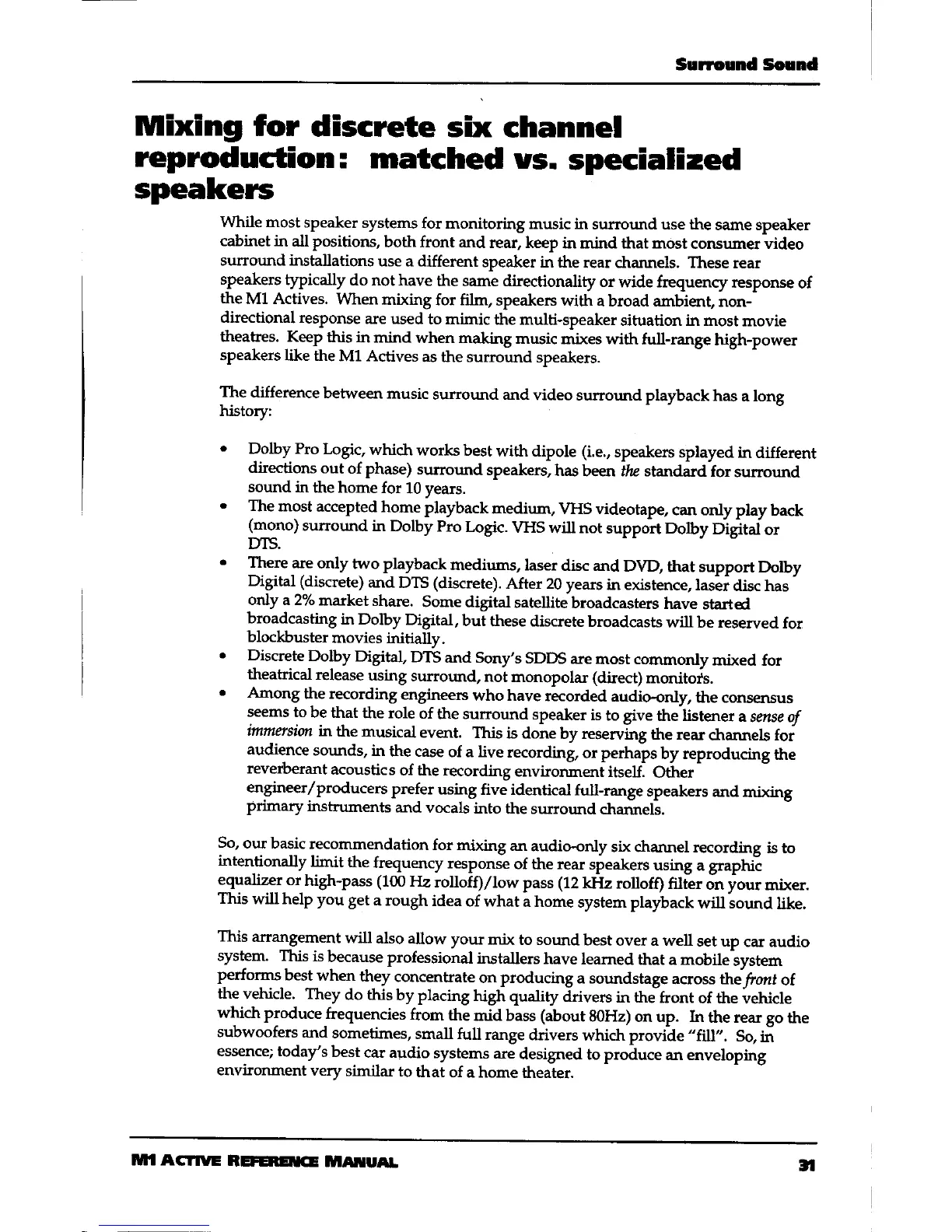
ML Actives.
When
mixing
for film,
speakers
with a broad ambimt,
non-
directional response
are used
to mimic
the multi-speaker
situation in most
movie
theatres. Keep
this in
mind
when making
music
mixes
with ftrll-range
high-power
speakers
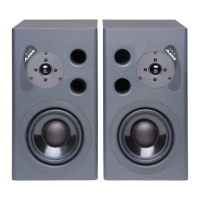
like the
M1 Actives
as the surround
speakers.
The
difference
between
music
surround and
video
surround playback
has
a long
history:
.
D- olby Pro
Logic,
whidr
works best
with dipole (i.e.,
speakers
splayed in
different
directions
out
of phase)
surround
speakers,
has
been ltre standardiot
surround
sound in
the home
for
L0
vears.
.
The
most
accepted
home
playback
medium,
VHS videotape,
can only play
back
(mono)
surround
in Dolby
Pro
Logic.
VHS
will not
support Dolby
Digitai
or
DTS.
.
T...
"-T:"ly
two playback
mediurns,
laser
disc and
DVD,
that support
Dolby
Digital (discrete)
and
DTS
(discrete).
After 20
years
in existence,
lasei
disc has
only a 2%
market
share.
Some
digital
satellite
broadcasters
have
started
broadcasting
in Dolby
Digital,
but
these discrete
broadcasts
will be reserved
for
blocl$uster
movies
initially.
r
D. iscrete
Dolby
Digital,
DTS
and Sony,s
SDD6
are
most commonly
mixed
for
theatrical
release
using
surrotmd,
not
monopolar (direct)
monitois.
r
Among
the recording
engineers
who have
recorded
audio-only,
the consensus
seems to
be that
the role
of
the surround
speaker
is
to give
the listm
er a
sense of
immersion
in
the musical
evmt.
This
is done
by reserving
the rear
ctrannels {oi
audience
so'nds,
in
the case
of a live
recording,
or
perhaps
by reproducing
the
reverberant
acoustics
of the recording
environment
itseU.
Other-
mgineer/producers
prefer
using
five identical
full-range
speakers
and
mixing
primary
inskuments
and
vocals
into
the surround
channeli.
so,
our basic
recommendation
for rnixing
an
audioonly
six channel recording
is to
intentionally
lirnit
the
frequency
response
of the rear
speakers
using
a graphii
equalizer
or
high-pass
(100
Hz
rolloff)/low
pass
(12
kHz rolloff)
filter
on your
mixer.
This
will help you
get
a rough
idea
of what
i home
system playback
williound
like.
This
arrangement
will
also allow
your
mix
to sound
best
over a well
set up
car audio
syslenu
fhis
is
because
professional
installers
have
learned
that a mobileiystem
performs.besl
v/hen
they
concentrate
on
producing
a soundstage
across thefont
of
the
vehicle. They
do this
by placing
high
quality
ddvers
in the
front
of the
vehicle
which producerrequencies
from
the
mid bass
(about
80Hz)
on up. In
the rear go
the
subwoofers
and
sometimes,
small
full range
drivers
which provide,,fill,,.
So,
in
essence; today's
best
car audio
systems
are
designed
to produce
an
mveloping
environment
very
similar
to
that
of a home
theater.
IUII ACTUE
Rffi
IIIAilUAL
tl

Related product manuals