Sheet
1 of 3
Alexander Schleicher
GmbH & Co.
Segelflugzeugbau
D - 36163 Poppenhausen
Maintenance Instruction
Adjusting the drive belt
Issue I
Power-plant AE50R and IAE50R-AA
Subject: The belt tension is adjusted such that the belt eigenfrequency - in the area where it is
running in the channel inside both swivel support arms - corresponds to 48 Hz. As ex-
perience shows the adjusted belt tension remains constant over a long period of time. If
during pre-flight check there is reason to believe that the belt tension is too low or if any
assembly works make it necessary to re-adjust the belt tension, this is done according to
the procedure mentioned below:
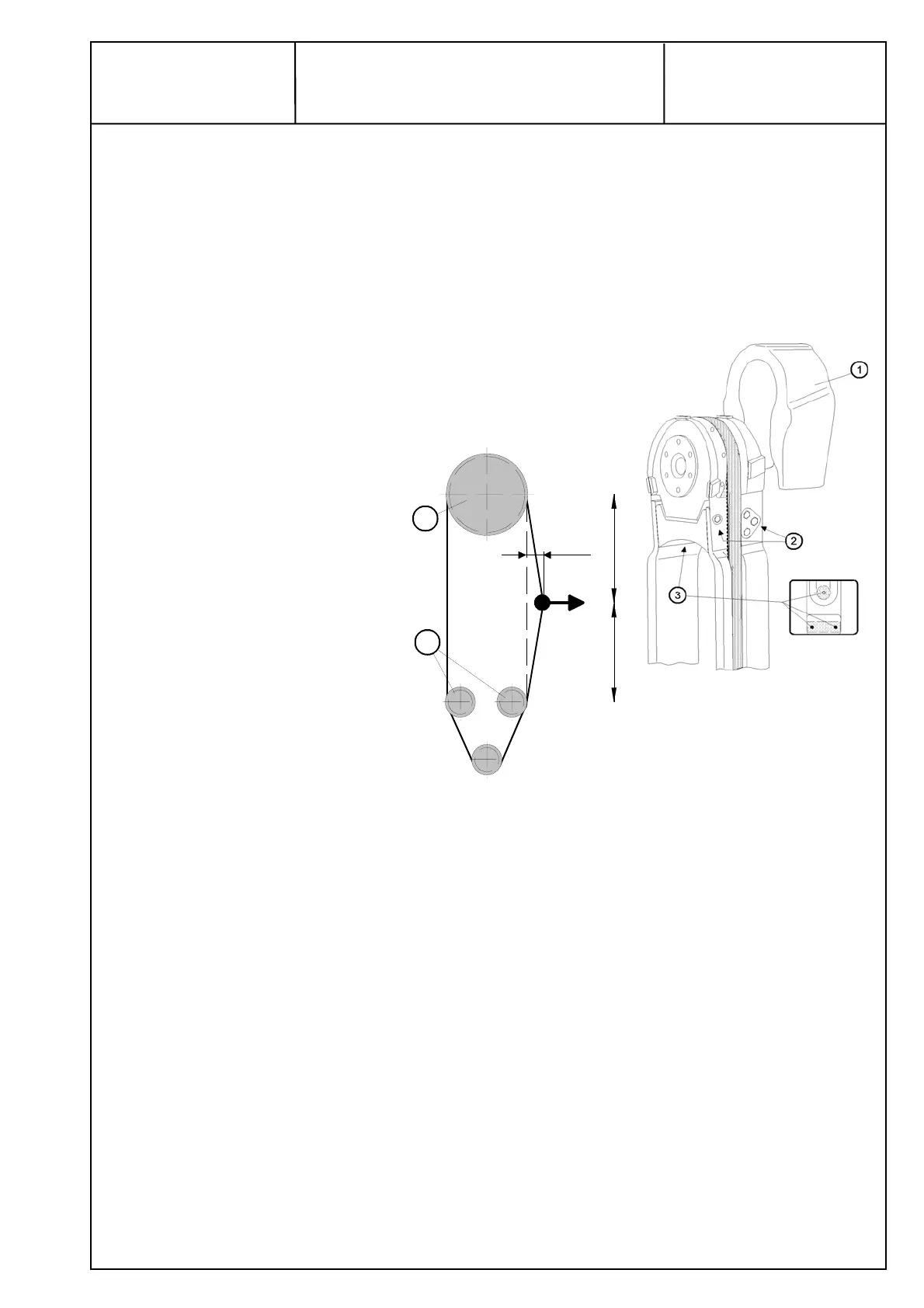
Preparation: Remove the side fairing of the swivel support
arms as well as the propeller head fairing [1].
Un-tighten the 4 lateral fixing screws [2] at the
propeller head (only un-tighten them, do not
remove).
Initial adjustment: Prior to the fine tuning
of the belt tension via
its eigenfrequency, an
initial adjustment is
done using a spring
scale.
The belt deflection shall be approx. 9 mm [A] with a tensile load applied of F=58 N, to
be measured at the point in the middle between the lower guide pulley [5] and the upper
belt wheel [4],
A
F
½½
4
5
Change of the
belt tension: The lock-nuts of the 3 tensioning screws [3] must be loosened. By evenly turning in
and out respectively the 3 tensioning screws the prop head is moved parallel and thus
the belt tension changed.
If the propeller is fully extended, the belt tension makes it difficult to turn the tension-
ing screws. For adjusting the tensioning screws the propeller may be retracted a little,
until the belt tension decreases.
Fine adjustment: With the above described measuring method the adjusting tolerances of the belt ten-
sion are still relatively large. More exact results are achieved by measuring the eigen-
frequency of the belt. This is done by "picking" the belt (like a guitar string) between
the lower guide pulley [5] and the upper belt wheel [4]. Using a
frequency meter the
oscillation (eigenfrequency) of the belt is then measured.
After the above described initial adjustment has been done the belt tension is in-
creased by evenly turning in and out respectively the 3 tensioning screws [3] so that
the belt eigenfrequency will become 48 Hz.



 To Next Page