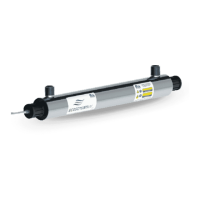
INSTALLATION
Please cross reference the numbers in brackets [] with the reactor component diagram provided.
1. Pick a suitable location for the reactor [1] and the control panel. Make sure that there is a
minimum allowance of 1.2 meters (4 feet) of clear space at the connection end of the
chamber to facilitate lamp replacement and servicing.
2. In an effort to adequately protect the electrical components inside the reactor, the unit
must be connected to an electrical outlet which is protected by an earthing line as well as a
surge suppressor.
3. Once the reactor is securely mounted, plumb the inlet [15] and outlet [16] ports to the
supply and delivery lines with the appropriate connections. Make sure Teflon tape or an
equivalent is used on the threads to ensure an adequate seal. When making connections, be
sure not to drop anything into the reactor chamber that may damage the quartz
sleeves/lamps or contaminate the reactor chamber.
4. After all connections are made, SLOWLY turn on the inlet valve and SLOWLY fill the reactor
chamber with water. Once the chamber is full, check for leaks from the fittings. If a leak is
evident, drain system and reconnect the fittings.
5. Secure the control panel to the appropriate wall making sure the panel is mounted within 2
meters (6 feet) of the connection end of the reactor chamber. Install the UV lamps as
described in the lamp installation/replacement section and make all the necessary lamp
connections. Do not forget to connect the earthing wire [9] to the earthing stud [11] on the
UV reactor using the provided earthing nut [10].
6. If your system has been supplied with a UV Intensity Sensor (EcoStream+ models), then
carefully install the sensor assembly into the reactor housing at the sensor mounting point
[17] by first inserting the sensor o-ring and then the sensor itself. Screw the sensor into the
reactor and tighten to achieve a water-tight seal. DO NOT OVER TIGHTEN. Attach the sensor
cable to the controller.
7. Next, plug the reactor into the appropriate outlet (230V) and check to see if all the UV
lamps are illuminated. Do not look directly at the burning UV lamp without the use of
protective eyewear. Once it is determined that the UV lamps are illuminated and that the
lamp LEDs are illuminated, disconnect panel from power source until all plumbing
connections are final.
8. The system should now be thoroughly flushed to clean out any particulate matter that may
have entered the reactor chamber during installation as well as flushing out any air that
may have accumulated during the “filling” of the reactor.
WARNING: SUDDEN OPENING OF THE INLET FLOW MAY SERIOUSLY DAMAGE UV LAMPS OR
QUARTZ SLEEVES.


 To Next Page