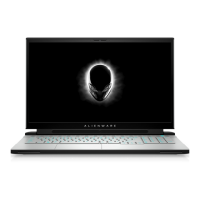
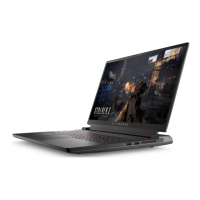
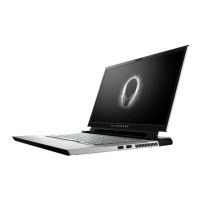
Need help?
Do you have a question about the Alienware m17 R2 and is the answer not in the manual?
Details ports and features on the left and right sides of the laptop.
Explains power button functions and touchpad navigation.
Details display-mounted microphones and front camera.
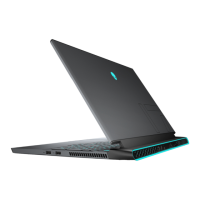
Lists video, data, power, and security ports on the back.
Describes bottom speakers and service tag label.
The Alienware m17 R2 is a high-performance gaming laptop designed for an immersive user experience. It features a sleek and robust design, incorporating various ports and components strategically placed for optimal functionality and connectivity. The device is built to handle demanding applications and games, offering a range of features to enhance performance, user interaction, and overall system management.
The Alienware m17 R2 serves as a portable gaming and high-performance computing platform. Its primary function is to provide a powerful and responsive environment for gaming, content creation, and other resource-intensive tasks. The laptop integrates advanced processors, graphics, and memory to deliver smooth performance. It also includes specialized features like the Alienware Command Center (AWCC) to customize and optimize the gaming experience, allowing users to manage lighting, power, sound, and thermal settings.
The Alienware m17 R2 offers a comprehensive set of usage features designed to cater to gamers and power users.
The laptop's physical design includes several ports for external connectivity. On the left side, it features a security-cable slot, a network port (RJ45) for wired internet access, and a USB 3.1 Gen 1 port with PowerShare. The PowerShare feature allows users to charge USB devices even when the computer is turned off, provided the power adapter is connected and the feature is enabled in the BIOS setup. On the right side, there are two additional USB 3.1 Gen 1 ports for connecting peripherals like external storage devices and printers. The back of the laptop houses an HDMI port for connecting to external displays, a Mini DisplayPort, and a Thunderbolt 3 (USB Type-C) port, which supports USB 3.1 Gen 2, DisplayPort 1.2, and Thunderbolt 3, offering high data transfer rates and external display connectivity via an adapter. An external graphics port is also present for connecting an Alienware Graphics Amplifier to boost graphics performance. The power-adapter port is located at the back for charging the battery and powering the system.
The Alienware m17 R2 features a responsive keyboard and touchpad. The keyboard is a full-size RGB backlit keyboard with a QWERTY layout, providing a comfortable typing and gaming experience. It includes shortcut keys that can perform alternate characters or secondary functions, such as controlling multimedia, adjusting volume, or switching displays. The behavior of these function keys (F1-F12) can be customized in the BIOS setup program. Additionally, the laptop includes pre-programmable macro keys (A, B, C) that allow users to execute multiple actions with a single key press, which can be configured through the Alienware Command Center. The touchpad supports multi-finger gestures for intuitive navigation and interaction with the operating system.
The laptop is equipped with a high-definition display, offering clear and vibrant visuals for gaming and multimedia consumption. It features a camera for video chat and capturing photos, accompanied by left and right microphones for clear audio input. The audio system includes internal speakers (left and right) and an internal speaker amplifier, providing immersive sound. A headset port is available for connecting headphones or a headset (headphone and microphone combo).
The Alienware m17 R2 incorporates a "Hybrid Power" feature, which optimizes performance during heavy loading scenarios like gaming or running processor-intensive applications. This feature allows the system to draw power from both the power adapter and the battery simultaneously to maintain peak performance. When the battery charge is between 20% and 100% and the power adapter is plugged in, the system will use hybrid power, depleting the battery by up to five percent per hour to sustain performance. If the battery charge drops below 20%, the hybrid function is disabled, and the computer may experience performance throttling during heavy loads. The power button, located on the base, also serves as an Alienhead logo and allows users to turn the computer on/off, put it into sleep state, or force a shut-down by holding it for 4 seconds. The power-button behavior can be customized in Power Options.
The Alienware Command Center (AWCC) is a central hub for customizing and enhancing the gaming experience. It provides a dashboard to display recently played games and offers game-specific information, themes, profiles, and access to computer settings. AWCC allows users to manage AlienFX zones for customizable lighting effects, adjust power, sound, and thermal management settings through the Fusion feature, and manage connected peripherals. It also supports monitoring of CPU, GPU, and RAM.
While the Alienware m17 R2 is designed for robust performance, certain aspects of its design and software facilitate maintenance and longevity.
The laptop includes a Service Tag label on the bottom, which is a unique alphanumeric identifier. This tag is crucial for Dell service technicians to identify hardware components and access warranty information, streamlining support and repair processes. Users can also access self-help resources through the Dell Help & Support app, online support websites (www.alienware.com, www.dell.com/support/windows, www.dell.com/support/linux), and video tutorials (www.youtube.com/alienwareservices) for troubleshooting, setup instructions, and software updates.
The memory in the Alienware m17 R2 is integrated on the system board and cannot be upgraded after purchase, which simplifies component management but limits future memory upgrades. The wireless card is also soldered onto the left I/O-board, meaning it cannot be upgraded. These design choices ensure stability and integration but require users to consider their needs at the time of purchase.
The Dell Power Manager application allows users to control battery charging time, duration, and start/end times, which can help optimize battery health and lifespan. The operating range for battery charging is specified, and charging will discontinue if the battery temperature falls outside this range, protecting the battery from damage. The battery is a 6-cell lithium-ion polymer type, designed for a certain number of discharge/charge cycles.
The computer is designed to operate within specific temperature and humidity ranges, and it is important to adhere to these guidelines to ensure optimal performance and prevent damage. The "Hybrid Power" feature, by managing power draw, also indirectly contributes to thermal management during high-load scenarios.
 General
| Color name | Lunar Light |
|---|---|
| Form factor | Clamshell |
| Product type | Laptop |
| Product color | Black, White |
| Market positioning | Gaming |
| Panel type | WVA |
| Pixel pitch | 0.2 x 0.2 mm |
| LED backlight | Yes |
| Pixel density | 127 ppi |
| Display diagonal | 17.3 \ |
| Display brightness | 300 cd/m² |
| Native aspect ratio | 16:9 |
| NTSC coverage (typical) | 72 % |
| Display response rise/fall | 19 ms |
| Motherboard chipset | Intel® HM370 |
| Internal memory | 16 GB |
| Memory clock speed | 2666 MHz |
| Memory form factor | On-board |
| Internal memory type | DDR4-SDRAM |
| Memory layout (slots x size) | 2 x 8 GB |
| SSD capacity | 512 GB |
| SSD interface | PCI Express |
| Storage media | SSD |
| SSD form factor | M.2 |
| Total storage capacity | 1024 GB |
| Number of SSDs installed | 2 |
| Audio chip | Realtek ALC3281-CG |
| Speaker power | 2 W |
| Front camera HD type | HD |
| Video capturing speed | 30 fps |
| Front camera resolution | 1280 x 720 pixels |
| Front camera signal format | 720p |
| Front camera resolution (numeric) | 0.92 MP |
| MIMO type | Multi User MIMO |
| Antenna type | 2x2 |
| Wi-Fi standards | Wi-Fi 5 (802.11ac) |
| Bluetooth version | 4.2 |
| Ethernet LAN data rates | 1000, 2500 Mbit/s |
| Charging port type | DC-in jack |
| USB 2.0 ports quantity | 0 |
| Number of USB ports with PowerShare support | 1 |
| USB 3.2 Gen 1 (3.1 Gen 1) Type-A ports quantity | 3 |
| Pointing device | Touchpad |
| Keyboard language | UK English |
| Keyboard backlit color | Various |
| Processor ARK ID | 191045 |
| Processor package size | 42 x 28 mm |
| Supported instruction sets | SSE4.1, SSE4.2, AVX 2.0 |
| Battery weight | 320 g |
| Battery voltage | 11.4 V |
| Battery capacity | 76 Wh |
| Battery recharge time | 4 h |
| Number of battery cells | 6 |
| AC adapter power | 180 W |
| AC adapter frequency | 50 - 60 Hz |
| AC adapter input voltage | 100 - 240 V |
| AC adapter output current | 9.23 A |
| AC adapter output voltage | 19.5 V |
| Cable lock slot type | Noble |
| Operating shock | 110 G |
| Operating altitude | -15.2 - 3048 m |
| Non-operating shock | 160 G |
| Operating vibration | 0.66 G |
| Non-operating altitude | -15.2 - 10668 m |
| Non-operating vibration | 1.3 G |
| Storage temperature (T-T) | -40 - 65 °C |
| Operating temperature (T-T) | 0 - 35 °C |
| Storage relative humidity (H-H) | 0 - 95 % |
| Operating relative humidity (H-H) | 10 - 90 % |
| EPEAT rating | 88.96 % |
| Tjunction | 100 °C |
| Processor cache | 12 MB |
| Processor model | i7-9750H |
| System bus rate | 8 GT/s |
| Processor family | Intel® Core™ i7 |
| Processor socket | BGA 1440 |
| Processor threads | 12 |
| Processor codename | Coffee Lake |
| Processor frequency | 2.6 GHz |
| Processor cache type | Smart Cache |
| Configurable TDP-down | 35 W |
| Processor lithography | 14 nm |
| Processor manufacturer | Intel |
| PCI Express slots version | 3.0 |
| Processor boost frequency | 4.5 GHz |
| Processor operating modes | 64-bit |
| PCI Express configurations | 1x16, 2x8, 1x8+2x4 |
| Thermal Design Power (TDP) | 45 W |
| Maximum number of PCI Express lanes | 16 |
| On-board graphics card ID | 0x3E9B |
| Discrete graphics card model | NVIDIA® GeForce RTX™ 2070 Max-Q |
| On-board graphics card model | Intel® UHD Graphics 630 |
| Discrete graphics card memory | 8 GB |
| Discrete graphics memory type | GDDR6 |
| Maximum on-board graphics card memory | 64 GB |
| On-board graphics card OpenGL version | 4.5 |
| On-board graphics card base frequency | 350 MHz |
| On-board graphics card DirectX version | 12.0 |
| On-board graphics card dynamic frequency (max) | 1150 MHz |
| Bundled software | Financial Tracker & Retail Information |
| Operating system language | English |
| Pallet width | 1000 mm |
| Pallet length | 1200 mm |
| Pallet weight | 200096 g |
| Quantity per pallet | 36 pc(s) |
| Pallet volume weight | 74960 g |
| Quantity per pallet layer | 18 pc(s) |
| Number of layers per pallet | 2 pc(s) |
| Quantity per intermodal container (20ft) | 720 pc(s) |
| Quantity per intermodal container (40ft) | 1512 pc(s) |
| Package depth | 502.8 mm |
| Package width | 425.8 mm |
| Package height | 117.4 mm |
| Package weight | 5336 g |
| Package material | Corrugated cardboard, Polypropylene (PP) |
| Other materials content per package | 166 g |
| Polypropylene (PP) content per package | 19 g |
| Corrugated cardboard content per package | 1491 g |
| Corrugated cardboard content per box for accessories | 229 g |
| High-density polyethylene (HDPE) content per package | 0 g |
| Corrugated cardboard content per shipping (inner) case | 1057 g |
| Corrugated cardboard content per sleeve for accessories | 205 g |
 Weight and Dimensions
| Depth | 294.3 mm |
|---|---|
| Width | 399.8 mm |
| Weight | 2630 g |
| Height (rear) | 19.5 mm |
| Height (front) | 18.6 mm |

 To Next Page