
 Need help?
Do you have a question about the ALLEN & HEATH ZED-6 and is the answer not in the manual?
Details on mono input channels including Mic/Line inputs, Gain, EQ, PAN, and PFL settings.
Explains stereo input channels for keyboards, drum machines, covering inputs, gain, EQ, and BAL.
Covers main outputs, phantom power, power LED, LR meters, main mix fader, PFL LED, and headphone controls.
Steps for safely powering on and connecting equipment to avoid thumps and bangs.
Guide on connecting microphones and DI boxes, including phantom power usage.
Details for connecting high-impedance instruments and line-level equipment like keyboards.
Setting input levels for maximum signal quality and a low noise ratio.
Using lo-cut, HF EQ, and LF EQ to adjust frequencies and improve sound quality.
Techniques for mixing channels, setting levels, using PAN, and creating a balanced stereo image.
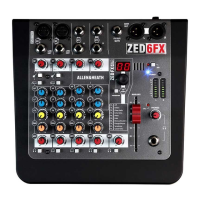
The Allen & Heath ZED-6 is a 6-channel live and recording mixer designed for musicians, sound engineers, and content creators who need a compact yet versatile audio mixing solution. It provides essential features for capturing and mixing audio from various sources, making it suitable for small live performances, home studio recording, and podcasting.
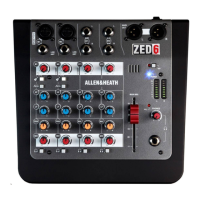
The ZED-6 serves as a central hub for audio signals, allowing users to connect microphones, instruments, and line-level devices, mix their signals, and send the combined audio to a sound system, recording device, or headphones. It features two mono input channels (M1, M2) and two stereo input channels (ST1, ST2), offering flexibility for different audio setups.
Each mono input channel (M1, M2) is equipped with a Mic Input Socket (XLR) for dynamic or condenser microphones and a Line / Inst Input Socket (1/4" Jack) for instruments like guitars and other line-level sources. A crucial feature is the "Instrument" switch, which activates the high-impedance input circuit specifically designed for electro-acoustic and electric guitars and basses, eliminating the need for an external DI box. These channels also include a "Gain Control" to adjust the input preamplifier, a "lo-cut" (Hi-Pass Filter) to reduce low-frequency noise, and a 2-band EQ (HF and LF) to shape the tone. The "PAN" control allows positioning the mono signal within the stereo field, and the "MIX" rotary fader controls the signal's level sent to the main outputs. A "Pre-Fade Listen (PFL)" switch is available for monitoring the channel's input signal in headphones before it's sent to the main mix.
The stereo input channels (ST1, ST2) utilize 1/4" Jack sockets for balanced or unbalanced line-level stereo sources such as keyboards, drum machines, or other pro audio equipment. They feature a "Gain Control" to adjust the input level, the same 2-band EQ (HF and LF) as the mono channels, and a "BAL" control to adjust the relative level between the left and right stereo signals as they are sent to the main outputs.
The mixer's "Master Section" provides overall control. "MAIN OUT L & R" are line-level XLR outputs for the main stereo mix. A "48V" switch enables phantom power for condenser microphones and active DI boxes across all microphone inputs. The "POWER LED" indicates when the mixer is on, and "LR Meters" display the level of the main mix or the PFL signal. The "MAIN MIX fader" is the master volume control for the main stereo mix. A "PFL LED" indicates when any PFL switch is active. "PHONES level" controls the volume of the "PHONES output," which uses a 1/4" jack socket for headphones.
The ZED-6 emphasizes ease of use and good audio practice. Before connecting any devices, a "zeroing" procedure is recommended: ensuring the mixer is off, connecting the power cable, turning down all gain and mix controls, setting EQ and PAN controls to the center, and ensuring Instrument, HPF, PFL, and 48V switches are not pressed. Speakers should always be switched on last and off first.
Connecting microphones involves using balanced XLR cables to the Mic Input Socket. Condenser microphones require the 48V phantom power to be enabled, but users are advised to avoid "hot plugging" and ensure master controls are down before activating 48V to prevent loud thumps.
For instruments, high-impedance instruments like guitars connect to the Line / Inst Inputs on M1 & M2, with the "Instrument" switch activated. Line-level instruments can connect to M1 & M2 Line / Inst Inputs or ST1 & ST2 inputs.
Setting up the "Gain Structure" is crucial for optimal sound quality. This involves adjusting the "Gain Control" on each channel while monitoring the signal level on the LR Meters (using PFL for individual channels) to achieve maximum signal level without undesirable distortion, aiming for peaks between "0" and "+6". If distortion occurs at low signal levels, users should enable any pad switch on the microphone or adjust microphone placement.
The EQ section allows for "shaping sound" by cutting or boosting selected frequencies. The "lo-cut" (Hi-pass Filter) removes unwanted low-frequency noise at 100Hz. The "HF EQ" (12kHz) affects treble frequencies for brightness or reducing hiss, while the "LF EQ" (80Hz) affects bass frequencies for roundness or removing boom. Overuse of EQ should be avoided to prevent unnatural sound.
"Balancing the Mix" involves disabling all PFL switches to view the main mix metering, slowly raising the "MAIN MIX fader" to "0," and then adjusting individual channel "MIX" controls to send signals to the main mix. Users should aim for average peaks around "0" on the meters, leaving headroom for louder moments. The "PAN" and "BAL" controls are used to separate sounds and create a stereo image, with high-energy low-frequency sounds ideally kept center.
The manual highlights several important safety precautions to ensure the longevity and safe operation of the ZED-6.
These guidelines are crucial for maintaining the mixer's performance and ensuring user safety. For additional information, hardware specifications, product information, or technical support, users are directed to the Allen & Heath website. The product comes with a limited one-year manufacturer's warranty, and registration is encouraged to receive useful information.
 General
| Frequency range | 10 - 20000 Hz |
|---|---|
| Channels quantity | 6 channels |
| Digital sound processing | - bit |
| Number of EQ bands per channel | 2 |
| Headphone connectivity | 3.5 mm |
| Phantom power | 48 V |
| AC input voltage | 100-240 V |
| AC input frequency | 50 - 60 Hz |
| Power consumption (typical) | 12 W |
| Equalizer bands quantity | 4 |
| Product color | Black |
| Rack mounting | No |
 Weight and Dimensions
| Depth | 236.4 mm |
|---|---|
| Width | 249 mm |
| Height | 88.9 mm |
| Weight | 1300 g |
| Package depth | 291 mm |
| Package width | 364 mm |
| Package height | 138 mm |
| Package weight | 1950 g |


 To Next Page