508096-01 Issue 2037 Page 27 of 34
Maintenance
At the beginning of each heating season, and to comply
with the Allied Limited Warranty, your system should
be checked by a licensed professional technician (or
equivalent) as follows:
If a high-eciency lter is being installed as part of this
system to ensure better indoor air quality, the lter must
be properly sized. High-eciency lters have a higher
static pressure drop than standard-eciency glass/foam
lters. If the pressure drop is too great, system capacity
and performance may be reduced. The pressure drop
may also cause the limit to trip more frequently during
the winter and the indoor coil to freeze in the summer,
resulting in an increase in the number of service calls.
Before using any lter with this system, check the
specications provided by the lter manufacturer
IMPORTANT
Fire Hazard. Use of aluminum wire with this product
may result in a re, causing property damage, severe
injury or death. Use copper wire only with this product.
WARNING
Failure to use properly sized wiring and circuit breaker
may result in property damage. Size wiring and circuit
breaker(s) per Product Specications and unit rating
plate.
CAUTION
Filters
All air lters are installed external to the unit. Filters should
be inspected monthly. Clean or replace the lters when
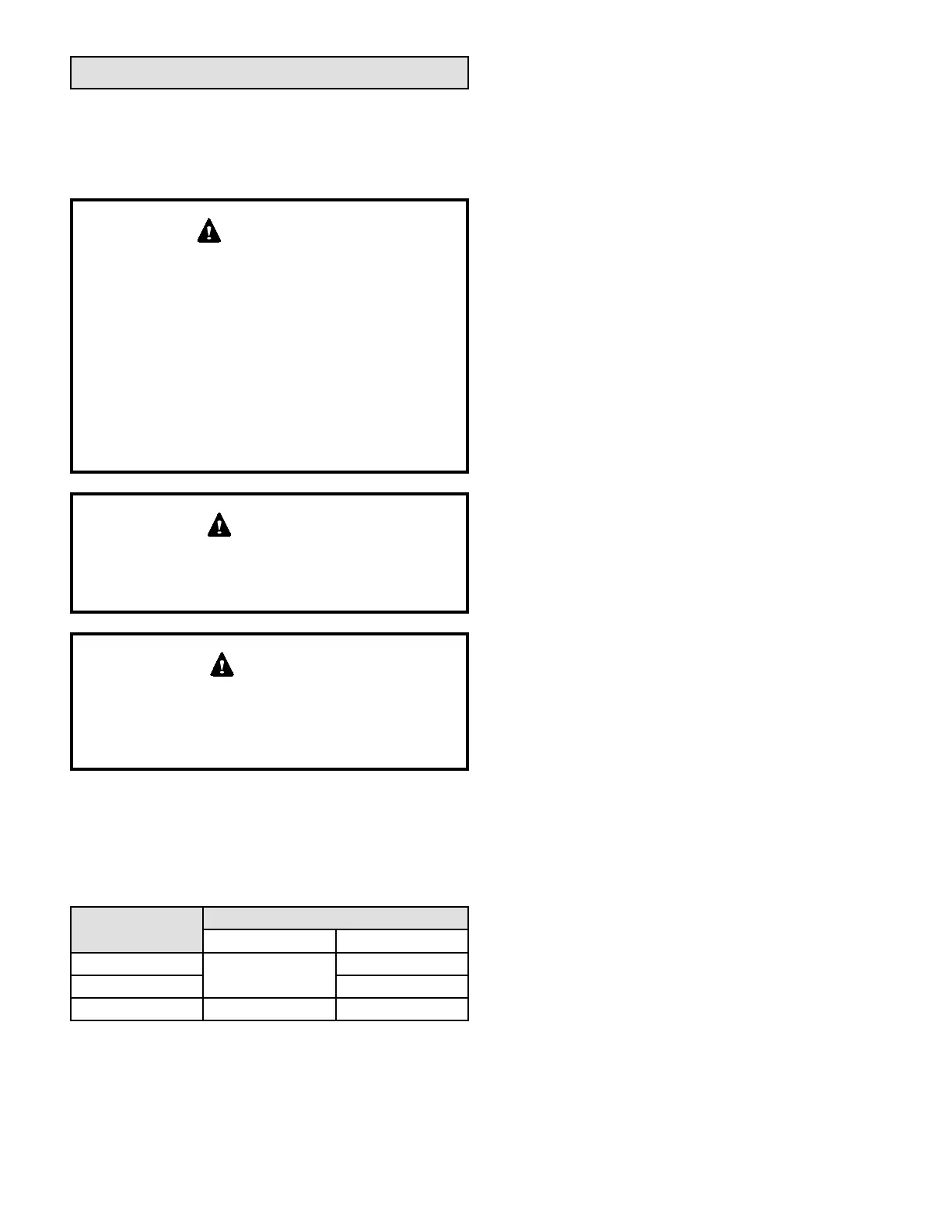
necessary to ensure proper furnace operation. Table 13
lists recommended lter sizes.
Cabinet Width
Filter Size
Side Return Bottom Return
17-1/2”
16 x 25 x 1 (1)
16 x 25 x 1 (1)
21” 20 x 25 x 1 (1)
24-1/2” 16 x 25 x 1 (2) 24 x 25 x 1 (1)
Table 13.
1. Check wiring for loose connections, voltage at indoor
unit and amperage of indoor motor.
2. Check the condition of the belt and shaft bearings if
applicable.
3. Inspect all gas pipe and connections for leaks.
4. Check the cleanliness of lters and change if necessary
(monthly).
5. Check the condition and cleanliness of burners and
heat exchanger and clean if necessary.
6. Check the cleanliness of blower assembly and
clean the housing, blower wheel and blower motor if
necessary. The blower motors are prelubricated for
extended bearing life. No further lubrication is needed.
7. Inspect the combustion air inducer and clean if
necessary.
8. Evaluate the heat exchanger integrity by inspecting
the heat exchanger per the AHRI heat exchanger
inspection procedure. This procedure can be viewed
at www.ahrinet.org
9. Ensure sucient combustion air is available to the
furnace. Fresh air grilles and louvers (on the unit and
in the room where the furnace is installed) must be
properly sized, open and unobstructed to provide
combustion air.
10. Inspect the furnace venting system to make sure
it is in place, structurally sound, and without holes,
corrosion, or blockage. Vent system must be free and
clear of obstructions and must slope upward away
from the furnace. Vent system should be installed per
the National Fuel Gas Code.
11. Inspect the furnace return air duct connection to
ensure the duct is sealed to the furnace. Check for
air leaks on supply and return ducts and seal where
necessary.
12. Check the condition of the furnace cabinet insulation
and repair if necessary.
13. Perform a complete combustion analysis during
the furnace inspection to ensure proper combustion
and operation. Consult Service Literature for proper
combustion values.
14. Verify operation of CO detectors and replace batteries
as required.
Perform a general system test. Turn on the furnace to
check operating functions such as the start-up and shut-o
operation.
1. Check the operation of the ignition system, inspect
and clean ame sensor. Check microamps before and
after. Check controls and safety devices (gas valve,
ame sensor, temperature limits). Consult Service
Manual for proper operating range. Thermal Limits
should be checked by restricting airow and not
disconnecting the indoor blower. For additional details,
please see Service and Application Note H049.
2. Verify that system total static pressure and airow
settings are within specic operating parameters.


 To Next Page
 Loading...