507270-03 Page 25 of 60Issue 1621
General Guidelines for Vent Terminations
In Non–Direct Vent applications, combustion air is taken
from indoors and the ue gases are discharged to the
outdoors. This furnace is then classied as a non–direct
vent, Category IV gas furnace.
In Direct Vent applications, combustion air is taken from
outdoors and the ue gases are discharged to the outdoors.
This furnace is then classied as a direct vent, Category IV
gas furnace.
In both Non–Direct Vent and Direct Vent applications, the
vent termination is limited by local building codes. In the
absence of local codes, refer to the current National Fuel
Gas Code ANSI Z223-1/NFPA 54 in U.S.A., and current
CSA-B149 Natural Gas and Propane Installation Codes in
Canada for details.
Position termination according to location given in Figures 31
or 32. In addition, position termination so it is free from any
obstructions and 12” above the average snow accumulation.
At vent termination, care must be taken to maintain protective
coatings over building materials (prolonged exposure to
exhaust condensate can destroy protective coatings). It
is recommended that the exhaust outlet not be located
within 6 feet (1.8 m) of a condensing unit because the
condensate can damage the painted coating.
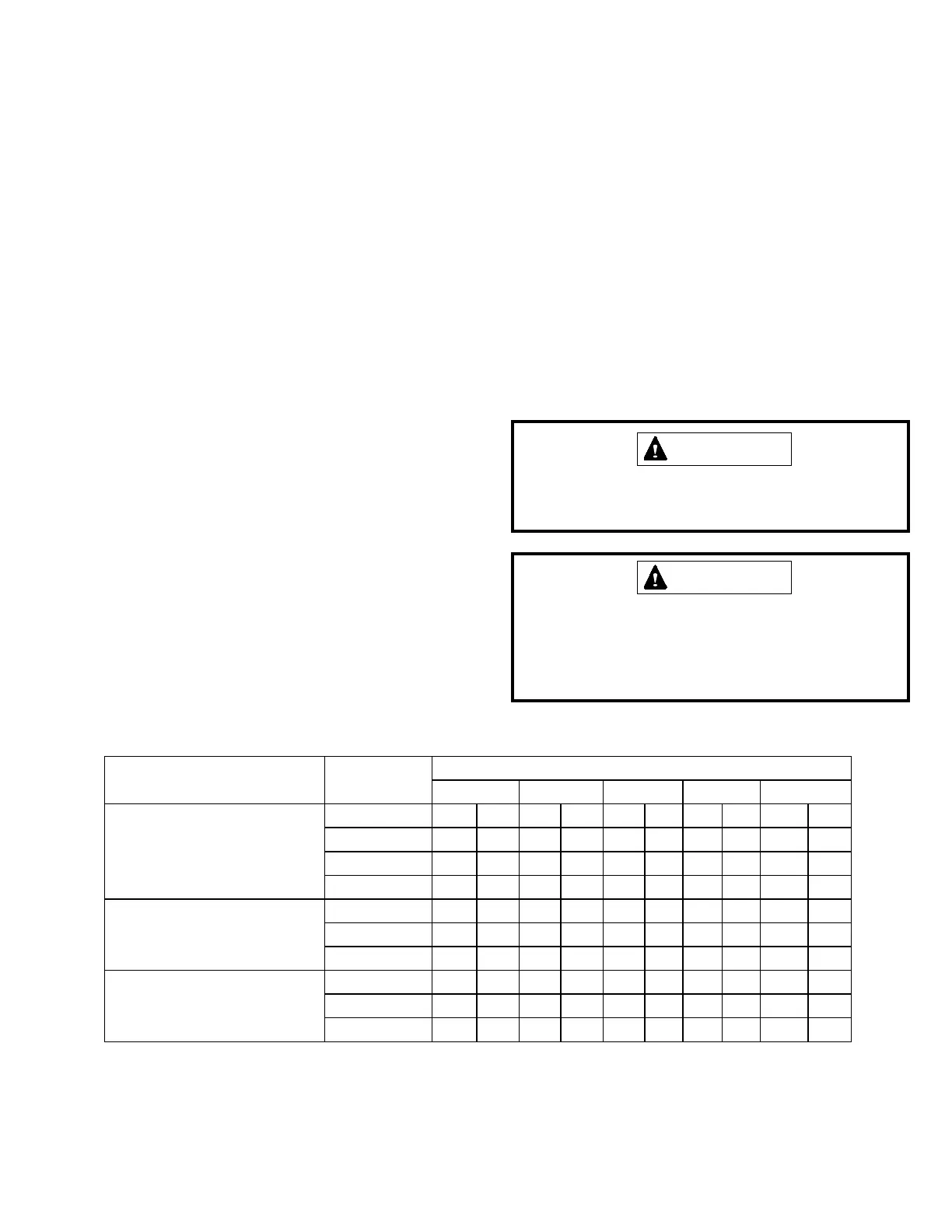
NOTE: See Table 7 for maximum allowed exhaust pipe
length without insulation in unconditiioned space during
winter design temperature is below 32° F (0° C). If required,
exhaust piping should be insulated with 1/2” (13 mm),
Armaex or equivalent. In extremely cold climate areas with
temperature below 20° F (6.7° C) it is recommended that,
3/4” (19 mm) Armaex or equivalent be used. Insulation
on outside runs of exhaust pipe may be painted or wrapped
to protect insulation from deterioration in accordance with
the insulation manufacturers recommendation. Exhaust
pipe insulation may not be necessary in some specic
applications.
NOTE: During extremely cold temperatures, below
approximately 20° F (6.7° C), units with long runs of vent
pipe through unconditioned space, even when insulated,
may form ice in the exhaust termination that prevents the
unit from operating properly. Longer run times of at least 5
minutes will alleviate most icing problems. Also, a heating
cable may be installed on exhaust piping and termination
to prevent freeze-ups. Heating cable installation kits are
available. See unit specication sheets for part numbers.
For Canadian Installations Only:
In accordance to CSA International B149 installation
codes, the minimum allowed distance between the
combustion air intake inlet and the exhaust outlet of
other appliances shall not be less than 12 inches (305
mm).
IMPORTANT
Do not use screens or perforated metal in exhaust
terminations. Doing so will cause freeze-ups and may
block the terminations.
IMPORTANT
Table 7
Maximum Allowable Exhaust Vent Pipe Length (in ft.) Without Insulation
In Unconditioned Space For Winter Design Temperatures Single - Stage High Efciency Furnace
Winter Design Temperatures
1
ºF (ºC)
Vent Pipe
Diameter
Unit Input Size
045 070 090 110 135
32 to 21
(0 to -6)
PVC
2
PP PVC
2
PP PVC
2
PP PVC
2
PP PVC
2
PP
2 in. 18 16 31 28 50 48 30 30 N/A N/A
2-1/2 in. 13 N/A 24 N/A 42 N/A 56 N/A N/A N/A
3 in. 9 9 18 18 35 35 47 47 52 52
20 to 1
(-7 to -17)
2 in. 9 8 18 16 32 29 30 30 N/A N/A
2-1/2 in. 5 N/A 13 N/A 24 N/A 34 N/A N/A N/A
3 in. N/A N/A 8 8 19 19 26 26 30 30
0 to -20
(-18 to -29)
2 in. 5 3 12 10 22 19 30 27 N/A N/A
2-1/2 in. N/A N/A 7 N/A 15 N/A 22 N/A N/A N/A
3 in. N/A N/A N/A N/A 10 10 16 16 18 18
1
Refer to 99% Minimum Design Temperature table provided in the current edition of the ASHRAE Fundamentals Handbook.
2
Poly-Propylene vent pipe (PP) by Duravent and Centrotherm
NOTE - Concentric terminations are the equivalent of 5’ and should be considered when measuring pipe length.
NOTE- Maximum uninsulated vent lengths listed may include the termination (vent pipe exterior to the structure ) and
cannot exceed 5 linear feet or the maximum allowable intake or exhaust vent length listed in table 5 or 6.
NOTE - If insulation is required an unconditioned space, it must be located on the pipe closed to the furnace.



 To Next Page