~
,喝-•-
T
'
,
.
#
r
、
、
J
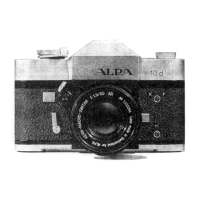
Fig. 1
B. EXTERNAL CONTROL
1) Winding
The high speed
,
short stroke winding
lever (A Fig. 1) cocks the shutter
,
advances the film and counts the expo-
sures. Because of the short travel of
only 160
0
and its 3 separate functions
γou feel a certain resistance. Ifγou do
not wind the lever completelγto its
positive stop
,
the shutter release will be
blocked. Just wind it once more
,
without
anγforce
,
to unblock i
t.
The high speed winding lever never
interferes with γour viewing
,
so thatγou
can rapidly release and wind γour ALPA
again and again
,
without ever removing
it from γour eye.
2) Setting of ASA Film Speed Rating
The equidistant click stop settings of
the extreme film speed range are cali-
brated in black and correspond to inter-
national standards: 3-6-12-25-50-100-
200-400-800-1600-3200-6400 AS
A.
2
For fine adjustments you have a choice
of 2 each intermediate click stop settings
between (Fig. 1).
Depress the outer ring of the speed dial
(P) and turn the black index mark oppo-
site the desired black figure or any
intermediate calibration in the blank
sector. To facilitate the ASA setting
γou can turn the speed dial first to one
of the 2 extreme speed settings of
1/1000 second or B (see below).
3) Setting of Shutter Speeds
The ALPA 10d features a Swiss preci-
sion movement with electronically
tested
,
equidistant click stop speeds
,
calibrated in white on black (T).
Turn the outer ring of the speed dial (P)
to the desired setting
,
indicated by the
red line across the transparent disc.
Do not trγto force the red line past the
black sector. Shutter speeds can be
changed at any time
,
whether the shutter
is cocked or no
t.
Their calibrated range
corresponds to international standards:
1/1000
,
1/500
,
1/250
,
1/60
,
1/30
,
1/15
,
1/8
,
1/4
,
1/2
,
1 second.
B permits γou to take time exposures of
anγdesired length. The shutter remains
open
,
as long as γou keep the release
knob depressed. For longer time expo-
sure or ifγou mount γour ALPA on a
tripod
,
use a cable release with set
screw.
Important: For slower speeds such as
1/8
,
1/4
,
1/2
,
1 second or longer
,
either
disconnect the automatic diaphragm
control of your automatic lenses
,
or
make sure that the shutter release
remains depressed for the entire dura-
tion of the exposure. The setting of 1/60
second is marked in red
,
indicating that
it is the fastest shutter speed for sγn-
chronization with electronic flash. If you
try faster speeds
,
the moving slit of the
focal plane shutter will only expose part
of the frame.
Selection of the correct shutter speed
usua
l!
γdepends on the mobilitγofγour
subjec
t.
Consider speed
,
direction
,
distance as well as focal length and
stability of γour camera. For maximal
sharpness
,
use one of the faster shutter
speeds.


 To Next Page