Section 4
OPERATION
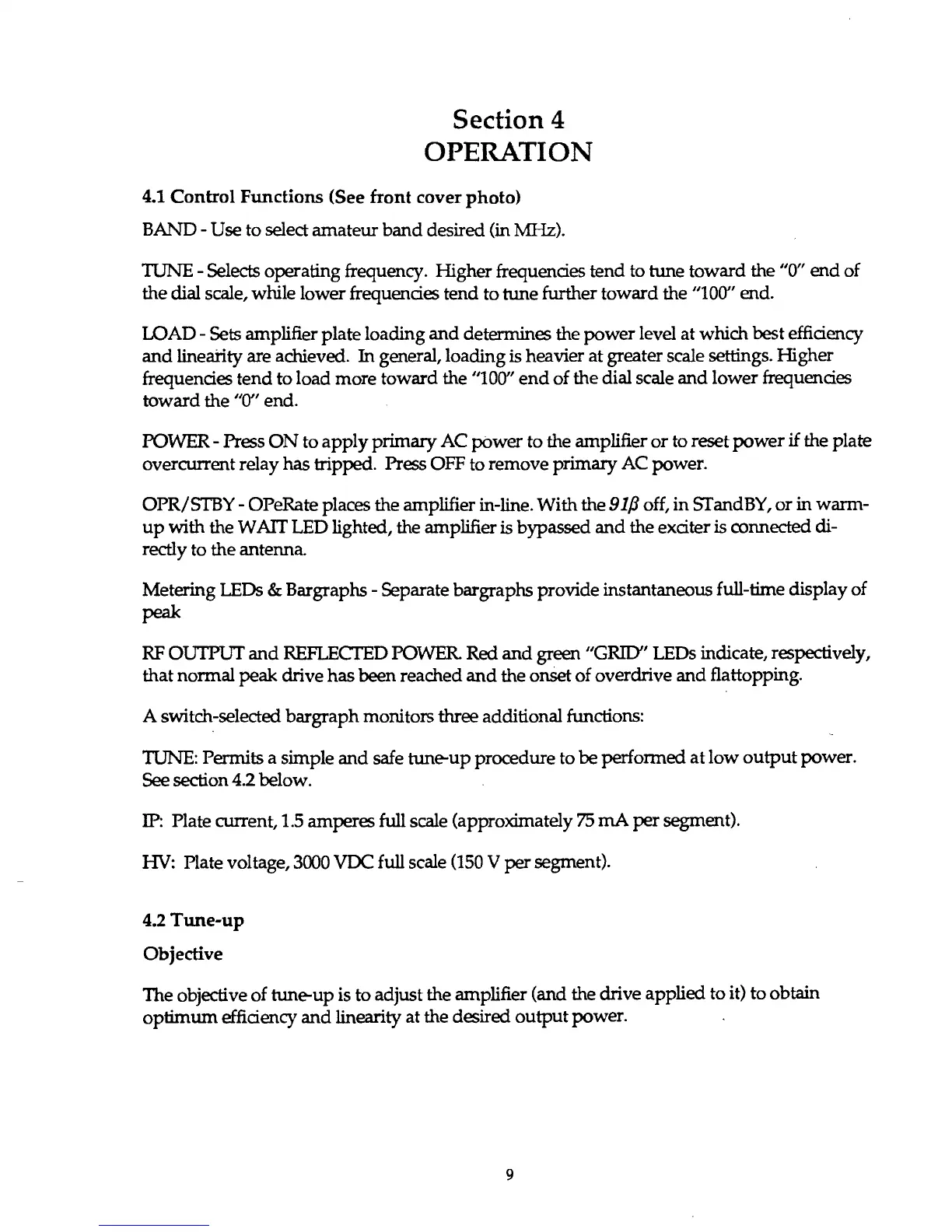
4.1 Control Functions (See front cover photo)
BAND - Use to select amateur band desired (in MHz).
TUNE - Selects operating frequency. Higher frequencies tend to tune toward the "0" end of
the dial scale, while lower frequencies tend to tune further toward the "100" end.
LOAD - Sets amplifier plate loading and determines the power level at which best efficiency
and linearity are achieved. In general, loading is heavier at greater scale settings. Higher
frequencies tend to load more toward the "100" end of the dial scale and lower frequencies
toward the "0" end.
POWER - Press ON to apply primary AC power to the amplifier or to reset power if the plate
overcurrent relay has tripped. Press OFF to remove primary AC power.
OPR/STBY - OPeRate places the amplifier in-line. With the 9 lß off, in STandBY, or in warm
up with the WATT LED lighted, the amplifier is bypassed and the exciter is connected di
rectly to the antenna.
Metering LEDs & Bargraphs - Separate bargraphs provide instantaneous full-time display of
peak
RF OUTPUT and REFLECTED POWER. Red and green "GRID" LEDs indicate, respectively,
that normal peak drive has been reached and the onset of overdrive and flattopping.
A switch-selected bar graph monitors three additional functions:
TUNE: Permits a simple and safe tune-up procedure to be performed at low output power.
See section 4.2 below.
IP: Plate current, 1.5 amperes full scale (approximately 75 mA per segment).
HV: Plate voltage, 3000 VDC full scale (150 V per segment).
4.2 Tune-up
Objective
The objective of tune-up is to adjust the amplifier (and the drive applied to it) to obtain
optimum efficiency and linearity at the desired output power.


 To Next Page