5) Switch transceiver to CW and increase its carrier output to approximately 15 watts (9Iß
output approx. 300-500 watts).
NOTE! If more than about 15 W drive is applied while the 91ß is substantially mistuned, the 9lß will
switch to STBY. If the amplifier is returned to receive (key-up) it will automatically reset to
OPR in about 4 seconds.
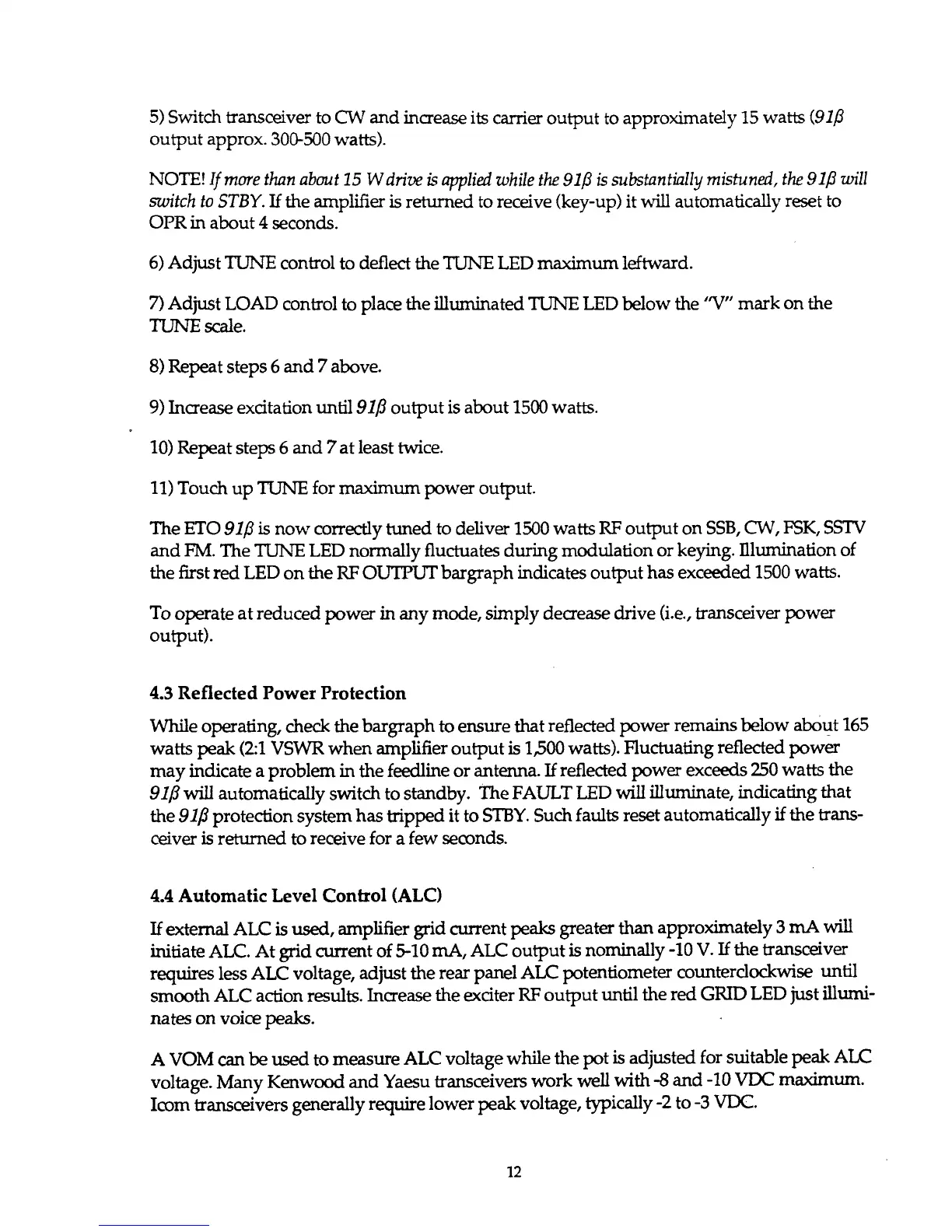
6) Adjust TUNE control to deflect the TUNE LED maximum leftward.
7) Adjust LOAD control to place the illuminated TUNE LED below the "V" mark on the
TUNE scale.
8) Repeat steps 6 and 7 above.
9) Increase excitation until 91ß output is about 1500 watts.
10) Repeat steps 6 and 7 at least twice.
11) Touch up TUNE for maximum power output.
The ETO 91ß is now correctly tuned to deliver 1500 watts RF output on SSB, CW, FSK, SSTV
and FM. The TUNE LED normally fluctuates during modulation or keying. Illumination of
the first red LED on the RF OUTPUT bargraph indicates output has exceeded 1500 watts.
To operate at reduced power in any mode, simply decrease drive (i.e., transceiver power
output).
4.3 Reflected Power Protection
While operating, check the bargraph to ensure that reflected power remains below about 165
watts peak (2:1 VSWR when amplifier output is 1,500 watts). Fluctuating reflected power
may indicate a problem in the feedline or antenna. If reflected power exceeds 250 watts the
9Iß will automatically switch to standby. The FAULT LED will illuminate, indicating that
the 9 Iß protection system has tripped it to STBY. Such faults reset automatically if the trans
ceiver is returned to receive for a few seconds.
4.4 Automatic Level Control (ALC)
If external ALC is used, amplifier grid current peaks greater than approximately 3 mA will
initiate ALC. At grid current of 5-10 mA, ALC output is nominally -10 V. If the transceiver
requires less ALC voltage, adjust the rear panel ALC potentiometer counterclockwise until
smooth ALC action results. Increase the exciter RF output until the red GRID LED just illumi
nates on voice peaks.
A VOM can be used to measure ALC voltage while the pot is adjusted for suitable peak ALC
voltage. Many Kenwood and Yaesu transceivers work well with -8 and -10 VDC maximum,
loom transceivers generally require lower peak voltage, typically -2 to -3 VDC.
12


 To Next Page