This document is an owner's manual for ALPIC AIR Split Type Wall-mounted Air Conditioners, specifically models AM2O-51HPDC1D, AM3O-71HPDC1D, and AM4O-81HPDC1D. It provides essential information for the safe and efficient operation, installation, and maintenance of these inverter-type air conditioning units.
Function Description
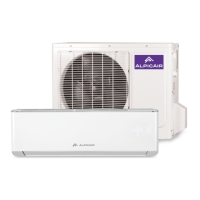
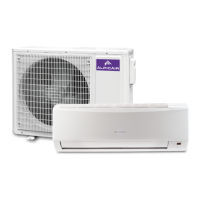
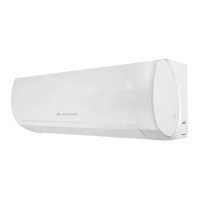
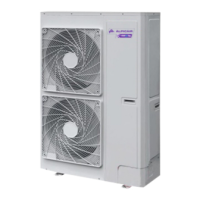
The ALPIC AIR split type wall-mounted air conditioner is designed to provide cooling and heating for indoor spaces. It operates using an inverter technology, which allows for more precise temperature control and energy efficiency compared to traditional on/off air conditioners. The system consists of an indoor unit and an outdoor unit, connected by refrigerant pipes and electrical wiring. The indoor unit is responsible for air intake and outlet, while the outdoor unit houses the compressor and condenser.
Important Technical Specifications
The manual provides technical data for different models:
-
AM2O-51HPDC1D (Outdoor Unit):
- Electrical data:
- Power supply: 220-240V~, 50Hz
- Electrical current: 25 A
- Fuse or air switch: 25 A
- Minimum power cord section: 1.0 mm²
- Size and clearance:
- Length (L): 892 mm
- Width (P): 341 mm
- Height (H): 700 mm
- Air switch capacity: 10A (for the air conditioner)
-
AM4O-81HPDC1D and AM3O-71HPDC1D (Outdoor Units):
- Electrical data:
- Power supply: 220-240V~, 50Hz
- Electrical current: 30 A
- Fuse or air switch: 30 A
- Minimum power cord section: 2.5 mm²
- Size and clearance:
- Length (L): 924 mm
- Width (P): 370 mm
- Height (H): 790 mm
- Air switch capacity: 25A (for the air conditioner)
-
Outdoor Unit Working Temperature Range:
- Maximum cooling: Indoor side DB/WB (°C) 32/23, Outdoor side DB/WB (°C) 43/26
- Maximum heating: Indoor side DB/WB (°C) 27/-, Outdoor side DB/WB (°C) 24/18
- Operating temperature range (outdoor temperature) for cooling only unit: -15°C ~ 43°C
- Operating temperature range (outdoor temperature) for heat pump unit: -20°C ~ 24°C
Usage Features
The air conditioner is designed for ease of use, but adherence to safety guidelines is crucial.
- Safety First: The manual emphasizes that the appliance can be used by children aged 8 years and above and persons with reduced physical, sensory, or mental capabilities, or lack of experience and knowledge, provided they receive supervision or instruction on safe use and understanding of hazards. Children should not play with the appliance, and cleaning/maintenance should not be performed by children without supervision.
- Power Supply: Users are warned against connecting the air conditioner to a multi-purpose socket to avoid fire hazards. Disconnecting the power supply during cleaning is essential to prevent electric shock. If the supply cord is damaged, it must be replaced by the manufacturer or a qualified service agent.
- Installation: Installation must be performed by qualified professionals. Proper grounding is critical to prevent electric shock. The manual specifies the need for an all-pole disconnection switch with a contact separation of at least 3mm in all poles, connected in fixed wiring. It also advises using suitable power supply circuits with adequate capacity, including a magnetic buckle and heating buckle function, to protect against short circuits and overloads. The power connection cable length should be sufficient, and extending the wire by oneself is discouraged. The appliance must be positioned so that the plug is accessible.
- Operation: Users should avoid extending fingers or objects into the air inlet or outlet to prevent personal injury or damage. Blocking the air outlet or inlet can cause malfunction. Spilling water on the remote controller can damage it.
- Troubleshooting: In case of abnormal phenomena such as overheating/damaged power cord, abnormal sound, frequent circuit breaker trips, burning smell, or indoor unit leaking, the air conditioner should be turned off, power disconnected immediately, and a dealer or qualified professional contacted.
Maintenance Features
Regular maintenance is crucial for the longevity and efficient operation of the air conditioner.
- Professional Maintenance: Maintenance must be performed by qualified professionals. Users are warned against attempting repairs themselves to avoid electric shock or damage.
- Cleaning: The air conditioner should not be washed with water, and water should not be sprayed on the indoor unit to prevent electric shock or malfunction. After removing the filter, users should avoid touching the fins to prevent injury. Fire or hair dryers should not be used to dry the filter, as this can cause deformation or fire hazards.
- Refrigerant: The manual specifies the use of R410A refrigerant and warns against using any other refrigerant. It also advises against using mineral oils to clean the unit.
- Pre-Installation Check: Before installation, ensure the power supply is cut off. Regularly check for gas leakage and ensure the thermal insulation of the unit is sufficient. Verify that drainage is smooth and that the power supply voltage matches the nameplate specifications. Confirm that lines and pipelines are correctly installed and the unit is safely grounded. Ensure the models of lines conform to requirements and there are no obstacles near the air inlet and outlet of the indoor and outdoor units. Record the length of the refrigerating pipe and refrigerant charge amount.
- Vacuuming and Bleeding: The manual details the process of vacuuming the system and bleeding air, which is a critical step during installation to ensure proper refrigerant circulation and prevent issues like unsatisfactory cooling/heating effect. This involves connecting a vacuum pump, evacuating the system to a specific pressure (10 mm Hg) for 10-15 minutes, and then opening the 2-way and 3-way valves.
- Disposal: The product is marked for separate collection of household waste within the EU. It should not be disposed of with other household waste. Users should return the product to a dealer or collection system for proper recycling.

 Need help?
 General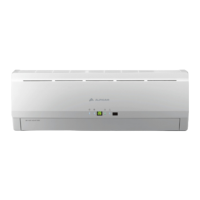



 To Next Page