
 Need help?
Do you have a question about the Amana GUI* and is the answer not in the manual?
Covers fire, explosion, property damage, personal injury, or death if instructions are not followed.
Warns against using the furnace if any part has been under water, requiring qualified inspection.
Instructs to turn off the manual gas control valve before electrical supply during overheating.
Emphasizes installer's duty to know product, safety, and instruct customers on safe use.
Covers clearances, flammable materials, ventilation, and storage around the furnace area.
Verifies flue, vent, duct integrity, physical support, and burner flame adjustment.
Warns about personal injury or fire from not maintaining minimum clearances to combustible surfaces.
Addresses need for fresh air, risks of CO from air starvation, and home sealing effects.
Provides recommended humidity levels based on outdoor temperature and its effects.
Highlights risks, odorant fading, and the necessity of a gas detecting warning device for propane.
Explains thermostat types, settings (Auto/ON), and functions for heating/cooling.
Covers electronic ignition, draft blower, door interlock switch, and water damage warning.
Step-by-step guide for starting the furnace, including gas valve operation.
Explains how the module indicates faults via flashing lights for troubleshooting.
Details how to reset the control module after ignition failure or lock-out.
Procedures for safely turning off the furnace using thermostat, power, and gas valve.
Describes the secondary limit control for blower failure and its manual reset.
Explains the device's function and the warning against resetting it without investigation.
Stresses the importance of a yearly check by a qualified servicer for safe operation.
Details why clean filters are crucial and filter compliance standards.
Instructions for removing, cleaning, and reinstalling filters in upflow configurations.
Procedures for maintaining filters in counterflow furnace installations.
Guidance on filter installation and cleaning for horizontal furnace setups.
Notes that induced draft and blower motor bearings are permanently lubricated.
Provides contact information for Amana dealer and consumer information line.
Instructions to read safety labels and actions for smelling gas.
Details the steps for starting and turning off the furnace as per safety labels.
Warning to keep the compartment closed except during servicing.
Covers risks from improper installation, adjustment, chemicals, and gasoline.
Warning about disconnecting power before servicing to prevent shock or death.
Space provided to record model, manufacturing, and serial numbers for reference.
This document is a user's information manual for an Amana GUI* or GCI* Gas Fired Warm Air Furnace, a heating appliance designed to provide warm air for residential or commercial spaces. It outlines general information, operating instructions, and maintenance procedures to ensure safe and efficient use.
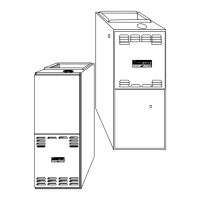
The Amana Gas Fired Warm Air Furnace is a heating system that utilizes natural gas or propane to generate warm air, which is then circulated throughout a building. It is equipped with an electronic ignition device that automatically lights the burners, eliminating the need for a pilot light. An induced draft blower draws combustion air into the heat exchanger, and an air circulating blower motor distributes the warmed air through ductwork. The furnace is designed for safe and dependable service, provided it is properly installed and maintained. It includes safety features such as a self-diagnostic electronic control module, an auxiliary limit control, and a roll-out protection device to prevent overheating and ensure safe operation. The self-diagnostic module flashes a red light in a factory-programmed sequence to indicate specific problems if a component is not operating correctly.
The furnace operation is primarily controlled by a thermostat, which can be a simple on/off type or a more advanced model that controls both heating and cooling functions, often with a fan switch for "Auto" or "ON" settings. In "Auto" mode, the circulating air blower cycles with the furnace, while in "ON" mode, it runs continuously. Some thermostats also offer night setback or multiple setback options to lower temperatures during unoccupied periods.
To operate the furnace:
To turn off the furnace:
The furnace is designed to operate only when the blower door is in place, thanks to an interlock switch. If an abnormal condition is noticed, users are advised to contact a qualified servicer immediately and not attempt to remove internal compartment covers.
Regular maintenance is crucial for the efficient and safe operation of the furnace. It is recommended to have the furnace and vent system checked by a qualified service technician at the beginning of each heating and cooling season. This includes verifying adequate combustion air, proper vent system function (free of blockages or leaks), and checking burner flames for good adjustment (stable, soft, and blue, without curling, floating, or lifting off).
The furnace requires a return air filter, which is not supplied with the unit but must be installed by the servicer. Filters should be inspected, cleaned, or changed every two months or as required, as dirty filters are a common cause of inadequate heating or cooling performance. To access filters, disconnect electrical power and remove the furnace's front panels (for upflow filters) or upper door (for counterflow filters).
For permanent filters, wash, rinse, and dry them, then spray both sides with a dust adhesive. If filters are badly torn or uncleanable, they must be replaced with new filters of the same type and size (complying with UL900 or CAN/ULC-S111 standards). When reinstalling, ensure the airflow direction arrow points towards the furnace.
Both the induced draft motor bearings and the air circulating blower motor bearings are permanently lubricated and do not require further lubrication.
The manual emphasizes several safety warnings, including the importance of providing enough fresh air for proper combustion and ventilation to prevent carbon monoxide exposure. It also warns against storing flammable materials near the furnace and advises against operating the furnace if any part has been submerged in water. In cases of gas leaks, users are instructed not to light any appliance, touch electrical switches, or use phones in the building, but to call the gas supplier from a neighbor's phone or the fire department. For propane furnaces, a gas detecting warning device is strongly recommended due to propane's density and the potential for its odorant to fade. If the roll-out protection device opens, it must not be reset manually; a qualified servicer must investigate the cause.
 General
| AFUE Rating | Up to 96% |
|---|---|
| Efficiency | Up to 96% |
| Heat Exchanger | Stainless Steel |
| Heating Capacity | 40, 000 - 120, 000 BTU |
| Warranty | 10-Year Parts |


 To Next Page
