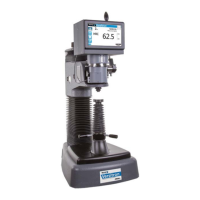
The Versitron Rockwell Hardness Testing System is a sophisticated instrument designed for precise hardness measurements according to ASTM E18 standards. It is utilized across various industries, including automotive, aerospace, and defense manufacturing, due to its advanced mechanical and digital components that simplify the testing process. The system is available in different configurations, including the AT130-RDS and AT130-SRDS models, which are equipped with either regular or superficial Rockwell test heads.
Function Description:
The Versitron system employs a unique top-loading and test surface referencing method. At the beginning of a test, the indenter descends to contact the specimen surface, and as preload and full loads are applied, an indenter shroud establishes a reference point against which the depth of penetration is measured. This design minimizes the effects of deflection in the test stand and specimen under load, which can invalidate tests on standard testers. The system automates the application of preload, zero set, and full load with a single downward lever motion (for manual units) or a foot pedal press (for automatic units), providing a hardness test result upon release of the load.
Important Technical Specifications:
The system offers a displayed hardness resolution of 0.1 Rockwell. It operates on either 115 or 230 +/-10% VAC with a supply frequency of 50-60Hz. The power rating is 230VAC @3.15A, and it uses two T3A15H250V (3.15A Slow Blow Ceramic) fuses. The test head itself weighs 8kg (18lb).
- BT130R Test Heads: Designed for Regular Rockwell scales, these heads apply full loads of 60, 100, and 150 Kg with a preload of 10 Kg, conforming to ASTM E18.
- BT130S Test Heads: Designed for Superficial Rockwell scales, these heads apply full loads of 15, 30, and 45 Kg with a preload of 3 Kg, conforming to ASTM E18.
The Versitron system is available with different stands:
- BT130T (T-Stand): This is the most versatile stand, offering two vertical adjustments: one for elevating screw testing and another for moving the entire head holder when the anvil stage is removed.
- Frame Construction: Cast Iron & Steel Rod
- Vertical Capacity (w/out Anvil Stage): 406mm (16.0in)
- Vertical Capacity (with Anvil Stage): 246mm (9.7in)
- Horizontal Capacity: 223mm (8.8in)
- Throat Depth: 223mm (8.8in)
- Approximate Weight: 63.5kg (266lb)
- Overall Dimensions: Max. Height 870mm (34.2in), Max. Width 419mm (16.5in), Max. Depth 632mm (24.9in), Base Height 114mm (4.5in), Max. Throat Depth 223mm (8.8in).
- BT130N (N-Stand):
- Frame Construction: Cast Iron
- Vertical Capacity: 208mm (8.2in)
- Horizontal Capacity: 198mm (7.8in)
- Throat Depth: 219mm (8.7in)
- Approximate Weight: 63.5kg (140lb)
- Overall Dimensions: Max. Height 813mm (32.0in), Max. Width 412mm (16.2in), Max. Depth 572mm (22.5in), Base Height 134mm (5.3in), Max. Throat Depth 219mm (8.7in).
Usage Features:
- Ease of Operation: The top-loading design and test surface referencing simplify operation, reducing operator influence on test results. The system is designed for fast, single-stroke testing in a few seconds.
- Environmental Robustness: The tester is less susceptible to dirt, corrosion, oil, or heavy vibration, which improves reliability and reduces maintenance in challenging environments.
- Scale Changeover: The test heads are designed for quick installation and removal, facilitating easy changeover between regular and superficial Rockwell scales.
- Indenter and Load Adjustment: The system guides the user through physical adjustments for indenter installation and load setting via the Capstan Wheel, ensuring proper load position within tolerance.
- User Interface (UI) Control Unit: The UI features function tabs for navigation to Test Screen, Statistics Screen, Files Screen, and Setup Screen. It displays hardness scale, load time, measurement count, hardness reading, and tolerance limits.
- Data Management: The File Screen allows copying stored files to an external USB drive, opening existing files, clearing data (supervisor login required), and enabling/disabling logging to DataView (an off-line data analysis package).
- Advanced Settings: Includes options for Minimum Thickness, Verification Mode (measurements not stored in data), Set Date & Time, and access to Technician settings.
- Round Correction: The system can apply roundness correction for testing cylindrical specimens, with a dedicated icon and correction displayed on the Test Screen when enabled.
- Clamping Shield: An optional clamping shield can be used to firmly fix specimens, especially large parts, and protect the indenter from impact.
- Motor Drive Option (AT130-MT2): For automatic systems, an electric motor assembly applies test loads, activated by a remote foot pedal.
- Automatic Head-Height Adjustment (AT130-MT4): Available on T-Stands, this option allows motorized adjustment of the test head height to accommodate parts of varying sizes.
Maintenance Features:
- Minimal Routine Maintenance: The Versitron requires no regularly scheduled maintenance other than calibration.
- Component Checks: Anvils, indenters, and indenter shrouds should be checked for damage and dirt occasionally or when changed. Vee anvil alignment should be checked regularly, especially before testing small diameter rounds.
- Troubleshooting Guide: The manual provides a comprehensive troubleshooting checklist and guide to assist operators in diagnosing and resolving common issues before contacting service.
- Factory Service: AMETEK Newage Testing Instruments offers factory service for test heads, including calibration, preventive maintenance, and repairs. A loaner/rental program is available.
- Indirect Calibration: A password-protected Technician Screen allows qualified technicians to indirectly calibrate the equipment by establishing new data point profiles based on machine, indenter, or hardness scale levels using reference blocks. This process is not required for normal operation.
- Factory Calibration Restore: This function allows technicians to revert the system to original factory calibration settings, removing any previously performed indirect calibrations.

 Need help?
 General


 To Next Page