75
rate of positive airway pressure over time in order to maintain a constant airway
pressure at the predicted CPAP level. CPAP is a ventilation mode that provides a
certain pressure level under the condition of spontaneous respiration, so that the
positive airway pressure is maintained throughout the respiratory cycle. PSV with
pressure support means the system activates a pressure support ventilation cycle
when the patient's inspiratory effort reaches the preset inspiratory trigger level. The
pressure rise time and pressure support level are set by the user. When the
inspiration starts, the system will make the patient's airway pressure rise to the
preset pressure level according to the preset pressure rise time, and then maintain
this pressure level, until the patient's inspiratory flow rate reaches the expiratory
trigger level.
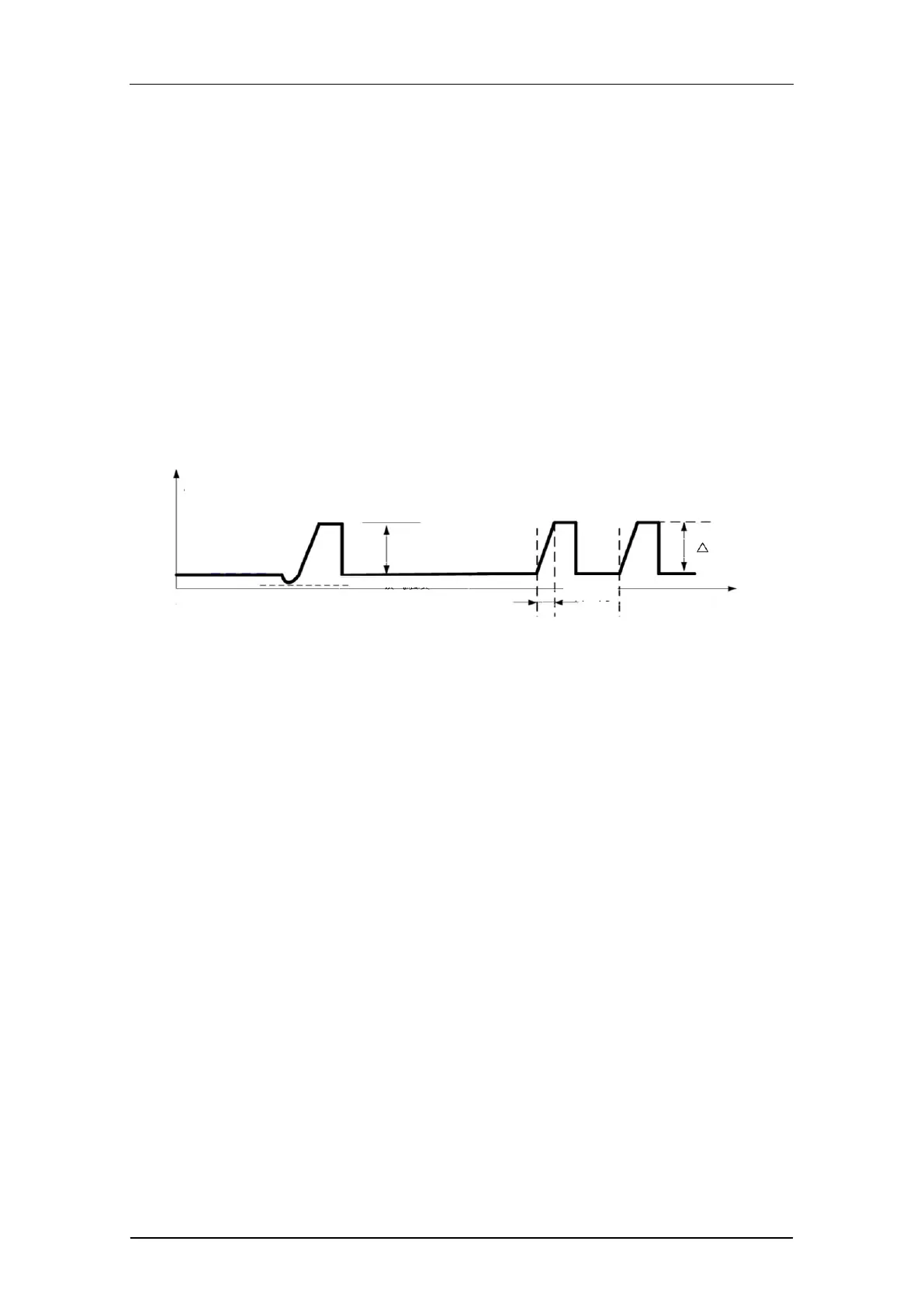
The typical pressure waveform of CPAP/PSV is shown below:
Fig. 40 CPAP/PSV typical pressure waveform
7.6.7 BiPPV
BiPPV, known as the bi-level positive airway pressure, is a procedure in which the
ventilator alternately supplies two different levels of positive airway pressure during
mechanical ventilation or autonomous respiration. Autonomous respiration of the
patient at both of these two pressure levels is available, and support pressures can
be set at both high and low pressure stages. The trigger window can be set at both
the high and low pressure stages. The low-pressure support ventilation will be
supplied for any triggering outside the trigger window in low-pressure stage, while
high-pressure gas will be supplied for inspiratory triggering in the trigger window in
low-pressure stage. High-pressure support ventilation will be supplied for the
inspiratory triggering outside the trigger window in high-pressure stage, while
expiration will be changed to during expiratory triggering within the trigger window
in high-pressure stage.
Typical pressure waveform of BIPPV:
Pressure support
ventilation


 To Next Page