APPENDIX 2 - FREE FIELD CALIBRATION PROCEDURE
32 MODEL 260 INSTRUCTION FOR USE
APPENDIX 2 - FREE FIELD CALIBRATION PROCEDURE
A2.1 ASSURANCE OF CALIBRATION
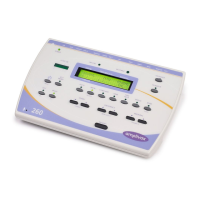
The following is a brief description of the equipment and procedures to be used with the Model 260 audiometer as a
means of performing free-field calibration.
However it must be emphasised that it is the responsibility of the equipment operator to ensure that correct free-field
calibration has been achieved, and it is recommended that the standards for free-field & speech testing & calibration
(e.g. ISO 8253-3 & ISO 389-7) and other appropriate reference works are consulted.
It is assumed that the room, speakers and listening position have been set up in conformance with the relevant
standards and that the required calibration equipment, operating procedures and trained technical staff are available
to perform this operation. Once calibrated, items should not be moved, removed, or added to the room without re-
calibration.
A2.2 EXTERNAL AMPLIFIER AND LOUDSPEAKER
The following external equipment is specified for use of the Model 260 audiometer in free-field modes of operation:
• Amplifier: Interacoustics AP70
• Loudspeaker: Interacoustics ALS7
A2.3 CALIBRATION OVERVIEW
The following calibration should be performed before any free-field tests are performed, and repeated if any changes
to equipment positions or settings are made, or if there are other changes to the room (e.g. furniture moved). Place the
speaker(s) in the desired position(s), at least 1.5 meters from the subject’s listening position. Refer to the specification
for the test to be performed for correct loudspeaker and subject alignment(s).
For calibration, the measuring microphone of a sound level meter (SLM) is placed at the reference point (the point that
the subject’s head will be located).
The procedures outlined below cover calibration for both speech and warble tone modes of audiometry. If both modes
are to be use then speech calibration must be carried out first. If only warble mode is to be used then only the warble
part of the calibration procedure may be carried out.
However, if speech mode is required later (and a speech calibration is performed) this will invalidate any previous warble
calibration which would then need to be repeated. If warble tones are to be used as a means of equalising the frequency
response in the speech calibration (see Section A2.4.1.1) then this will invalidate any previous warble calibration which
would then need to be repeated when warble tone testing is required.
A2.4 FREE-FIELD SPEECH CALIBRATION
This is carried out in two stages:
1) the speech channel, which contains two elements:
1. an optional equalisation phase
2. a level-setting phase


 To Next Page
 Loading...