EasyManua.ls Logo

AmpliVox 260 - User Manual

AmpliVox 260
52 pages
Print Icon
To Next Page IconTo Next Page
Loading...
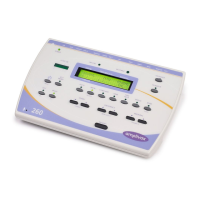
Amplivox Model 260
Diagnostic Audiometer
Operating Manual
(Applies from serial number 12790 onwards)
Amplivox Ltd
29-30 Station Approach
Kidlington
Oxford OX5 1JD
ENGLAND
Tel: +44 (0)1865 842411
Fax: +44 (0)1865 841853
sales@amplivox.ltd.uk
www.amplivox.ltd.uk

Other manuals for AmpliVox 260

Question and Answer IconNeed help?

Do you have a question about the AmpliVox 260 and is the answer not in the manual?

AmpliVox 260 Specifications

General IconGeneral
BrandAmpliVox
Model260
CategoryMeasuring Instruments
LanguageEnglish

Summary

1 Introduction

1.1 Intended applications

Defines the intended users and capabilities of the diagnostic audiometer.

1.2 Unpacking

Instructions for opening the shipping carton and checking contents.

1.3 Warranty card (UK customers only)

Details on completing and returning the warranty registration card.

1.4 Standard contents

Lists all items included in the standard package with the audiometer.

1.5 Optional accessories

2 Important Safety Instructions

2.1 Precautions

General safety advice and warnings before using the instrument.

2.2 Electromagnetic compatibility (EMC) considerations

Guidance on EMC requirements and potential interference from other equipment.

2.3 Mains supply operation

Details on connecting and operating the audiometer using the mains adapter.

2.4 Audiometer connections

2.5 Data transfer to a printer

2.6 Data transfer to a computer

2.7 Line in;out connection (audio)

3 Using the Audiometer

3.1 Switching the audiometer on and off

Procedure for powering the audiometer on and off.

3.2 Testing the patient response switch

3.3 Audiometer display

3.4 Audiometer controls

3.4.2 MENU

3.5 Threshold Retention Function

3.4.3 Description of Function of Other Keys

3.6 Saving audiograms in internal memory

3.7 Loading audiograms from internal memory

3.8 Printing audiograms

3.9 Data transfer to a NOAH database

4 Suggested Sequence of Operation and Test Procedure

4.1 Audiometry preparation and ambient conditions

Guidelines for preparing the test environment and patient.

4.2 Test system arrangement

Diagram and description of the typical audiometric test setup.

4.3 Headset

Instructions for fitting the headset or transducer correctly.

4.4 Patient instructions

4.5 Pre-test

4.6 Test

4.7 Post-test

5 Specification

5.1 Output data

Specifies the types of outputs and their ranges for the audiometer.

5.2 Maximum hearing levels provided at each frequency

5.3 Physical Data

5.4 Equipment classification

6 Symbols

7 Technical Information

8 Routine Maintenance

8.1 Audiometer maintenance

Instructions for cleaning and maintaining the audiometer unit.

8.2 Transducer maintenance

Guidance on checking and maintaining headset and bone vibrator.

8.3 Mains adapter maintenance

9 Instrument Storage and Transportation

10 Calibration and Repair of the Instrument

11 Guarantee

12 Ordering Consumables and Accessories

Appendix 1 - Speech Audiometry

A1.1 Live Voice Speech Audiometry to Headphones

Setup and procedure for performing live voice speech audiometry.

A1.2 Live Voice Speech Audiometry with Contralateral Masking

Procedure for live voice speech audiometry with contralateral masking.

A1.3 Recorded Speech Audiometry to Headphones

Setup and procedure for recorded speech audiometry.

A1.4 Recorded Speech Audiometry to Headphones with Contralateral Masking

Procedure for recorded speech audiometry with contralateral masking.

A1.5 Free Field Live Voice Speech Audiometry

Setup and procedure for free field live voice speech audiometry.

A1.6 Free Field Recorded Speech Audiometry

Setup and procedure for free field recorded speech audiometry.

A1.7 Free Field Recorded Speech Audiometry With Competing Noise (Audiometer-Generated)

Procedure for free field recorded speech audiometry with audiometer-generated noise.

A1.8 Free Field Recorded Speech Audiometry With Competing Noise (Recorded)

Procedure for free field recorded speech audiometry with recorded competing noise.

Appendix 2 - Free Field Calibration Procedure

A2.1 Assurance of Calibration

Emphasizes operator responsibility for ensuring correct free-field calibration.

A2.2 External Amplifier and Loudspeaker

Specifies external equipment required for free-field modes.

A2.3 Calibration Overview

Outlines the calibration process and requirements.

A2.4 Free-field Speech Calibration

Details the two stages for free-field speech calibration.

A2.5 Free-field Warble Tones Calibration

Procedure for calibrating warble tones for free-field audiometry.

A2.6 Free-field Live Speech Calibration

Calibration steps for free-field live speech audiometry.

Appendix 3 - EMC Guidance & Manufacturers Declaration

Guidance and manufacturers declaration - electromagnetic emissions

Declaration regarding electromagnetic emissions and compliance.

Guidance and manufacturers declaration - electromagnetic immunity (1)

Declaration regarding electromagnetic immunity for ESD, transients, and surge.

Guidance and manufacturers declaration - electromagnetic immunity (2)

Declaration regarding immunity to RF, conducted, and radiated fields.

Appendix 4 - Use with Non-medical Electrical Equipment

Diagram 1: Model 260 used with the medically-approved mains adapter

Diagram illustrating the basic setup with the mains adapter.

Diagram 2: Model 260 used with the medically-approved mains adapter and printer

Diagram showing connection of the audiometer with a printer.

Diagram 3: Model 260 used with the medically-approved mains adapter and PC

Diagram illustrating connection of the audiometer with a PC.

Diagram 4: Model 260 used with the medically-approved mains adapter and CD;Tape player

Diagram showing connection of the audiometer with a CD/Tape player.

Diagram 5: Model 260 used with the medically-approved mains adapter and external amplifier

Diagram illustrating connection of the audiometer with an external amplifier.

Related product manuals