APPENDIX 2 - FREE FIELD CALIBRATION PROCEDURE
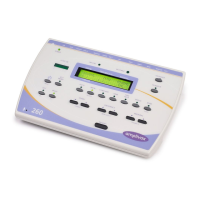
35 MODEL 260 INSTRUCTION FOR USE
It is possible that, because of the characteristics of the listening room or test set-up, the calibration levels above cannot
be achieved because the limit of adjustment is reached for one or more frequencies. Re-arrangement of the listening
room may improve the situation, but if not, the following is a possible solution:
• Set all of the frequencies for which calibration can be achieved
• For frequencies where this is not possible, adjust each to be a multiple of 5dBs from the required level
• Produce a correction table for each frequency for which calibration could not be achieved to be applied to
the output level of the audiometer while conducting a test to relate the instrument display to actual output
level from the speakers.
A2.5.2 Calibrating the Competing Noise Channel
This part of the calibration procedure may be omitted if Free-field speech masking is not required.
• Enter the Free-field calibration mode as described in A2.5.1
• Press the SPEECH key and the display will change to indicate the option to adjust the competing noise
calibration level – the legend “Sp Mask” is used to indicate this
• Without changing the setting on the external amplifier use the SIGNAL keys to adjust the level of the
competing noise to 90dBSPL as measured by the SLM using dBA settings.
• Calibrate each channel, pressing the RIGHT and LEFT keys to switch between channels
• If necessary it is possible to switch between speech (competing noise) and warble calibration modes by
pressing the SPEECH key again
• To store the levels and leave Free-field calibration mode, press the MENU key
A2.6 FREE-FIELD LIVE SPEECH CALIBRATION
Note: as stated in Appendix 1 of this operating manual, users should be aware that there is a growing body of
professional opinion that Live Voice speech audiometry is generally not recommended. Exceptional skill and
concentration are required to achieve accurate and consistent levels.
• Connect a microphone to the MIC1 input on the audiometer
• Press SPEECH repeatedly to ensure that ‘MIC’ is displayed in capitals at the bottom left of the display
(indicating that the external microphone is selected)
• The input signal is adjusted in 1dB steps with the MASKING keys
• Input signal adjustment should be made to adjust for the operator’s voice to peak at the 0dB point on the
LEVEL dB bar graph
• If recorded speech has been calibrated no further action is necessary
• If recorded speech has not been calibrated, the volume control of the amplifier should be adjusted so that
the SLM reads 90dBSPL at the listening point with a 70dBHL setting on the instrument; note that this is an
approximate setting only, as it is not possible to produce a true calibration signal in live speech

 To Next Page
 Loading...