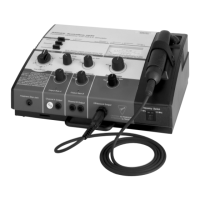
24 US/50 User's Guide
Part 5
Adverse Effects - Shortwave Diathermy Interference
It is extremely important for the physiotherapist to have a clear understanding
of the potential danger involved in the use of a ultrasound device in close proximity
to an active shortwave diathermy unit.
A medical shortwave diathermy unit is a very powerful transmitter of radio
energy, the larger ones having an output of 500 watts. Any ultrasound device
with external leads, in close proximity to a shortwave unit, is likely to be affected
by interference. This interference may be in the form of sparking between
electrodes or between the leads and the device casing. The leads connecting the
ultrasound device to the patient can act as an aerial and collect the radio frequency
energy from the shortwave unit. This could interfere with the operation of the
ultrasound unit or affect internal functions of the device. Or, it could result in
the patient experiencing some unusual "surges" of current. There is no significant
electrical radiation from a ultrasound device.
The increasing electronic sophistication of physiotherapeutic equipment is likely
to mean that this problem is going to become more obvious. The minimum safe
operating distance is difficult to determine since local factors must be considered.
At least two or three meters is needed between the nearest parts of either
instrument, including the cables and electrodes. The ultrasound device does not
need to be plugged into a power supply to be affected by interference from a
shortwave unit. Some very old types of shortwave generators seem to produce
more interference than others which compounds the problem even further. With
some shortwave units, the distance between devices of at least three meters may
still be inadequate.
In practice, shortwave diathermy units and ultrasound units should be placed
and operated as far away from each other as possible. It may be necessary to
screen off all shortwave units from other equipment or to have fully screened
rooms in which shortwave diathermy equipment can be operated without risk
of interfering with other sensitive equipment. This is often difficult in a small
practice where space is at a premium. In such cases, the units may have to be
operated at different times, not simultaneously. In all cases, it would be very
dangerous to give shortwave diathermy and ultrasound treatment to a patient
simultaneously.
Any patient who reports a sudden, unexplainable "surge" in output may be
experiencing the effects of shortwave interference.


 To Next Page