EasyManua.ls Logo

ANCEL BA101 - User Manual

ANCEL BA101
17 pages
Print Icon
To Next Page IconTo Next Page
Loading...
Item: BA101
Question and Answer IconNeed help?

Do you have a question about the ANCEL BA101 and is the answer not in the manual?

Summary

Product Summary

Product Profile

Details the advanced conductance testing technology and its benefits.

Product Function

Explains the core functions: battery, cranking, and charging tests.

Technical Parameters

Lists measurement ranges for various battery standards like CCA, DIN, IEC.

Working Environment Requirement

Specifies the operating and storage temperature ranges for the tester.

Product Information

Tool Description

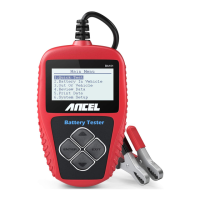
Describes the physical layout, buttons, and ports of the battery tester.

Product Specifications

Details display type, operating temperature, dimensions, and weight.

Accessories Included

Lists the items provided with the battery tester, like cables and software.

Product Setup

Guides on setting language and adjusting LCD contrast for the tester.

Battery Test

Quick Test

Performs a rapid assessment of battery health, voltage, CCA, and resistance.

Battery In-Vehicle Test

Covers testing procedures for batteries installed in a vehicle, including cranking and charging.

Battery Out-of-Vehicle Test

Select Battery Type

User selects battery type (Flooded, AGM, Gel, EFB) for accurate testing.

Review Data

Print Data

Instructions for transferring and printing test results via USB cable and software.

Warranty and Service

Limited One Year Warranty

Details the terms and conditions of the product's one-year warranty.

Service Procedures

Provides contact information for customer support and technical assistance.

Overview

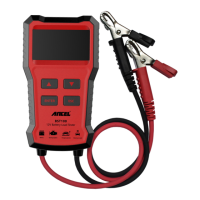
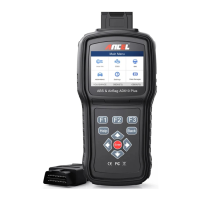
The ANCEL BA101 Car Battery Tester is a sophisticated diagnostic tool designed to quickly, accurately, and easily assess the health of vehicle starting batteries, as well as the vehicle's starting and charging systems. It employs advanced conductance testing technology to provide reliable analysis, helping maintenance personnel identify and resolve issues efficiently.

Function Description:

The BA101 battery tester offers several key functions:

  • Battery Test: This is the primary function, aimed at analyzing the battery's healthy status. It calculates the actual cold cranking capability of the battery and its aging extent, providing crucial data for maintenance decisions. The tester notifies the user when a battery is aging and needs replacement.
  • Cranking Test: This function focuses on testing and analyzing the starting motor. By measuring the actual required cranking current and cranking voltage, it determines if the starting motor is functioning correctly. It can help identify issues such as lubricating system faults leading to increased loaded torque or rotor friction.
  • Charging Test: This feature checks and analyzes the vehicle's charging system, including the generator, rectifier, and rectifier diode. It helps determine if the generator's output voltage is normal, if the rectifier diode is working correctly, and if the charging current is within specifications. Abnormalities in these components can lead to overcharging or incomplete charging, which can damage the battery and other electrical appliances.
  • Quick Test: This allows for a rapid assessment of battery status, including voltage, CCA, electronic resistance, rated CCA, charging value, healthy value, and the overall testing result, all within one second. Users need to input the battery's rated capacity (AH value) for this test.
  • Review Data: This function allows users to check the history of battery testing results.
  • Print Data: The device can connect to a computer via a Mini USB cable to print test data using dedicated software.
  • System Setup: This menu allows users to adjust settings such as language, LCD contrast, and view tool information (software and hardware versions).

The tester supports various battery types, including ordinary lead-acid batteries, AGM flat plate batteries, AGM spiral batteries, Gel batteries, and EFB batteries. It can directly detect bad cell batteries and features polarity reverse connection protection, ensuring the tester, vehicle, and battery are not damaged by incorrect connections. It can also test batteries with low charge without requiring a full charge beforehand.

Important Technical Specifications:

  • Display: LCD
  • Operating Temperature: 0 to 50°C (32 to 122°F)
  • Storage Temperature: -20 to 70°C (-4 to 158°F)
  • Power: Provided via cable from the car battery
  • Dimensions: 110 mm (4.3") Length x 70 mm (2.75") Width x 16 mm (0.63") Height
  • Weight: 450g
  • Cold Cranking Amps (CCA) Measure Range: 100-2000 (for CCA, BCI, CA, MCA, EN, SAE, GB standards)
  • Cold Cranking Amps (CCA) Measure Range: 100-1400 (for DIN, IEC standards)
  • JIS Standard Range: 26A17--245H52
  • Voltage Measure Range: 8-30V DC
  • Supported Battery Standards: CCA, BCI, CA, MCA, JIS, DIN, IEC, EN, SAE, GB. These standards cover the majority of battery types worldwide.

Usage Features:

The BA101 is designed for ease of use with a simple button interface:

  • Up / Down Button: For navigating menus and selecting options.
  • Exit Button: To return to the previous menu or the main menu.
  • Enter Button: To confirm selections.
  • Mini-USB Port: For connecting to a computer for data printing.

The device supports multiple languages, including English, French, Spanish, German, Italian, and Polish, with options for customization.

When performing a battery test in-vehicle, the tester may prompt the user to turn on headlights for about 10 seconds to eliminate surface charge, ensuring accurate results. For cranking tests, the user is prompted to start the engine. For charging tests, the user is instructed to increase engine RPM to 2500 r/min and hold for 5 seconds, with all other electrical appliances turned off to maintain accuracy.

The test results are categorized into five types:

  1. Good Battery: The battery is in optimal condition.
  2. Good, Recharge: The battery is good but has low current and needs recharging.
  3. Replace: The battery is nearing or has reached the end of its life and should be replaced.
  4. Bad Cell, Replace: The battery has internal damage, a bad cell, or a short circuit and must be replaced.
  5. Charge, Retest: The battery is unstable and requires recharging and retesting. If the same result persists, the battery is considered damaged and should be replaced.

Maintenance Features:

  • Troubleshooting for "Replace" Result (In-Vehicle): If a "Replace" result occurs in in-vehicle mode, users are advised to check the vehicle cable connection to the battery. It's recommended to retest the battery under "Out-of-Vehicle" mode after disconnecting the vehicle cable to confirm the diagnosis before replacing the battery.
  • Troubleshooting for Charging Test Issues: The manual provides guidance for various charging test results, such as "Charging Volt: Low" (check drive belt, generator connection), "Charging Volt: High" (generator assembly replacement, or regulator replacement for older cars), and "No Volt Output" (check generator connection cable and belt). For "Diode Test" failures (high ripple volt), it indicates a damaged diode that needs replacement.
  • Software Updates: While not explicitly detailed as a user-initiated feature, the presence of "Software Version" in the tool information suggests the possibility of future updates or diagnostic capabilities related to software.

The ANCEL BA101 is a versatile and essential tool for automotive manufacturers, maintenance workshops, battery factories, distributors, and educational organizations, providing comprehensive battery and system diagnostics.

ANCEL BA101 Specifications

General IconGeneral
BrandANCEL
ModelBA101
CategoryTest Equipment
LanguageEnglish

Related product manuals