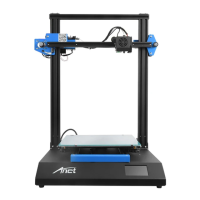
Need help?
Do you have a question about the Anet ET4 Pro and is the answer not in the manual?
Important warnings regarding heat sources, electrical safety, moving parts, and personal protection.
Instructions for regular cleaning, lubrication, and safe maintenance procedures.
Guidelines on age limits, assistance, and the consequences of self-disassembly or modification.
Recommended filament type (1.75mm PLA) and information sources like flash disk and website.
This document provides a comprehensive guide for the ET4 Pro 3D Printer, a DIY collection device that requires customer assembly. The manual emphasizes careful handling of all connection parts, recommending the use of Hot Glue or Silica Gel for secure fixation. It strictly advises against using the machine in ways not described in the instructions, warning that improper use can lead to serious injuries and property damage.
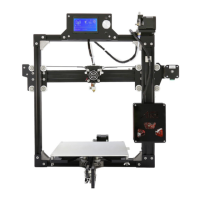
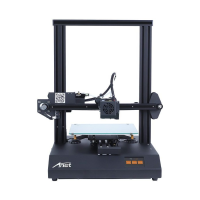
The ET4 Pro 3D Printer is designed for creating three-dimensional objects from digital designs. It operates by extruding heated filament layer by layer to build the desired shape. The printer is a DIY collection, meaning users are responsible for assembling its components. It is intended for use with 1.75mm PLA filament, with Anet official filament being recommended for optimal performance. The device is not suitable for children under 14 or individuals over 60 without assistance and guidance to prevent personal injury.
The printer's operation involves several key features and considerations:
Regular maintenance is crucial for the ET4 Pro 3D Printer to ensure good condition and high-quality prints. Key maintenance aspects include:
The manual also includes a "Notice" section that clarifies several important points:
The manual visually guides users through the assembly process, showing how to connect various components, including the main frame, extruder, and heating bed. It illustrates the proper way to tighten belts and connect electrical components, emphasizing the correct orientation for each part. The diagrams clearly show the different modules and their corresponding connection points, such as S-Z, BL, TMP, FAN, E-M, S-M, X-M, and Z-M, indicating where each motor and sensor should be connected. The visual instructions also highlight critical steps like securing the deco seals and ensuring proper belt tension. The inclusion of tools like wrenches and nuts in the diagrams further aids in understanding the assembly process.
 General
| Print Technology | FDM |
|---|---|
| Build Volume | 220 x 220 x 250 mm |
| Nozzle Diameter | 0.4 mm |
| Filament Diameter | 1.75 mm |
| Connectivity | USB, SD Card |
| Frame Material | Aluminum |
| Heating Bed | Yes |
| Bed Temperature | up to 100°C |
| Nozzle Temperature | up to 260°C |
| Extruder Type | Single |
| Print Speed | 100 mm/s |
| Display | Touchscreen |
| Supported Materials | PLA, ABS, PETG, TPU |
| File Format | STL, G-code |
| Power Supply | 24V, 360W |

 To Next Page