Connecting Your Subwoofer
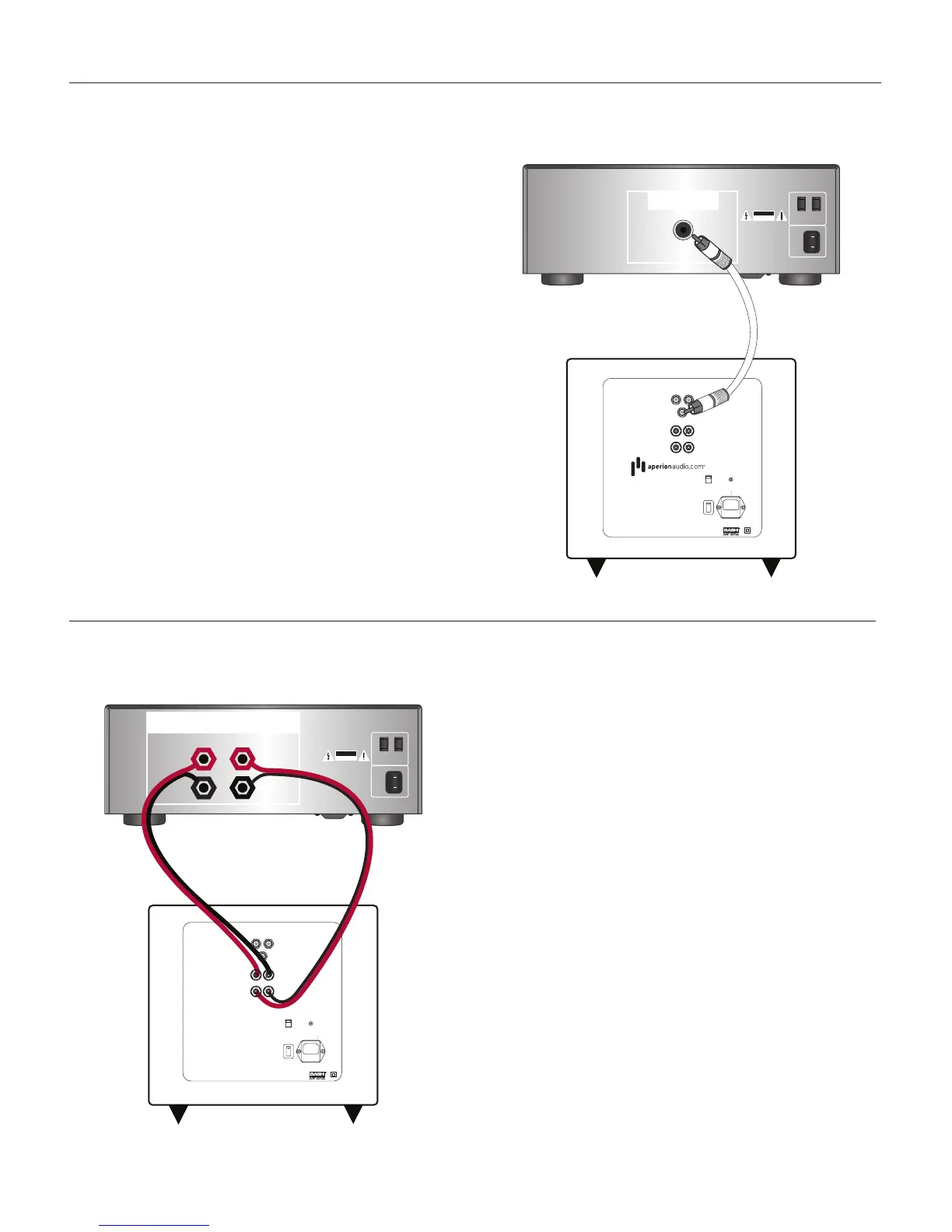
If your receiver has a subwoofer output: (Most modern receivers do)
1. Run a dedicated RCA type subwoofer cable from the
receiver’s subwoofer output to the subwoofer input
labeled LFE. It is best to use a shielded cable for your
subwoofer so other pesky signals don’t worm their way
into your precious bass.
2. If your subwoofer cable has to cross the power cable
for another electronic device, have it cross at a 90-
degree angle.
3. Plug the power cable into the back of your subwoofer
and into a wall outlet or power strip. DO NOT plug it
into the back of your receiver or preamp.
Note: Most subwoofers have both left & right inputs.
Since the sub signal is mono, it doesn’t matter which
one you use. Some people will buy a “Y adapter” or
“splitter” so that a single cable can feed both sub-
woofer inputs. There’s no harm in doing this, the
reason subwoofers have L & R inputs is so that if you
have a stereo pre-amplifier, you can use both “pre-
outs” to the subwoofer without losing any bass.
If your receiver DOES NOT have a subwoofer output:
1. Run speaker wires from your receiver (or your front
left & right speakers) to the subwoofer’s high-level
inputs.
2. Since speaker wire is typically unshielded, it’s best
to steer clear of household wiring. If it does need to
cross the power cable for another electronic device,
have it cross at a 90
-
degree angle. If your subwoofer
emits a buzz or a hum, this may be the culprit.
3. Plug the power cable into the back of your subwoofer
and into a wall outlet or power strip. DO NOT plug it
into the back of your receiver or preamp.
CAU T I ON
RISK OF ELECTRIC SHOCK
DO NOT OPEN
Speaker Level Outs
+
+
-
-
L
R
+
+
HIGH LEVEL
INPUT
RIGHT
LEFT
120V
120V
60Hz 2A
POWER
ON
INPUT
VOLTAGE
220-240V
240V
50Hz 1A
POWER
-
-
CAU T I ON
RISK OF ELECTRIC SHOCK
DO NOT OPEN
PRE OUT
SW
120V
60Hz 2A
POWER
ON
INPUT
VOLTAGE
220-240V
50Hz 1A
POWER
LFE
IN
Connecting Your Subwoofer
5
Connecting Your Subwoofer


 To Next Page
 Loading...