I. Introduction
The analysis of gas samples to determine their oxygen (O
2
) and carbon dioxide (CO
2
)
composition is an important procedure during the course of a source test. This information is required in
order to calculate the flue gas molecular weight so that effluent velocities and volumetric flow rates can
be calculated. At this time the pollutant conc entrations can be corrected to a reference diluent
concentration, such as seven percent oxygen or twelve percent carbon dioxide. Absorptiometric gas
analysis has long been a chief technique for the determination of O
2
and CO
2
concentrations for these
purposes.
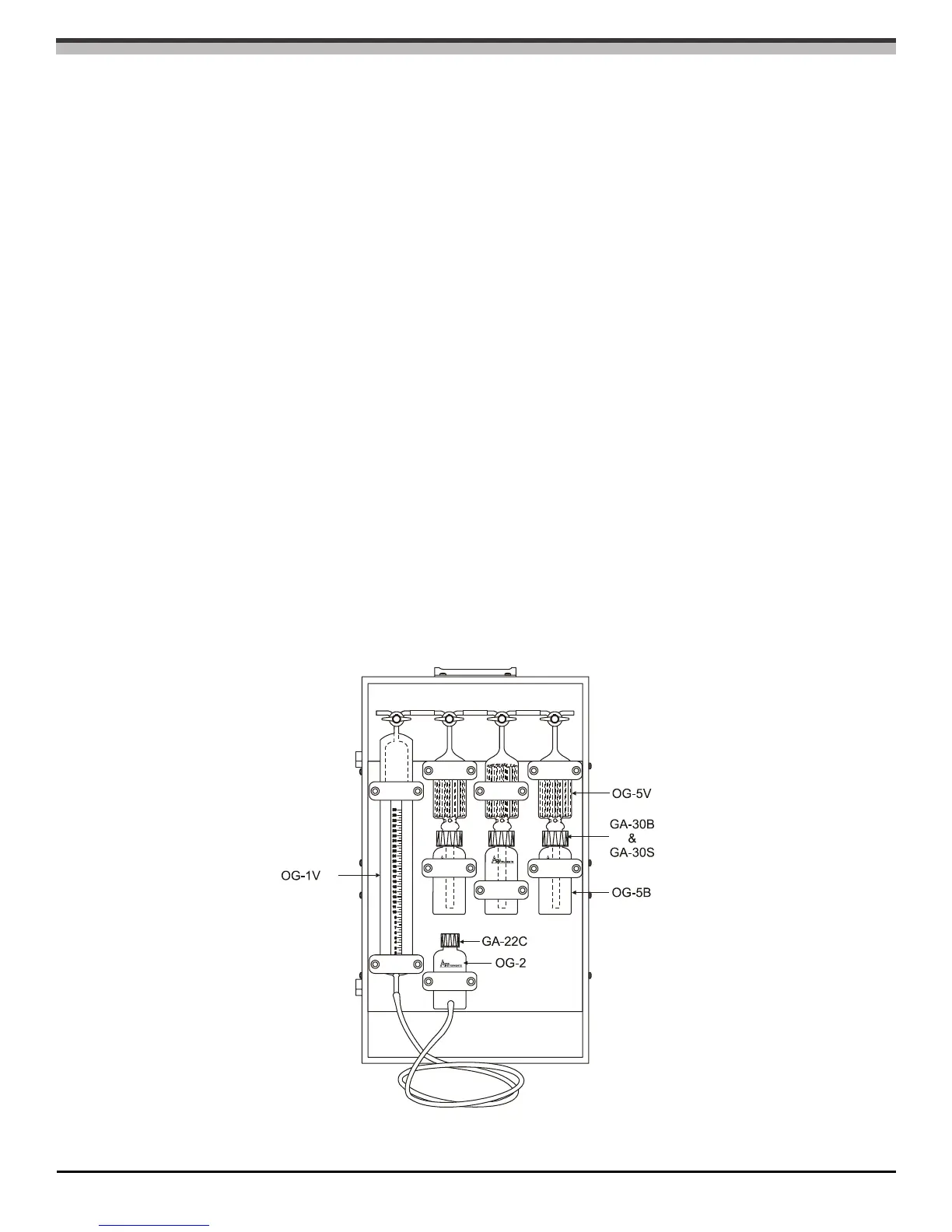
The Apex Instruments VSC-33 Orsat Analyzer (see
Figure 1
) consists of a graduated glass burette and
thr
ee absorption pipettes. The burette and the
pipettes are each fitted with three-way gas stopcocks,
which enable the operator to load the analyzer with
a gas sample, and then to direct the sample to t
he
appropriate pipettes for analysis.
The sample is
exposed to absorbing reagents in the pipettes to remove carbon dioxide, oxygen, (
carbon
monoxide). Each absorption pipette consists of a reagent bottle, a gas absorption bottle, with a three-way
stopcock. During analysis, the volume of gas is measured before and after each absorption, under
constant pressure and temperature. Any decrease in the sample gas volume is measured using the
burette, and represents the amount of constituent that was present, with results reported on a volume
percentage basis.
Figure 1 VSC-33 Orsat Analyzer
The pipettes are arranged so that a gas sample can be drawn into the analyzer, exhausted to the
atmosphere, or directed to any of the absorption pipettes for gas analysis. A multi-compartment gas
expansion bag is attached to the pipette reagent bottles to prevent exhaustion of the absorbents through air
contact, and also to protect a long-standing sample from being slowly diffused with air. The bottom of the
burette is connected to a leveling bottle which contains a confining liquid, consisting of an acidic sulfate
solution. The confining solution is acidic in order to minimize diffusion of the gas sample into the solution
during analytical procedures. By adjusting the height of the leveling bottle, gases in the burette can be
brought to any desired volume, relative to the pressure of the confining liquid.
/18
VSC-33
APEX INSTRUMENTS, INC.
4



 To Next Page