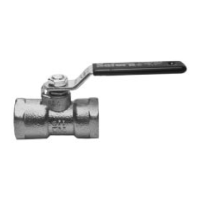
Apollo Full Port & Standard Port Three Piece Ball Valves
Installation, Operation, & Maintenance Guide
Installation
Proper valve selection is the first step in any successful installation.
Refer to Product Data Sheets for application guidance or contact
Apollo Industrial Technical Support for additional guidance with
control-valve sizing.
Apollo V-Port Ball Valves are available in a variety of sizes and
characterizations to provide a selective range of flow characteristics.
Accurate system operating characteristics and fluid properties are
required to ensure proper selection and performance. Due to the
nature of throttling a characterized ball valve, care should be taken to
mitigate the risk of cavitation.
WARNING: All installations shall be provided with pressure
relief devices in accordance with the requirements of the
Pressure Equipment Directive 2014/68/EU. Proper installation
prior to initial operation is the user’s responsibility.
Furthermore, where an additional hazard can occur due to valve
exposure to fire or other unexpected external heat source, a
supplemental pressure relief device shall be installed to protect
against excessive pressure. This device shall prevent the
pressure from rising more than 21% above the maximum
allowable working pressure. Means must also be provided to
monitor valve filling to prevent over pressurization and
instability.
Pre-Installation Inspection
Inspect the piping system prior to valve installation, whenever
possible, to ensure that it has been properly flushed and cleared of
construction and fabrication debris. The seating surfaces in soft
seated valves are particularly susceptible to weld slag and sand
blasting grit. Pipe scale, metal chips and other foreign materials
should be removed.
Just prior to installation, remove each valve from its packaging.
Examine the flow bore for debris. All Apollo ball valves are shipped in
the open position to prevent damage to the ball surface. Any grit or
foreign matter must be removed. Scratched or dented balls must be
replaced. Do not install a damaged valve.
It is important to check for valve operation clearances.
V-port valves have a preferred flow direction denoted by an arrow that
has been laser-etched on the body. If valve is disassembled, ensure
ball is reinstalled in the preferred flow direction. Refer to Reassembly
Instructions. Apollo 3-Piece Valves with the V-Port option do not allow
center swing-out service. Means for removing the valve shall be made
to perform maintenance.
Threaded-End Valve Installation
After removing the valve from its packaging, inspect the NPT threads
for damage. Occasionally threads may require chasing prior to
installation to remove burrs or other minor imperfections.
Apply pipe sealant compound or PTFE tape to the male pipeline
threads. Do not use sealant on the female threads because excess
compound may be forced into the valve body. This could cause
sticking of the ball or encourage the accumulation of dirt and debris
that could prevent positive valve shutoff.
Weld-End Valve Installation
Installation welding shall be done in accordance with the applicable
code or regulation covering the system into which the valve is
installed. Both butt-weld and socket-weld valves require special
consideration for installation. In addition to the general cautions
already discussed, the heat of welding may damage seats and seals.
A warning label is included with all weld-end valves.
1. Only personnel qualified per ASME BPVC Section IX should
weld pressure-containing components. Only qualified weld
procedures should be employed.
2. Place the valve in the fully open position and remove handle,
operator or actuator.


 To Next Page
 Loading...