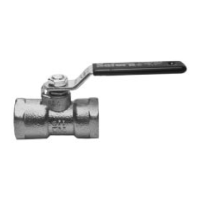
Apollo Full Port & Standard Port Three Piece Ball Valves
Installation, Operation, & Maintenance Guide
3. Align valve in the piping system. For socket-weld valves, slip
into the piping system retracting the pipe approximately 1/16”
(1.5mm) from the bottom of socket weld connections.
4. Wrap the center section of valve with wet rags to minimize
heat transfer to the seats and seals. Do not allow the valve
center section temperature to exceed 400°F (204°C) as
monitored by either a Tempil® Stick or other suitable method.
5. Use multiple passes with a bead size of 1/8” (3mm) or less.
Stop after each pass and allow the valve to cool so as not to
exceed the body temperature limit noted above. Maintain wet
rags.
6. After the valve has fully cooled, reinstall the handle, operator
or actuator.
Operation
Apollo Full Port and Standard Port 3-Piece valves are identified by
laser-etching the valve body. Apollo V-Port Ball Valves have a
preferred flow direction denoted by a laser-etched arrow on the body.
Although each valve is thoroughly tested and inspected before it
leaves the factory, nameplates and/or warning tags could be lost or
destroyed during shipment or while in storage. If either is missing or
not legible, contact your distributor or the factory for assistance before
placing the valve in service.
V-Port ball valves are intended to be used for throttling operating
through 90
o
of stem rotation. Operation is clockwise to close. Users
should note that there is a dead-band in the beginning of the flow
curve for each valve size. Refer to Product Data Sheets for listed Cv
values for each size.
V-Port ball valves may be operated with a hand-lever or fitted with
quarter-turn actuators. Valves with actuators shall be checked for
acceptable valve stem alignment. Angular or linear misalignment may
result in high operational torque and unnecessary wear.
The most common service failures not related to the installation and
start-up processes are:
Exceeding the operating temperature or pressure limits of the valve
due to a process upset condition.
A chemical attack on valve components due to either
misapplication or changes in the service.
Inaccurate service conditions used in valve size and profile
selection
Violating temperature and pressure limits can result in immediate
valve failure where chemical attack or corrosion generally occurs
gradually.
Media that may harden or solidify should not be allowed to remain
stagnant in the valve cavity unless regular maintenance is performed.
Maintenance
Preventive Maintenance Schedule
A regularly scheduled and documented preventive maintenance
program needs to be established to achieve maximum useful valve
life at the lowest cost. Initially, it is recommended that valves be
inspected monthly for smooth operation and leak free performance.
Apollo 3-Piece V-Port Valves come standard with a “live-loading” stem
packing feature and graphite packing. The “live loading” feature has
design allowances for compaction and wear of the stem packing. It
also makes allowance for thermal expansion and contraction as the
valve goes through temperature cycles.


 To Next Page
 Loading...