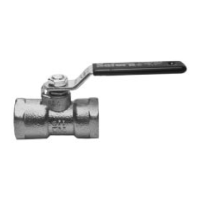
Apollo Full Port & Standard Port Three Piece Ball Valves
Installation, Operation, & Maintenance Guide
Valve Adjustments
WARNING: Never back off the stem packing adjustment screws
or nuts when the valve is under pressure.
At some point in the service life of the valve, leakage may occur. This
should be noted in the maintenance history log of the valve. The stem
packing was adjusted at the factory to provide a leak tight seal when
the valve was new, but compaction can occur within these seals that
may make re-adjustment necessary. Stem packing leakage should be
stopped as soon as it is detected. On actuated valves, most mounting
hardware allows access to the packing adjustment fasteners. If this is
not the case, it may be necessary to remove the actuator to gain
adequate access to make the packing adjustment. Packing
adjustment can be accomplished by turning the stem packing
adjustment fasteners clockwise to the maximum torque shown in
Table 1 or 2, as applicable.
Do not over tighten the adjustment fasteners. Over-tightening will
result in excessive operating torque and shorten the packing’s service
life. If stem leakage continues, or operating torque becomes
excessive, de-pressurize the valve and replace the stem seals.
Valves with high operating torque not resulting from stem seal over-
tightening or valves, which have leakage by the seats, may have
damaged seats or ball surfaces. These valves should be de-
pressurized, disassembled, and inspected for damage.
Valve Overhaul
As part of planned maintenance or as a result of a problem that
cannot be adjusted away, a valve may require a complete overhaul.
The first step is to contact your distributor to acquire an appropriate
rebuild kit. These kits typically contain a complete set of seats, seals,
and gaskets. To properly order spare parts, you will need the valve
model number laser-etched on the valve body.
Disassembly
WARNING: Do not attempt to work on any valve under pressure.
Depending on the service, valve surface temperature may be hot.
Use proper protective gear to protect against burns and any
possible uncontrolled release of fluid.
WARNING: Use caution when servicing valves used to control
hazardous media. Wear appropriate protective equipment. Flush
and decontaminate valves prior to removal when possible.
Once the spare parts are on hand, the first step in the valve
disassembly is to isolate the valve from line pressure.
Remove actuation components, if applicable. Using an adjustable
wrench, valve handle, or properly sized open-end wrench, rotate
the stem until the valve is in the one half open, one half closed
position. Be careful not to damage the stem. This will allow any
cavity pressure to be released into the pipeline. Place the valve in
the open position after this is done.
Loosen each of the body joint fasteners approximately one turn
only initially. This will allow a second chance for any cavity
pressure stored within the valve to be released. Leakage may
occur outside of the pipeline.
Before removing the valve from the piping, take precautions to
ensure the safety of personnel. Make sure the valve and piping
system are properly stabilized and pressure has been appropriately
relieved.
Remove the valve from piping.
Set the valve on a suitable clean, solid work surface.
To remove valve seats, body seals, and ball:
Rotate the stem so the ball is in the closed position.
Remove body joint fasteners and separate end caps.
Remove body joint gaskets from the recesses in the ends of the
body.
Pressing either by hand or with a non-marring soft face tool on the
spherical surface of the ball, remove one seat.
Press in the opposite direction to remove the other seat.


 To Next Page
 Loading...