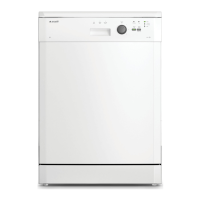
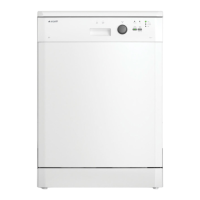
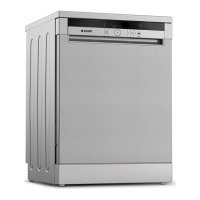
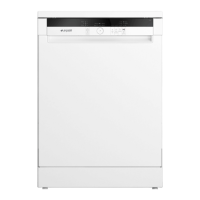
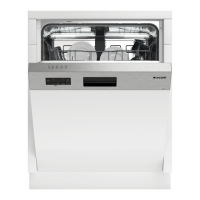
This document describes the Arçelik 6230 HT dishwasher, providing details on its functions, technical specifications, usage, and maintenance.
Function Description
The Arçelik 6230 HT dishwasher features a control panel with a program selection knob (1) for choosing washing programs, an On/Off button (9) for powering the machine, and a Start/Pause button (6) to initiate or temporarily stop a program. Indicator lights provide feedback on the machine's status: an On/Off indicator light (4) shows when the machine is powered, a Rinse-aid level indicator light (2) and a Salt level indicator light (3) alert users when these consumables need refilling, and LED progress indicator lights (7) track the current stage of the washing cycle (On/Off, Wash, Dry, End). A Combi Tablet button (5) is available for models using multi-purpose detergents like 2in1, 3in1, 4in1, or 5in1, optimizing drying performance based on water hardness.
The machine offers three main programs:
- Ekonomi (Eco) 50°C (1): Suitable for normally dirty dishes with starch-containing food leftovers that are not dried on. This program includes pre-wash, wash, cold rinse, hot rinse, and dry stages.
- Ekspres 58' (Express) 60°C (2): Designed for normally dirty dishes with starch-containing food leftovers that are not dried on. This program includes wash, cold rinse, hot rinse, and dry stages.
- Süper (Intensive) 70°C (3): Ideal for especially dirty dishes with dried-on food leftovers. This program includes pre-wash, wash, cold rinse, hot rinse, and dry stages.
Important Technical Specifications
The dishwasher operates with a permitted water pressure of 0.3 – 10 bar (3 – 100 N/cm² = 0.01-1.0MPa). The electrical connection requires 220-240 Volts, 10 Amps (see type plate), with an output of 1900-2200 W and a heat output of 1800 W. The appliance complies with EU directives 2006/95/EC (Low Voltage Directive) and 2004/108/EC (EMV Directive), and EN 50242 for household dishwashers.
The water inlet hose can be either for cold water (up to 25°C) or hot water (up to 60°C), depending on the model. For water pressure above 10 bars, a pressure reduction valve must be installed. Some models feature an AQUASAFE+ system for protection against water damage at the inlet hose.
Consumption values for the programs are:
- Ekonomi (Eco) 50°C: Duration 136 min, Energy 1.05 kWh, Water 15 l.
- Ekspres 58' (Express) 60°C: Duration 58 min, Energy 1.32 kWh, Water 11.8 l.
- Süper (Intensive) 70°C: Duration 115 min, Energy 1.67 kWh, Water 17.5 l.
Usage Features
Starting the Dishwasher:
- Open the water tap and plug the machine into the mains.
- Open the door, load dishes, and ensure spray arms move freely.
- Fill detergent into the dispenser.
- Turn on the machine using the On/Off button.
- Check salt and rinse aid indicator lights and refill if necessary.
- Select a program using the program selection knob.
- Start the program with the Start/Pause button.
During Operation:
- Avoid opening the door during washing to prevent hot steam escape and program interruption.
- The machine will pause for approximately 35 minutes after the washing stage to drain and remove water, which is not a fault. The "End" progress indicator light will come on when the program is complete.
Cancelling/Changing Programs:
- To cancel a program, press the Start/Pause button for 3 seconds. The machine will drain water for 45 seconds, and the washing light will go off.
- To change a program, press Start/Pause, select a new program, and press Start/Pause again. The new program will continue from the stage where the previous one was interrupted.
Loading the Dishwasher:
- Baskets: The dishwasher includes an upper dish basket with a shelf, a cutlery basket, and a lower basket.
- Plate Supports: Some models have 4 folding plate support rods in the lower basket for accommodating larger items like saucepans and bowls. Other models have 2 folding plate support rods.
- Bottle Holder: For cleaning bottles, the bottle holder can be removed.
- Cutlery Basket: The variable cutlery basket can be separated into 3 parts. Smaller sections can fit into the upper basket. The basket inset can be removed for larger items.
- Basket Height Adjustment: Some models feature a basket insert with variable height settings or an upper basket with a lifting mechanism to adjust its height, even when fully loaded.
- Glass Support: For delicate glasses, a glass support can be used to lean them against the shelf, preventing damage.
- Upper Basket Drawer: Some models include an upper basket drawer for small items like dessert spoons, small forks, and knives.
Detergent, Rinse Aid, and Salt:
- Detergent: Use only detergents formulated for dishwashers. The dispenser holds up to 40 cm³ of detergent. For short programs without pre-washing, use powder detergent. Avoid excessive powder detergent to prevent scratches on glassware.
- Multipurpose Detergents: If using 2in1, 3in1, 4in1, or 5in1 detergents, additional rinse aid may not be needed. Ensure salt and rinse aid compartments are full when using these.
- Rinse Aid: Prevents watermarks and streaks. The dispenser has a regulator (levels 1-6) to set the dosage; factory preset is level 3. Adjust if watermarks (increase dosage) or streaks (decrease dosage) appear.
- Salt: Essential for water softening. The salt container holds approximately 2 kg. Refill when the salt level indicator light comes on. The water hardness level should be set according to local water supply.
Maintenance Features
Cleaning the Dishwasher:
- Filters: Regularly clean the main filter, coarse filter, and micro filter to ensure optimal cleaning results. Remove the lower basket, pull out the coarse filter, then the main filter, and finally the micro filter. Clean them under running water with a brush.
- Spray Arms: Regularly check and clean the nozzles on the spray arms to prevent dirt or calcium residue from blocking them. Remove the lower spray arm by pulling it upwards. Loosen the fastening screw of the upper spray arm and pull it off.
- Water Inlet Hose Filter: If applicable, clean the filter inset in the water inlet hose to prevent dirt from pipes.
Troubleshooting:
The manual provides guidance for common issues:
- Dishwasher not running: Check mains plug, fuses, water supply, door closure, On/Off button, and water intake filter.
- Unsatisfactory cleaning results: Address disorderly placement of dishes, incorrect program selection, blocked impellers, clogged filters, misplaced or displaced filters, clogged impeller holes, overloading baskets, or unsuitable detergent conditions.
- Inadequate rinse aid/unsealed dispenser lid: Increase rinse aid setting or add rinse aid, ensure detergent compartment lid is closed tightly.
- Tea, coffee, and lipstick stains: Select a longer program with higher temperatures.
- Lime stains, hazy look, insufficient water softening, salt leakage: Increase rinse aid setting, ensure water softening is properly set, add salt, and check salt box cover.
- Metallic look, bluish rainbow color: Lower rinse aid setting.
- Glass corrosion: Ensure water softening is properly set, and if water supply is soft, do not use salt. Use programs with higher temperatures (e.g., 60-65°C).
- Scratch/break in glassware, kitchenware containing aluminum, low water softening setting, inadequate salt, detergent kept under unsuitable conditions, overloading the baskets: Check salt box cover, ensure water softening is set correctly, store detergents in dry places, and do not overload baskets.
- Rusts, blackening, and corruption of surface, unsealed closing of the salt box cover, grounding line: Check salt box cover and grounding line.
- Detergent remains in the detergent dispenser, damp detergent compartment, putting detergent in the detergent dispenser long before washing, preventing opening of detergent dispenser lid during washing, clogged impeller holes: Ensure dispenser is dry, add detergent just before washing, and check impeller holes.
- Water remained in the dishwashing compartment after washing, clogged filters, blocking/twisting of drainage hose: Check filters and drainage hose.
- Odour, odour of new dishwasher, clogged filters, leaving the dishes in the dishwasher for a long time: Clean filters, run washing without detergent, and unload dishes promptly.
- Foam, loading the dishes into the dishwasher without completely drying after washing them with hand-wash detergent, spilling rinse aid in the machine while filling, leaving the rinse aid lid open or not closing it: Avoid hand-wash detergents, clean spilled rinse aid, and ensure rinse aid compartment is closed.
- Erasing of decorations, usage of decorated glasses and porcelains: Do not wash decorated items or those with luster porcelains.
Service:
For malfunctions, consult the manual. If issues persist, contact customer service. Repairs should only be carried out by qualified personnel.

 Need help?
 General

 To Next Page