This document serves as the owner's manual for ARIMAR inflatable boats, specifically the CLASSIC 270, 320, 360 and SOFT LINE 270 models. It provides comprehensive information on the boat's features, assembly, safe operation, maintenance, and warranty.
Function Description:
ARIMAR inflatable boats are designed for recreational use, offering a versatile and portable solution for water activities. They are intended for navigation in various weather conditions, depending on their design category. The boats are constructed with high-quality materials to ensure durability and safety, and are equipped with features for easy inflation, assembly, and transport.
Important Technical Specifications:
The manual includes a "Builder Plate" which provides crucial information about each specific boat model. Key technical specifications covered are:
- Length (cm): Varies by model (e.g., 270, 320, 360).
- Width (cm): Varies by model (e.g., 160, 170).
- Tube diameter (cm): Varies by model (e.g., 42, 44).
- Number of air chambers: Typically 3+1 for the listed models.
- Passenger capacity: Varies by model (e.g., 3.5, 4, 5 persons).
- Mass to empty (kg): The weight of the boat without accessories, engine, console, or fuel tank (e.g., 38, 47.5, 53.4, 28.5 kg).
- Maximum recommended power (kW/hp): The maximum engine power suitable for the boat (e.g., 7.7/10, 11.1/15, 18.4/25 kW/hp).
- Maximum motor mass (kg): The maximum weight of the engine allowed (e.g., 42, 52, 78 kg).
- Maximum capacity (kg): The total permissible load including passengers, luggage, and equipment (e.g., 380, 430, 580 kg).
- Operating pressure: The recommended inflation pressure for each compartment is 18 kPa (0.18 bar).
- Design Categories: Boats are classified into categories A, B, C, or D, indicating their suitability for different wind forces (Beaufort scale) and significant wave heights. For instance, Category C boats are designed for winds up to force 6 and wave heights up to 2 meters.
Usage Features:
- Assembly: The manual details the step-by-step assembly procedure, including unfolding the tubes, assembling the floorboard (wooden for CLASSIC, inflatable for SOFT LINE), and inflating the compartments and keel.
- Inflation: Emphasizes checking that valves are in the sealing position before inflation. It provides instructions on how to tighten the valves and recommends using a pressure gauge to ensure the correct operating pressure of 18 kPa (0.18 bar) for all air chambers. It warns against using air compressors or scuba tanks for inflation and highlights that pressure fluctuates with temperature changes.
- Engine Installation: Provides guidelines for choosing and installing an outboard engine, stressing adherence to the power limits specified on the builder plate. It recommends a weight/power ratio between 10 and 38 kg per kW.
- Load Distribution: Illustrates proper load distribution for calm seas, bow waves, and stern waves to maintain good trim and navigation stability. It warns against passengers sitting on bow tubes.
- Navigation: Offers basic operating instructions, including how the boat steers (stern swings opposite to the turn) and how to stop. It advises extreme caution when approaching people in the water and recommends performing all docking and undocking maneuvers at idle speed.
- Bad Weather Navigation: Provides guidelines for navigating in rough conditions, such as reducing speed, seeking shelter, avoiding close proximity to the shore, facing waves ¾ bow, and avoiding stern waves.
- Lifting and Transport: Describes the correct procedures for lifting the boat using designated hooks and transporting it on a trailer, emphasizing the use of soft, wide straps and regular checks of tires and fastenings.
Maintenance Features:
- General Maintenance: Recommends keeping the boat in good condition, especially during winter or long periods of disuse, by storing it dry, clean, and away from heat sources, with a few liters of air in the tubes.
- Cleaning: Advises washing the boat with water and neutral shampoo. For stainless steel parts, it recommends washing with fresh water after use in saltwater and cleaning with specific products if anomalous colors (similar to rust) appear. It warns against using high-pressure water jet machines, especially with hot water, on the tubes.
- Checks: Regular checks (every 6 months) of boat outlets, plugs, seals, and floodgates are recommended.
- Repairs: For repairs to pneumatic parts, it advises contacting a dealer or authorized technicians and using only glues and fabrics recommended by LALIZAS ITALIA s.r.l.
- Battery Maintenance: Suggests detaching and charging the battery periodically, especially in winter, and checking electrolyte levels and lubricating terminals.
- Hull Care: Recommends periodically cleaning the hull and protecting fiberglass parts with antifouling paint, avoiding contact with fabric parts.
- Safety Equipment: Stresses the importance of maintaining safety equipment (fire extinguishers, personal flotation devices, life belts) in perfect efficiency and servicing them before expiry dates.

 Need help?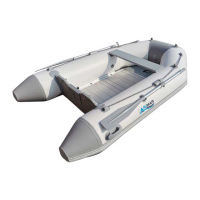

 To Next Page
 General