95
SEPTEMBER 2021
ENGLISH
4.2.6 Bad weather navigation
Should you be boating in the sea or in large lakes when bad weather
strikes, the following guidelines should be observed:
a) Reduce the boat speed - not too much since this would mean loosing
control.
b) Do not panic. Be careful but determined.
c) Seek shelter in a harbour or in a “protected” area.
d) Do not navigate close to the shore. There the sea is rippling and, in
case of engine failure you could hit against a rock or shoreline.
e) Face the waves ¾ bow. Follow the route in a zigzag way.
f) Always avoid stern waves when the sea is rough - that is avoiding
the navigation in the same direction of the waves.
WRONG
NAVIGATION
WRONG
NAVIGATION
CORRECT
NAVIGATION
4.2.7 Navigating instructions
Basic operation
When driving forward, the boat could list to starboard on the left. This is a
typical feature of “V” hulls, therefore no intervention is required. Just correct
the listing by moving slightly the helm, until the right direction is obtained.
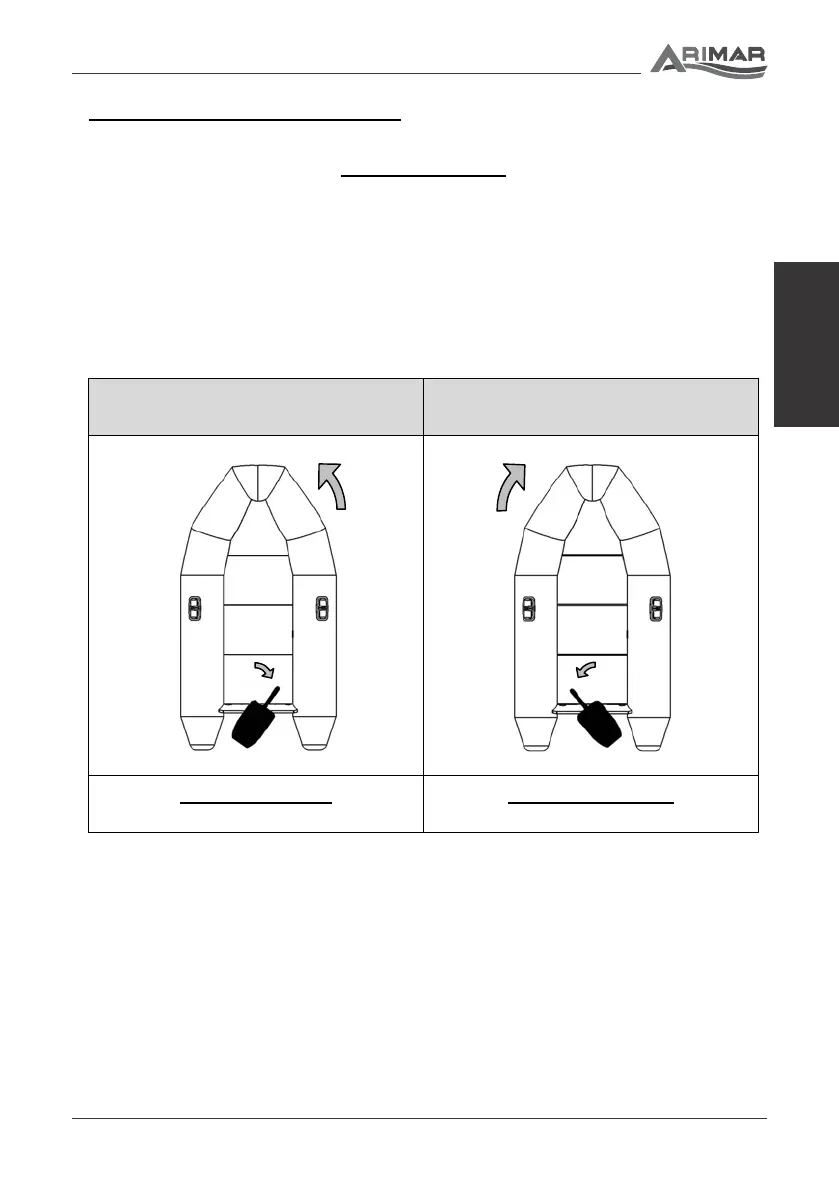
Remember that all boats steer by the stern. This means that the stern of
your boat will swing in the direction opposite to your turn. For example,
when you turn your helm wheel to the left, the stern of the boat will swing to
the right, and viceversa.
ANTI-CLOCKWISE TURN CLOCKWISE TURN
Helm turned left
(stern turns right)
Helm turned right
(stern turns left)
This is especially important to keep in mind when docking, when operating
in close quarters with other boats, or when approaching someone in the
water. If the boat has two engines, it is possible to run one engine in
forward gear and one engine in reverse, so as to perform a rapid U-turn.


 To Next Page