9
Find a suitable ying site
Performing a range check
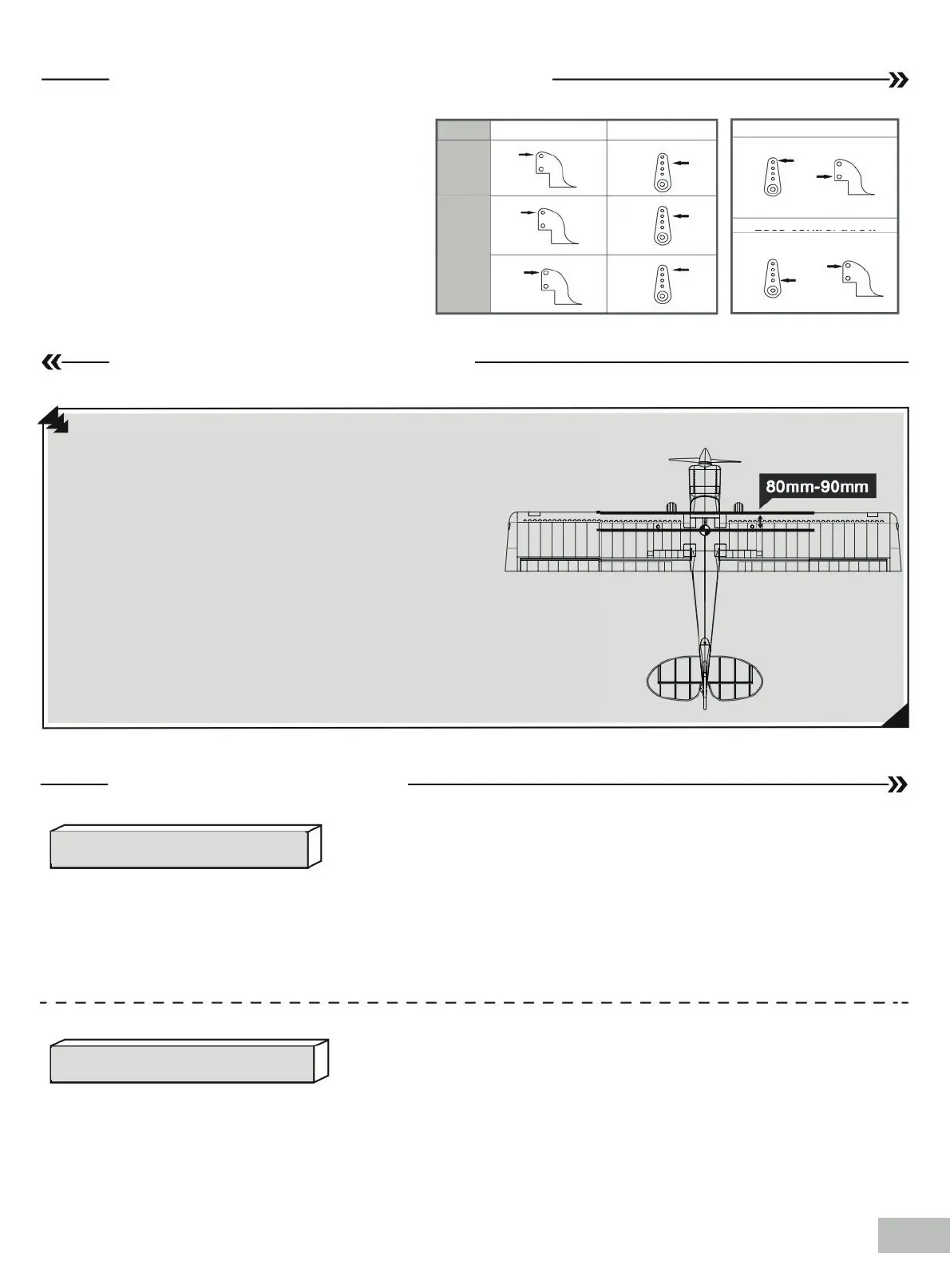
1. The table shows the factory settings for the
control horns and servo arms. Fly the aircraft at
the factory settings before making changes.
2. After flying, you may choose to adjust the
linkage positions for the desired control
response.
Finding the correct center of gravity is critical in ensuring that the
aircraft performs in a stable and responsive manner. Please adjust
the weight distribution so the aircraft balances in the range stated on
the diagram.
• If you cannot obtain the recommended CG by moving the battery
to a suitable location, you can also install a counterweight to achieve
correct CG. However, with the recommended battery size, a
counterweight is not required. We recommend flying without
unnecessary counterweight.
• Depending on the capacity and weight of your choo-
sen flight batteries, move the battery forward or back-
ward to adjust the center of gravity.
Find a flying site clear of buildings, trees, power lines and other obstructions. Until you know how much area
will be required and have mastered flying your plane in confined spaces, choose a site which is at least the
size of two to three football fields - a flying field specifically for R/C planes is best. Never fly near
people - especially children, who can wander unpredictably.
A radio range check should be performed prior to the first flight of the day. This test may assist you in
detecting electronic problems that may lead to a loss of control- problems such as low transmitter
batteries, defective or damaged radio com- ponents or radio interference. This usually requires an assistant
and should be done at the flying site.
Control horn and servo arm settings
Finding the center of gravity
Before ying the model
Horns
Elevator
RudderAilerons
Arms
More control throw
Less control throw


 To Next Page