9. CLEANING AND CARING FOR YOUR STOVE
9.1 Exterior Maintenance
The stove surface is painted with heat-resistant paint. It is best kept clean by vacuuming with a soft brush
attachment or by wiping with a lint-free cloth.
Over a period of time, the painted surface may become slightly grey. A canister of touch-up ARTE
®
spray
paint should be available from your stove supplier. This can be applied - in accordance with the instructions
- in just a few minutes. When first firing, after touching up, the stove will give off a slight smell as the paint
cures. Make sure to ventilate the room well during this phase.
When performing maintenance on your stove, always pro-
tect yourself, using safety goggles and gloves
Thus, the more correct secondary combustion we create, the higher the temperatures and the fewer resi-
dues we leave (gases and micro-particles). The vast majority of secondary combustions however take place
on the upper part of the burner, near the flue exit. Therefore a large part of the increased temperature
immediately exits to the outside space via the flue draught rather than entering the combustion chamber.
ARTE
®
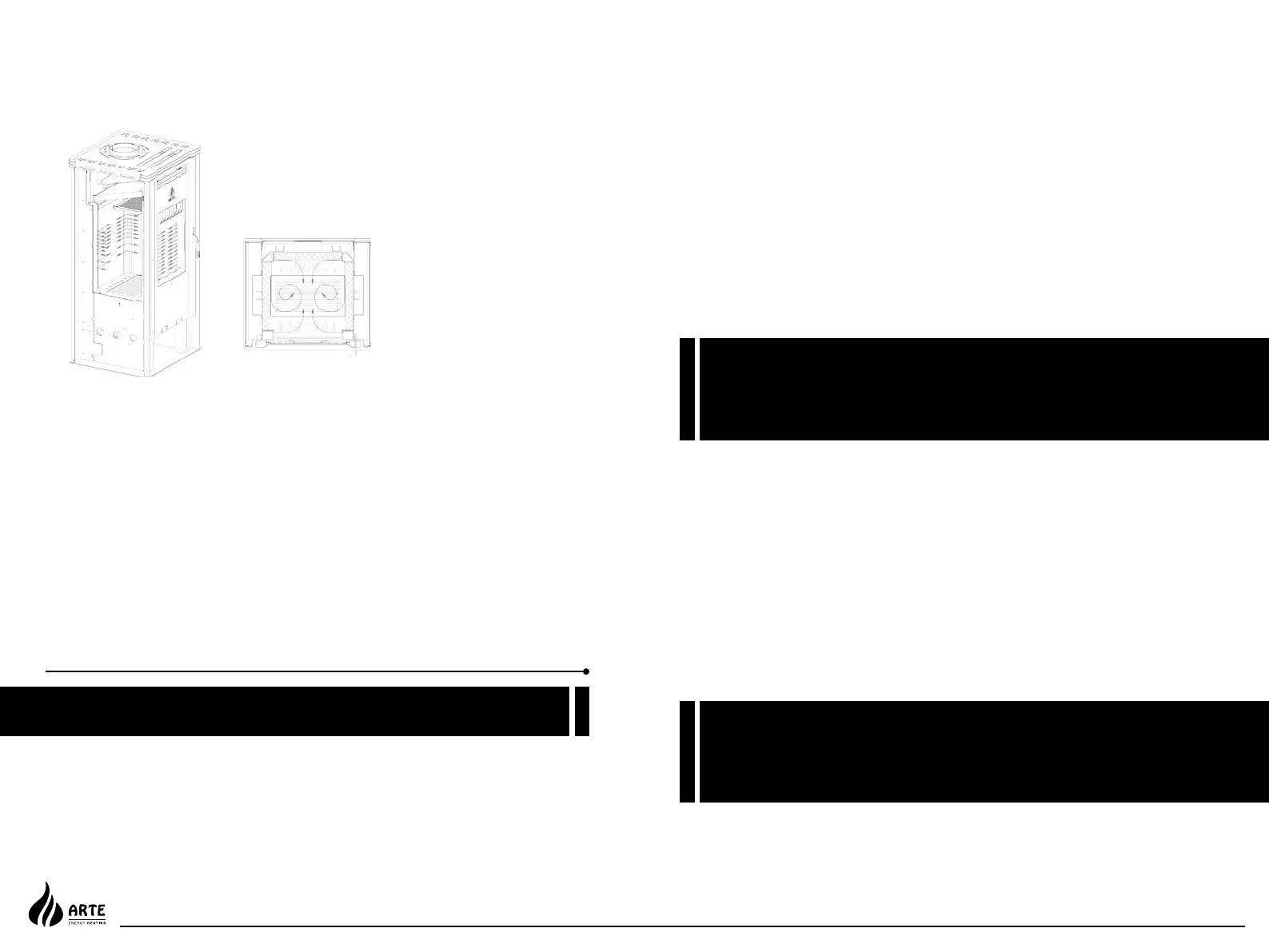
’s patented burner suc-
ceeds in providing us with op-
timum secondary combustion
performance. A system of regu-
lators and four vertical conductors
with apertures arranged in such a
way (Diagram 1 & Diagram 2) that
it allows throughout the length of
the conductors the right quantity
of pre-heated air to enter the hot
side of the combustion chamber
as well as the air-wash system
of the ceramic glass, permitting
the fire on each side of the burner
to receive the correct amount of
pre-heated oxygen.
Tertiary combustion
Tertiary combustion occurs with the correct and coordinated burning of the carbon and ash remaining under
the cast-iron grill. Carbon and ash contain large amounts of thermal energy, which when used provide a
large amount of heat. The correct arrangement of holes inside such a hot space places the remains in such
a way to lead to the almost complete burning of the material and the minimising of the ash which has col-
lected at the bottom.
Quaternary combustion
The stove has an innovative quartenary combustion process. As hot gases move towards the exit of the
combustion chamber they pass through a 3mm stainless mesh plate [diagram. 1]. When the soot and creo-
sote particles which have escaped the secondary and tertiary come into contact with this extremely hot plate
they ignite. This means less fumes and greater heat for the space we are heating.
44 | 45
APOLLO WOOD STOVE
9.2 Internal maintenance
Ash disposal
Empty the ash pan on a daily basis or as needed. Ash allowed to build up towards the underside of the grate
will trap heat and could cause premature failure of the grate.
Empty the ash pan according to this procedure:
> Open the front door, and use a shovel or poker to stir excess ash through the ash slots in the grate down
into the ash pan
> Take out the ash pan, making sure to keep it level to avoid spilling ash
> Dispose the ash in a metal container with a tight fitting lid
> The closed container of ashes should be placed on a noncombustible floor or on the ground, well away
from all combustible materials, pending final disposal. If the ashes are disposed of by burial in soil or oth-
erwise locally disperded, they should be retained in the closed container until all cinders have thoroughly
cooled.
> Return the ash pan to its original position in the stove, and close the door
Glass
If the stove is generally run at the correct temperatures, there should be little or no dirt on the glass. If dirt
does settle during lighting, most will burn off as temperatures increase.
For normal cleaning, moisten a paper towel with warm water and add some ash from the burn chamber.
Rub it over the glass and then clean the glass with clean water. Dry it well.
For heavier deposits that will not cleaning, use glass-cleaner, applied when the glass is cold, in accordance
with the instructions. Never use abrasive cleaners on the glass surface.
Reasons for dirty glass
> Fuel too wet
> Logs too large or not split
> Combustion temperatures too low
If you need to replace the glass, it should be replaced with the high temperature ceramic class supplied by
ARTE
®
, contact your ARTE
®
dealer.
Never empty a stove in operation.
Never use your household or shop vacuum cleaner to remove ash
from the stove.
Always remove and dispose of the ash properly.
To reduce the risk of breaking the glass, avoid striking the glass or
slamming the door.
Replace broken glass immediately.
Do not operate your stove if the glass in the door is damaged.
Diagram 1
Diagram 2



 To Next Page