5. FIRE PROTECTION
Installation of a wood stove must be according to local codes and regulations in each country.
All local regulations, including those which refer to national and European standards, must be ob-
served when installing the product. The installation can only be put into use after it has been checked by a
qualified inspector. Contact your local building authorities before installing a new wood stove.
> Avoid touching the outside surfaces when the stove is operating. Every stove gets hot when fired: risk of
burning!
> It is prohibited to use the stove as a waste incinerator
> Do not burn, refused or painted wood
> Dispose of the ashes only after they have cooled completely
> Ash should be placed outdoors or be emptied in a place where it will not present a potential of hazard
> Inform your specialized dealer without delay of defect gaskets
> Do not use chemicals or fluids to start the fire
5.2 General safety instructions
> Never leave children alone or unattended at a burning stove
> Teach your children how to behave properly and operate safely the stove
5.3 Chimney safety instructions
The condition and functionality of your chimneys must be inspected by a chimney sweep or specialist before
the ARTE
®
wood stove is installed. (EN 13384-1 & EN 13384-2)
This will provide the optimal conditions for trouble-free heating.
5.3.1 Common chimney problems
> Retrofitting an old chimney: Frequently, old chimneys are too big for today’s wood stoves. That means
the amount of air they draw is not proportional to the amount of heat the stove produces. A too-big chim-
ney means you’ll burn more wood than you need, and likely spend more time than necessary on fire
maintenance. You’ll need to install a “liner” stovepipe within the chimney. It should run the entire length
of the chimney, and nowhere along its length should it be any bigger than the stove’s exhaust opening.
But -- before you go jamming pipe up the chimney -- you should know how the chimney was built, and
what sort of insulation it contains. The heat produced by a wood-burning stove is different from the heat
produced by an open fireplace, and your chimney may not be up to the task without some work.
> Setting the stovepipe to minimum height requirements: A short chimney may look nicer (though that’s a
matter of opinion), but it may not supply an optimal draft to the stove. Work with a professional to figure
out the right stovepipe height for your stove.
> Running too much horizontal stovepipe: A venting system works best when it’s vertical. Some hom-
eowners, rather than create chimney holes in the roof, run stovepipe out windows or through walls. But
this is a very bad idea.
> Running the stovepipe along an exterior wall: This isn’t a safety issue so much as an efficiency issue. The
stove will heat more of the house if the pipe travels up along an interior wall, so all the heat from the pipe
stays in the house.
> Creating too many twists and turns: Venting systems should be direct and straight. Twists and turns in a
stovepipe invite the buildup of creosote, and that raises the risk of fire.
5.4 Conduct during malfunctions - SHUTTING DOWN safely
In rare cases, also a pilot fire can fail to generate a draught in the flue.
You must then ask your chimney sweep for advice. On no account must you attempt to light a larger fire.
When smoke escapes from your stove, air the room immediately and contact your chimney sweep. You
should then refrain from firing your stove.
4. PACKAGING
ARTE
®
is dedicated to protecting the environment, using wherever possible recyclable and least possible
packaging materials without cutting corners on product transportation safety.
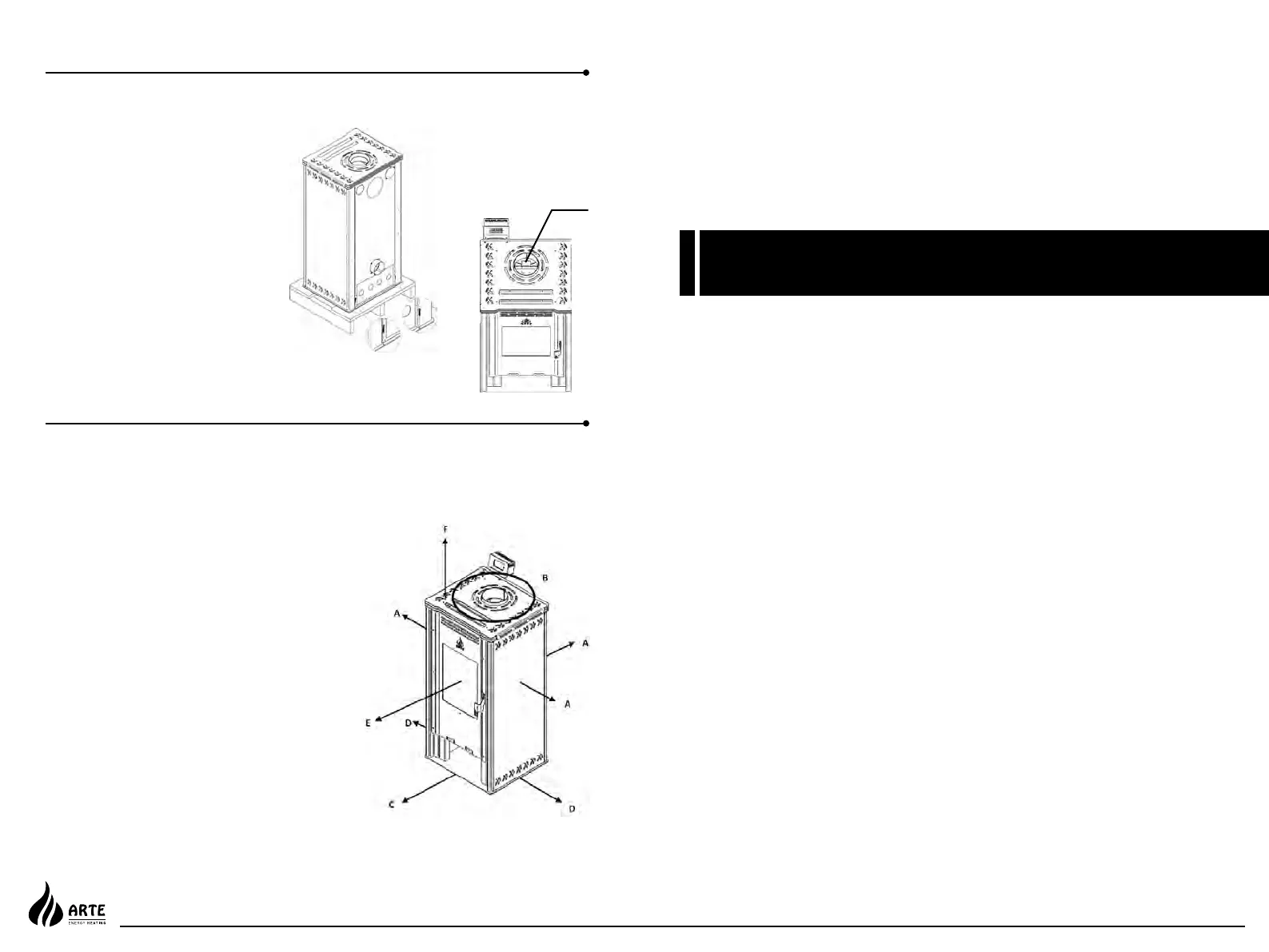
Unpacking
1. Remove the stretch film and the nylon
waterproofing. (be careful with sharp in-
struments)
2. Remove the polystyrene from the up-
per section of the clipper, taking off all
the other pieces inside the combustion
chamber and ash drawer.
3. Unscrew the screws (1) from the wood-
burning stove so as to free it from the
palette.
4. Carefully loft the stove off the palette and
place it where it is to be installed.
5.1 Safety distances
Safety distance A
The side and rear panels must be no closer than 25
cm to flammable materials e.g. furniture, cloths, etc.
Safety distance B
Smoke pipes must be no closer than 25 cm to flam-
mable materials
Safety distance C + D
Flammable floor materials must be no closer than
50 cm to the front and 30 cm to the sides
Safety distance E
Firing chamber apertures must be no closer than 80
cm to flammable materials within the radiation zone
Safety distance F
The minimum distance from the ceiling is 60 cm
Observe the information in our operating instructions and make
a proactive contribution to fire prevention and the protection of
our environment.
34 | 35
APOLLO WOOD STOVE
1
1
2
1. Screws
2. Wooden palette
Polystyrene



 To Next Page