42 | 43
BOX WOOD STOVE
9.3 Cleaning the Stove and the Flue
When wood is burned slowly, it produces tar and other organic vapors, which combine with expelled mois-
ture to form creosote. The creosote vapors condense in the relatively cool chimney flue of a slow-burning
fire. As a result, creosote residue accumulates on the flue lining. When ignited this creosote makes an
extremely hot fire.
Check for soot above the baffle plate and around the flue outlet every month or so to start with. If the stove
suddenly becomes sluggish, check for a soot fall around the flue collar or in the flue/chimney.
Clean the flue/chimney - all the way from the stove to the flue terminal point above the house.
A good routine is to clean the flue after each heating season in any case, and inspect prior to the season to
ensure that bird’s nests or other blockages have not occurred during the off season.
Chimney sweeping
Inspect the system regularly during the heating season as part of a regular maintenance schedule.
To inspect the chimney, let the stove cool completely. Then, using a mirror, sight up through the flue collar
into the chimney flue. If you cannot inspect the flue system in this fashion, the stove must be disconnected
to provide better viewing access.
Clean the chimney using a brush the same size and shape as the flue liner. Run the brush up and down
the liner, causing any deposits to fall to the bottom of the chimney where they can be removed through the
clean-out door.
Clean the chimney connector disconnecting the sections, taking them outside, and removing any deposits
with a stiff wire brush. Reinstall the connector sections after cleaning, being sure to secure the joints be-
tween individual sections with sheet metal screws.
If you cannot inspect or clean the chimney yourself, contact your local ARTE
®
Dealer or a professional chim-
ney sweep.
If you do experience a chimney fire, act promptly and:
> Close the air control.
> Get everyone out of the house.
> Call the Fire Department.
Annual maintenance
Before the heating season, perform a thorough cleaning, inspection and repair:
> Thoroughly clean the chimney and chimney connector.
> Inspect the chimney for damage and deterioration. Replace weak sections of prefabricated chimney.
Have a mason make repairs to a masonry chimney.
> Inspect the chimney connector and replace any damaged sections.
> Check gasketing for wear or compression, and replace if necessary.
> Check the glass for cracking; replace if needed.
> Check door and handle for tightness. Adjust if needed.
How to clean the inside parts of ARTE
®
When cleaning the inside parts of the stove in connection with the annual visits from your local chimney
sweep we recommend that you remove the inside parts from the fire chamber. Please be careful as the
vermiculite parts are porous thus fragile. (Chapter 9.4)
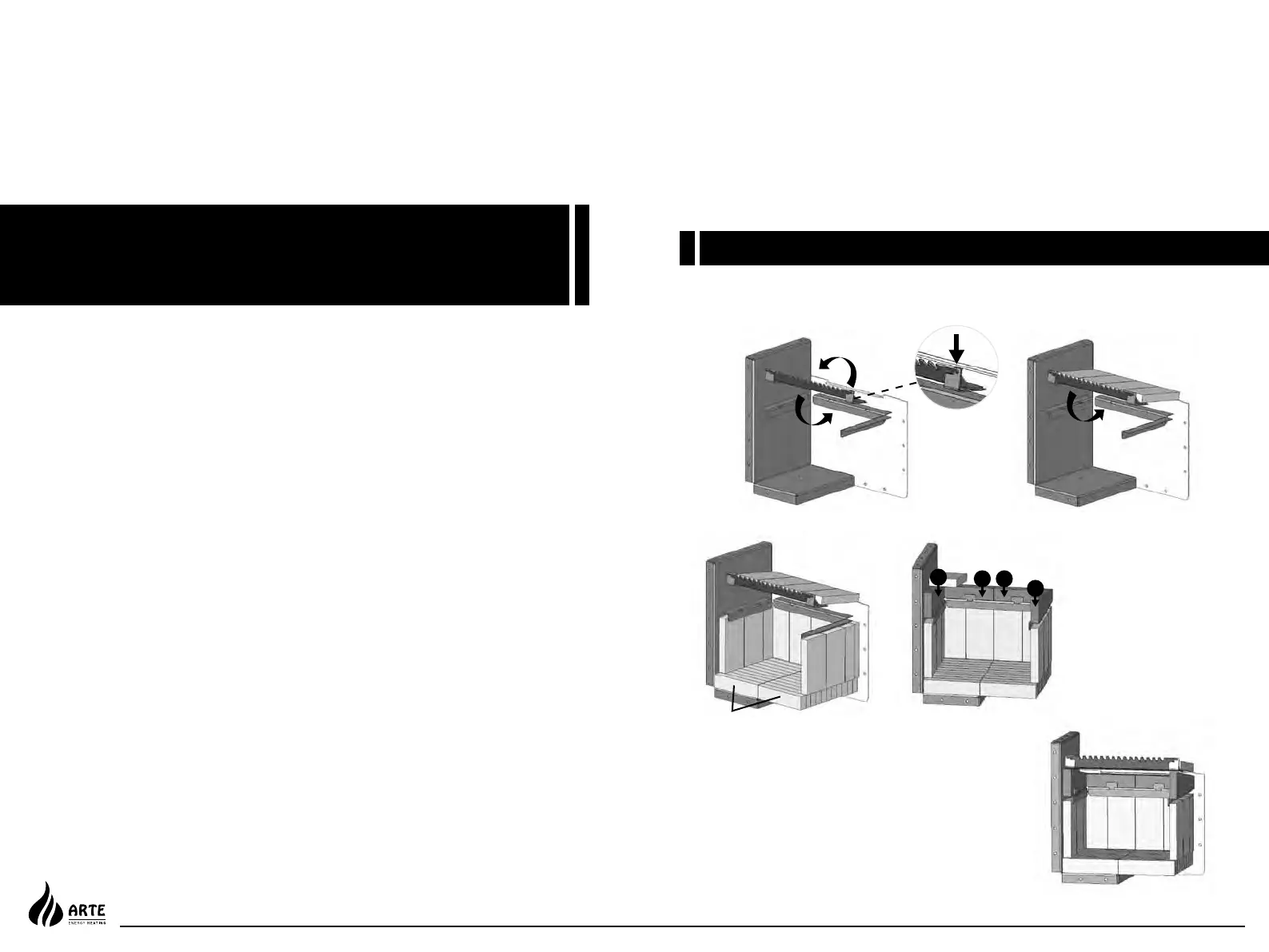
9.4 Inside parts
The chimney and chimney connector should be inspected
at least once every two months during the heating season
to determine if a creosote buildup has occurred. If creosote
has accumulated, it should be removed to reduce the risk of
a chimney fire.
Cleaning of the stove must be done when the stove is cold.
Final installation:
Chamotte firebricks 24 pcs 220x55x30
Chamotte firebricks 12 pcs 220x110x30
Vermiculite 2 pcs 305x105x30
Vermiculite 2 pcs 195x50x30
9
8
6
2
2 3 4 5
3
11
1(x22pcs)
10
7
A
C D
B
Fig. 6
Fig. 8 Fig. 9
Upper refractory plates
Refractory plates:
Follow the installa-
tion sequence
Fig. 10
Fig. 7


 To Next Page