30 | 31
BOX WOOD STOVE
2.3 Storing Your Wood
The full potential for heat will not be realized if you neglect the simple chore of piling and protecting your
wood. Proper storage is essential to avoid moisture, bacteria, and insect problems in your home.
To avoid problems with insects and moisture, store the wood as far from your house as is practical. Do not
store wood in your basement; one cord of wood can give off more than 500 liters of water. The basic rule is
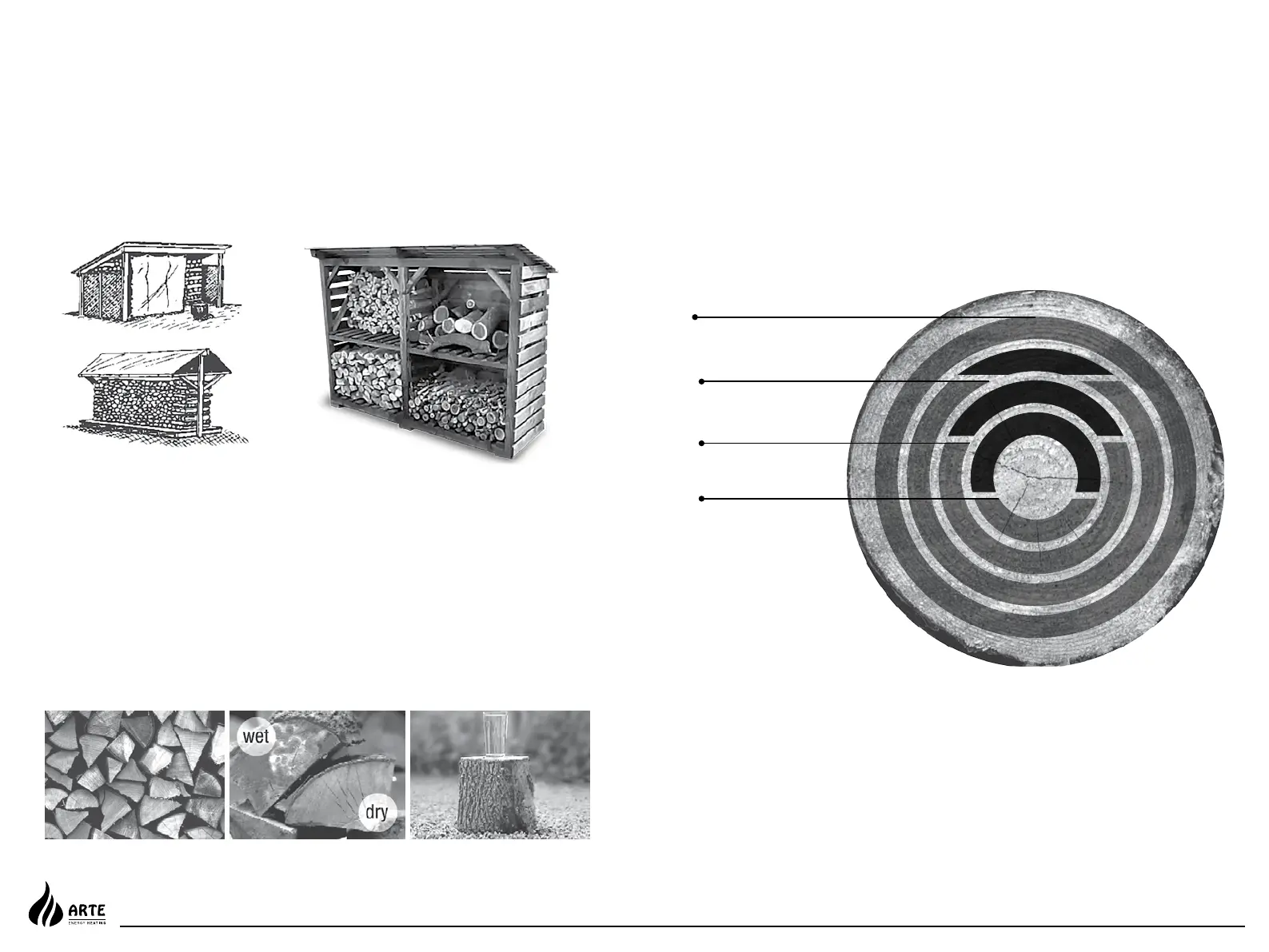
to hide the wood from water, but not from the sun or wind (Figs. 1 & 2). Green wood will dry slowly or not at
all if unprotected, while seasoned wood left unprotected may become unseasoned.
There are three basic rules to follow when storing wood:
1. Allow air circulation by piling one tier wide if possible
2. Protect wood from rain and snow by covering with a tarp or woodshed roof
3. Pile wood off the ground on scrap lumber or wooden pallets
The time-honored way to cure wood is to buck, split, and stack wood off the ground for one full year. How-
ever, wood can generally be reduced to 20 per cent moisture content in two to three months. The ideal 10%
to 15% may take longer (almost 18 months).
Fig. 1 Fig. 2
2.4 Wood types and calorific value
A wood’s efficiency does not depend only on its type, but also on its humidity, as well as the temperature of
the combustion chamber.
For more efficient and longer burning, without emission of hazardous substances, woods must be dry. Ide-
ally, their humidity percentage must not exceed 10% to 15%.
If this percentage is over 20%, the wood is not burned properly, whereas if the piece of wood has been cut
recently, the humidity is over 60% making it unsuitable for burning. The reason for that is that the fire will
be weak and pale and will produce dense smoke, unburned tar and creosote, soiling the ceramic glass and
the smoke duct.
It is preferable to get your wood supplies during the summer months and store them, to ensure better
combustion quality during the winter.
Useful tips
1. Always choose dry firewood
2. Avoid wood that pops (chestnut, conifers such as cedar, spruce and pine), as they may damage your
fireplace or the smoke duct
3. Pay attention to the size of the woods. Good firewood must have been cut at least twice
4. You should prefer oak, beech, olive wood, hard wood with high density since they will burn for longer
Briquettes
They ignite very easy, and burn slowly. They are economically advantageous because you will burn smaller
quantities compared to common firewood and they are easily stored. Also, you have less quantity of ashes
vs. to wood.
0% humidity
10% humidity
30% humidity
50% humidity
100% thermal efficiency
88% thermal efficiency
63% thermal efficiency
39% thermal efficiency


 To Next Page