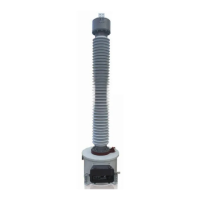
This document serves as a user manual for High Voltage Instrument Transformers manufactured by Arteche, specifically covering the CA (Current Transformers), UT (Inductive Voltage Transformers), and KA (Combined Transformers) series.
Function Description
These instrument transformers are designed for safe and accurate measurement of high voltages and currents in electrical systems. They isolate the high voltage/current circuits from the measurement and protection circuits, allowing standard measuring instruments and relays to operate safely at lower voltage and current levels. The active parts of the transformers are housed within a metal enclosure, with current transformers typically having their active parts in the upper section and voltage transformers in the lower section. The internal insulation relies on layers of paper impregnated with dielectric oil, hermetically sealed within the unit. Variations in oil volume due to temperature changes are compensated by stainless steel compensators located in the upper enclosure, with a visible indicator showing their position. Secondary terminals for windings are located in a terminal box at the base of the transformer. All metal components are treated for rust protection, and fasteners are made of stainless steel.
Important Technical Specifications
The manual applies to the following models:
- Current Transformers (CA Series): Models CA-36..800.
- Inductive Voltage Transformers (UT Series): Models UTx-52..525.
- Combined Transformers (KA Series): Models KA-36..245.
Weight and Handling:
- KA, CA (>1,600 kg): Handled by hooking the device with four slings through four holes at the base. An additional sling fixed at head height is used to prevent swinging. The center of gravity for CA models is very high, while for UT models it is very low.
- KA, CA (<1,600 kg) and UTx-420..525: Handled by hooking the device with two slings through two eyebolts on both sides of the head or intermediate body.
- The total weight of the transformer is indicated on the nameplate.
Electrical Connections:
- Primary Connections: Common connector materials are copper and aluminum, potentially with tin or silver coating to prevent galvanic corrosion. Contact surfaces should be cleaned (soft cloth for copper, metal brush/sandpaper for aluminum) and impregnated with contact grease. Tightening must be done with a torque wrench according to specified values (e.g., 30 Nm for insulator fixing, 30-40 Nm for primary reconnection taps). Excessive torque can damage connectors.
- Secondary Connections: Located in a terminal block within the terminal box.
- Current Transformers (CA) and Current Secondaries of Combined Transformers (KA): Any unloaded secondary must be short-circuited and grounded. Open-circuit secondary terminals can reach dangerous values.
- Voltage Transformers (UT) and Voltage Secondaries of Combined Transformers (KA): Any unloaded secondary must be left open and grounded at a single point. Short-circuited secondaries can reach dangerous values.
- Secondary windings must be connected to earth through one of their terminals, preferably in the secondary terminal box. For intermediate taps, the common terminal must be grounded.
- Screws for cable gland cover, block cover, and terminals must be tightened to specified torques (e.g., 12 Nm for secondary terminals, 20 Nm for terminal block cover).
- Grounding: The transformer's ground terminal must be solidly connected to the ground network, capable of carrying fault current. The connection should be tightened correctly and contact surfaces clean.
- Low Voltage (Neutral) Terminal of Voltage Primary Winding: Must always be grounded when the transformer is in service (not applicable for CA).
- Tangent Delta Measurement Tap: If present, must always be grounded when the transformer is in service. If removed, it must be reconnected following specific steps, including cleaning threads, applying contact grease, and tightening screws to specified torques. Resistance measurement between the link and CT base should be below 0.3 ohm.
Insulation:
- Internal insulation consists of oil-impregnated paper.
- Dielectric dissipation factor (tanδ) values are typically less than 0.5%. Field testing of tanδ may vary from factory results due to test equipment, voltage level, thermal conditions, and induced voltages.
Usage Features
- Qualified Personnel: Only qualified staff should perform maintenance, commissioning, or operation.
- Documentation: Users must read the instruction manual and other documentation before installation, commissioning, and maintenance.
- Operating Conditions: Equipment must be used within the guidelines specified in the manual and relevant documents.
- Malfunction Reporting: In case of malfunction, immediately contact Arteche, providing product nameplate information (name, serial number, type, date of manufacture) and a detailed description of the problem with supporting photos/videos.
- Oil Compensator: A highly visible indicator shows the compensator position. If the indicator is hidden, the device cannot be connected to the network, and Arteche must be informed. Some transformers have mechanical protection for the compensator that must be removed before installation.
- Mounting: Ensure all four legs sit perfectly on the platform before tightening anchor screws. Correct any defects by wedging metal plates to prevent insulator breakage or oil leakage.
- Primary Ratio Change: For CA and KA models, primary ratio changes can be made at one or both primary terminals. The position and torque of links are indicated on diagram plates. Verify the primary connection matches the operating current before commissioning.
Maintenance Features
Arteche instrument transformers are designed to require no active maintenance, as they have no moving parts or components susceptible to wear and tear. However, the manual suggests several inspection and monitoring points, which are typically part of a general substation maintenance program:
Inspection Points (Suggested):
- Physical Inspection:
- Mechanical: Check for signs of impact, damage, or loose parts.
- Electrical: Verify the correct state of electrical connections.
- Oil: Look for oil leaks and check the oil level. Oil stains are not necessarily leaks but could be manufacturing residues; clean with degreaser and observe. If stains reappear, contact the manufacturer.
- Dielectric Tests:
- Electrical Insulation Evaluation: Refer to Annex III for test procedures.
- Oil Tests:
- Oil Samples Analysis: Analyze insulating liquid properties to detect paper deterioration, overheating, or electrical faults. Follow Arteche's oil sampling manual. Replenish extracted oil with the same amount.
- Thermographic Testing:
- Use thermographic cameras to detect hot spots, especially at primary terminal connection points. If hot spots are found, check connector integrity and tightness.
Tests Program (Recommended Schedule):
- On arrival at warehouse/substation: A1 (Packaging check).
- After unpacking: A2, A3, A4, A6, C2 (Insulator, Primary Terminals, Secondary Terminal Box, Metal Parts, Oil Stains/Leaks check).
- During assembly: A2-A6, B1-B6, C1-C2, D2-D3 (Comprehensive checks including connections, grounding, insulation resistance, ratio test).
- After energizing: A7, B7, C1, C2, F1 (Unusual behavior, Readings, Oil Level, Thermographic analysis).
- Routine checks (weekly/monthly): A2, A7, B7, C1, C2.
- Annual check: A2-A7, B1-B7, C1-C2, F1.
- Every five years: Same as annual + D1 (PF/DDF/tgδ test).
- After re-connections/load changes: A7, B1-B2, B3-B7, F1.
- After fault conditions/short circuits: A3, A7, B1-B7, C1-C2, D1.
- After 1 year from start-up, then after 5 years, then every 5 years (if values are normal): E1-E4 (Oil visual aspect, water content, PF/DDF/tgδ at 90°C, DGA).
Careful Check of the Transformer:
- Repeat all regular tests after approximately 20 years of operation or after a major network disturbance (e.g., short circuit with high current/duration, over-voltages).
Quick Troubleshooting Guide:
- Oil stains: If from manufacturing, clean and observe for 24 hours. If persistent, contact Arteche. If from loose junctions, tighten screws/bolts, clean, and observe. If persistent, contact Arteche.
- Oil level indicator not visible: If stuck, remove top cover and clear blockage. If due to leakage/overpressure, remove service transformer and contact Arteche.
- Cracks in resin parts: Contact Arteche.
Insulation Resistance Measurement:
- Performed to check insulation integrity. Values above 200 MΩ are generally expected for new equipment.
- Caution: Do not test at voltages above 3 kV AC or 1 kV DC. Do not test for more than one minute, as frequent repetition can damage internal insulation.
- Current Transformers (CA):
- Primary vs. Secondary + Ground (P/S+G): Connect measuring equipment line cable to short-circuited P1/P2 primary terminals. Connect ground wire to short-circuited secondary wires and equipment base. Guard wire to porcelain insulator if used.
- Secondaries vs Ground (S/G): Disconnect P1/P2 primary terminals. Connect line cable to short-circuited secondary terminals. Connect ground cable to equipment base.
- Between Secondaries (S/S): Applicable for transformers with >1 secondary. Disconnect P1/P2 primary terminals. Connect secondaries to be assessed to line cable and ground cable of measuring equipment. Repeat for each secondary.
- Inductive Voltage Transformers (UT):
- Primaries vs. Secondaries + Ground (N/S+G): Connect measuring equipment line cable to short-circuited A-N primary terminals. Disconnect N* grounding plate from primary winding. Connect ground cable to short-circuited secondary terminals, secondary terminal block ground terminals, and tank.
- Secondaries vs Ground (S/G): Disconnect primary terminal A. Ground N* primary winding. Connect line cable to short-circuited secondary terminals. Connect ground cable to tank.
- Between Secondaries (S/S): Applicable for transformers with >1 secondary. Disconnect primary terminal A. Ground N* primary winding. Connect secondaries to be assessed to line cable and ground cable of measuring equipment. Repeat for each secondary.
Transformer Ratio Test (TTR):
- Measures ratio, excitation current, and polarity. Values serve as a reference for good condition.
- Current Transformers: Excite on the secondary side. Connect TTR clamps "X" to transformer's primary terminals (X1 to main CT terminal, X2 to other primary terminal). Connect TTR clamps "H" to transformer's secondary terminals (H1 to positive polarity terminal, H2 to negative polarity terminal). Short-circuit remaining secondaries.
- Inductive Voltage Transformers: Excite on the primary side. Connect TTR clamps "H" to transformer's primary terminals (H1 to primary terminal A, H2 to ground terminal at base). Connect TTR clamps "X" to transformer's secondary terminals (X1 to 1S1 or specific tap, X2 to end of secondary terminal). Test each secondary separately; leave untested secondaries open.

 Need help?
 General

 To Next Page