Need help?
Do you have a question about the Arteche DFK-245 765 Series and is the answer not in the manual?
Emphasizes qualified personnel, reading manuals, and adherence to safety warnings.
Instructions for safe transportation, packaging, and securing the equipment during transit.
Safety precautions and proper methods for handling the transformer during movement.
Steps for correctly mounting the transformer on its designated platform, checking alignment.
Procedures for assembling transformers composed of multiple capacitor units.
Guidance on connecting primary terminals, materials, cleaning, and torque specifications.
Instructions for connecting secondary wires, terminal box handling, and grounding.
Procedures for proper grounding of the transformer, including primary and high-frequency terminals.
The Arteche DDB/DFK DDN/DFN series comprises high-voltage instrument transformers, specifically capacitive voltage transformers and coupling capacitors, designed for safe and reliable operation within electrical grids. These devices are insulated by oil-paper and are intended for use by qualified personnel only, adhering strictly to the provided instruction manual and safety precautions.
The primary function of these devices is to accurately transform high voltages to lower, measurable levels for metering, protection, and control applications in high-voltage systems. Capacitive voltage transformers (CVTs) achieve this by utilizing a capacitive voltage divider in conjunction with an electromagnetic unit (EMU). The capacitive divider steps down the high voltage in stages, and the EMU further reduces it to the required secondary voltage, while also providing compensation for phase and magnitude errors. Coupling capacitors (CCs), on the other hand, function primarily as capacitive voltage dividers without the electromagnetic unit, often used for power line carrier (PLC) communication or as voltage sources for certain applications.
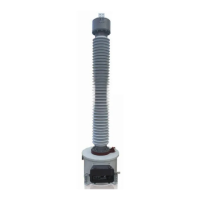
The capacitive voltage transformers consist of one or more capacitor units mounted on a tank. This tank houses the electromagnetic unit, compensation reactance, and other auxiliary elements. The tank also features a box for secondary terminals and adjustment compensations, protected by a sealed cover. Oil volume variations within the capacitor units are managed by metal diaphragms located at the top of each unit, ensuring hermetic sealing. The oil level in the inductive part (tank) is monitored by a direct indicator. Coupling capacitors share similar characteristics with CVTs but omit the electromagnetic unit.
The DDB/DFK DDN/DFN transformers are designed for vertical installation and must be handled with care to prevent damage. During transport, they are shipped in wooden boxes, with capacitor units disassembled and anchored to the base, except for the lower unit which is attached to the tank. Proper attachment to the packaging is crucial to prevent movement. Unpacking involves removing the top and sides of the box, and for single capacitor units, loosening screws that join the unit to the base. For multiple capacitor units, only the screws connecting the unit to the packaging base should be loosened before lifting. Slings should be attached to the upper flange of the insulator for single units, or to the upper flange/eyebolts of the cover for other capacitor units, to prevent tipping.
Installation on a structure or platform requires verifying that the electrical characteristics match the system and ensuring all four legs are perfectly placed before tightening anchor bolts. If not, shims or metal plates should be used to correct any defects to prevent insulator breakage or oil leakage. For multi-unit transformers, assembly involves placing the lower capacitor unit first, then intermediate units, and finally the upper capacitor unit. Protective covers are removed, and nuts are kept for subsequent attachment. Electrical connections between capacitor units must be made, and serial numbers should match. The grounding switch for carrier accessories (if applicable) must remain closed.
Electrical connections involve primary and secondary circuits. Primary terminals, made of aluminum or copper, may have tin or silver coatings to prevent galvanic corrosion. Contact surfaces should be cleaned with a soft cloth (or brushed with stainless steel/sandpaper for unfinished aluminum/copper/brass) and impregnated with contact grease. Tightening must be done with a torque wrench to prevent damage or improper contact. Secondary connections are made in a terminal box, with unused secondary windings grounded at a single point. The secondary winding(s) must be earthed through one of its terminals, preferably in the terminal box itself. The low voltage terminal of the primary winding must always be grounded when in service. The high-frequency (HF) terminal must be firmly connected to the ground terminal of the housing, or to the carrier accessory block if present, with the grounding switch remaining closed when not in use.
Arteche instrument transformers are designed for minimal maintenance, lacking moving parts or components susceptible to wear and tear. However, some companies incorporate maintenance operations as part of general substation maintenance programs. These programs aim to assess insulation status and detect potential damage, rather than extending unit life.
A comprehensive inspection and monitoring program is suggested, including:
A detailed test program is provided, outlining checks to be performed at various stages: upon arrival, after unpacking, during assembly, after energizing, and during routine, annual, and five-year verifications. Specific checks include packaging integrity, insulator condition, terminal tightness, secondary circuit status, grounding, oil level, and dielectric properties.
A quick troubleshooting guide assists in identifying and resolving common issues. For instance, oil stains might be manufacturing residues (clean and observe) or loose junctures (tighten screws and observe). Cracks or damage to components, non-visible oil levels, or cracks in resin parts necessitate contacting Arteche and potentially removing the transformer from service.
The manual emphasizes that all operations and maintenance tasks must be performed by qualified personnel, strictly adhering to safety precautions to prevent physical damage, serious injury, or even death. ARTECHE disclaims liability for accidents caused by non-adherence to safety measures. Environmental considerations for disposal and oil spill management are also provided, stressing compliance with local legislation and proper handling of materials.
 General
| Brand | Arteche |
|---|---|
| Model | DFK-245 765 Series |
| Category | Transformer |
| Language | English |


 To Next Page