The provided document is an assembly and anti-tip installation guide for the ARTICLE. SENO 71" Sideboard.
Function Description
The SENO 71" Sideboard is a piece of furniture designed for storage and display, likely in a living room, dining room, or entryway setting. It features three compartments, each with a door, and is supported by legs. The "71" in its name suggests its approximate width in inches. As a sideboard, its primary function is to provide enclosed storage space, helping to keep items organized and out of sight, while its top surface can be used for displaying decorative items, lamps, or serving food.
Important Technical Specifications
Based on the assembly instructions, the sideboard includes:
- Dimensions: 71" width (implied by the product name). Other dimensions (height, depth) are not explicitly stated but can be inferred from the diagrams.
- Components:
- Legs (A): 4 pieces, indicating a four-legged support structure.
- Shelf Pins (B): 12 pieces, suggesting adjustable shelving within the compartments.
- Shelves (C): 3 pieces, one for each compartment.
- Materials: Not explicitly stated, but typical for sideboards would include wood, engineered wood, or a combination. The hardware includes metal shelf pins and various screws and brackets for assembly and anti-tip installation.
- Assembly Time: Approximately 15 minutes for the main assembly.
- Number of People for Assembly: 2 people are recommended for assembly, indicating that some steps might involve handling larger or heavier components.
- Difficulty: Rated as 1 (on an unspecified scale, but likely indicating low difficulty).
- Anti-Tip Installation: Required for safety. This involves specific hardware:
- Brackets (A): 4 pieces for attaching to the unit and the wall.
- M4 x 20mm Screws (B): 4 pieces for attaching brackets to the unit.
- M8 x 51mm Plugs (C): 4 pieces, likely wall anchors for drywall.
- M6 x 70mm Screws (D): 4 pieces for attaching brackets to the wall.
- Straps (E): 2 pieces to connect the unit to the wall brackets.
- Anti-Tip Installation Time: Approximately 20 minutes.
- Required Tools for Anti-Tip: 8mm / 5/16" drill bit and a screwdriver (implied by the diagrams).
Usage Features
- Storage: The sideboard offers three distinct storage compartments, each with a door, allowing for organized and concealed storage.
- Adjustable Shelving: The inclusion of shelf pins and shelves indicates that the internal shelves are likely adjustable, allowing users to customize the storage space to accommodate items of varying heights.
- Versatile Placement: While not explicitly stated, sideboards are typically used in dining rooms for serving and storing dinnerware, in living rooms for media or general storage, or in entryways for keys, mail, and other essentials.
- Door Adjustment: The manual provides detailed instructions for adjusting the doors, addressing common issues like crooked doors or doors that need side-to-side or forward/backward alignment. This feature ensures proper functionality and aesthetic appeal over time.
Maintenance Features
- Door Adjustment: The "Door Adjustment Instructions" section is a key maintenance feature. It guides users on how to correct door alignment issues that may arise due to shipping or regular use. This includes:
- Crooked Door Adjustment: Adjusting hinges up or down to level the door.
- Side-to-Side Adjustment: Adjusting hinges to move the door horizontally.
- Forward/Backward Adjustment: Adjusting hinges to move the door in or out relative to the cabinet frame.
- The instructions emphasize starting with the top hinge for crooked doors and using a screwdriver (implied) for adjustments.
- Anti-Tip Restraint: The mandatory anti-tip installation is a crucial safety and maintenance feature. It prevents the furniture from tipping over, especially if heavy objects are placed on top or if children attempt to climb on it. This restraint system involves securing the unit to the wall using brackets, plugs, screws, and straps. The manual warns against placing heavy objects on top unless specifically designed for it and advises against allowing children to climb on the unit. It also notes that the provided hardware for wall attachment is designed for drywall and recommends consulting a local hardware store for other wall types.
- General Care (Implied): While not explicitly detailed in the provided pages, general furniture maintenance would typically involve regular cleaning with a soft, damp cloth, avoiding harsh chemicals, and protecting surfaces from spills and scratches. The instruction to "place all parts on a soft, clean, and flat surface such as a carpet to prevent scratches" during assembly also implies a need for careful handling to maintain the product's appearance.

 Need help?
 General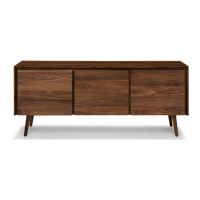

 To Next Page