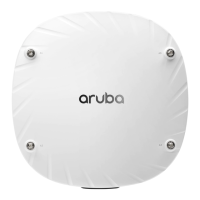
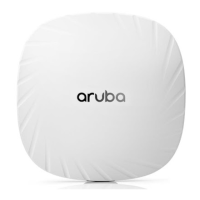
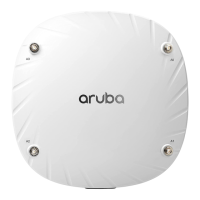
6 Aruba 555 Access Point| Installation Guide
phase is critical. Make sure that these sources are taken into consideration when you attach an access point to its
fixed location.
RF absorbers include:
Cement/concrete—Old concrete has high levels of water dissipation, which dries out the concrete, allowing
for potential RF propagation. New concrete has high levels of water concentration in the concrete, blocking
RF signals.
Natural Items—Fish tanks, water fountains, ponds, and trees
Brick
RF reflectors include:
Metal Objects—Metal pans between floors, rebar, fire doors, air conditioning/heating ducts, mesh windows,
blinds, chain link fences (depending on aperture size), refrigerators, racks, shelves, and filing cabinets.
Do not place an access point between two air conditioning/heating ducts. Make sure that access points are
placed below ducts to avoid RF disturbances.
RF interference sources include:
Microwave ovens and other 2.4 or 5 GHz objects (such as cordless phones)
Cordless headset such as those used in call centers or lunch rooms
Access Point Installation
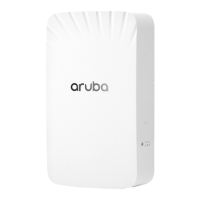
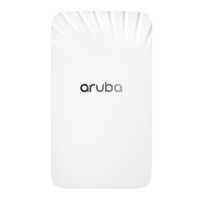
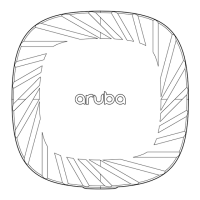
The Aruba 555 access points are designed for ceiling or wall-mounted deployments.
Software
The Aruba 555 requires ArubaOS or ArubaInstant 8.6.0.0 or later. For instructions on choosing operating modes
RF Radiation Exposure Statement: This equipment complies with RF radiation exposure limits. This equipment
should be installed and operated with a minimum distance of 13.78 inches (35cm) between the radiator and
your body for 2.4 GHz and 5 GHz operations. This transmitter must not be co-located or operating in conjunction
with any other antenna or transmitter.
Déclaration sur les limites d'exposition aux radiofréquences : cet équipement est conforme aux limites
d'exposition aux rayonnements radioélectriques spécifiées. Il doit être installé et utilisé à une distance minimale
de 35 cm par rapport à votre corps pour les fréquences de 2,4 et 5 GHz. Cet émetteur-récepteur ne doit pas être
utilisé ou situé à proximité d'autres antennes ou émetteurs-récepteurs.
All Aruba access points should be professionally installed by an Aruba-Certified Mobility Professional (ACMP).
The installer is responsible for ensuring that grounding is available and meets applicable national and electrical
codes. Failure to properly install this product may result in physical injury and/or damage to property.
Tous les points d'accès Aruba doivent impérativement être installés par un professionnel agréé. Ce dernier doit
s'assurer que l'appareil est mis à la terre et que le circuit de mise à la terre est conforme aux codes électriques
nationaux en vigueur. Le fait de ne pas installer correctement ce produit peut entraîner des blessures
corporelles et / ou des dommages matériels.
The installer is responsible for securing the access point onto the ceiling tile rail in accordance with the steps
below. Failure to properly install this product may result in physical injury and/or damage to property.
Use of accessories, transducers and cables other than those specified or provided by the manufacturer of this
equipment could result in increased electromagnetic emissions or decreased electromagnetic immunity of this
equipment and result in improper operation.
For indoor use only. The access point, AC adapter, and all connected cables are not to be installed
outdoors. This device is intended for stationary use in partly temperature controlled weather-protected
environments (class 3.2 per ETSI 300 019)


 To Next Page