46
4 Using the Notebook PC
NOTE: The built-in modem and network cannot be installed later as an upgrade. After
purchase, modem and/or network can be installed as a PC card (PCMCIA).
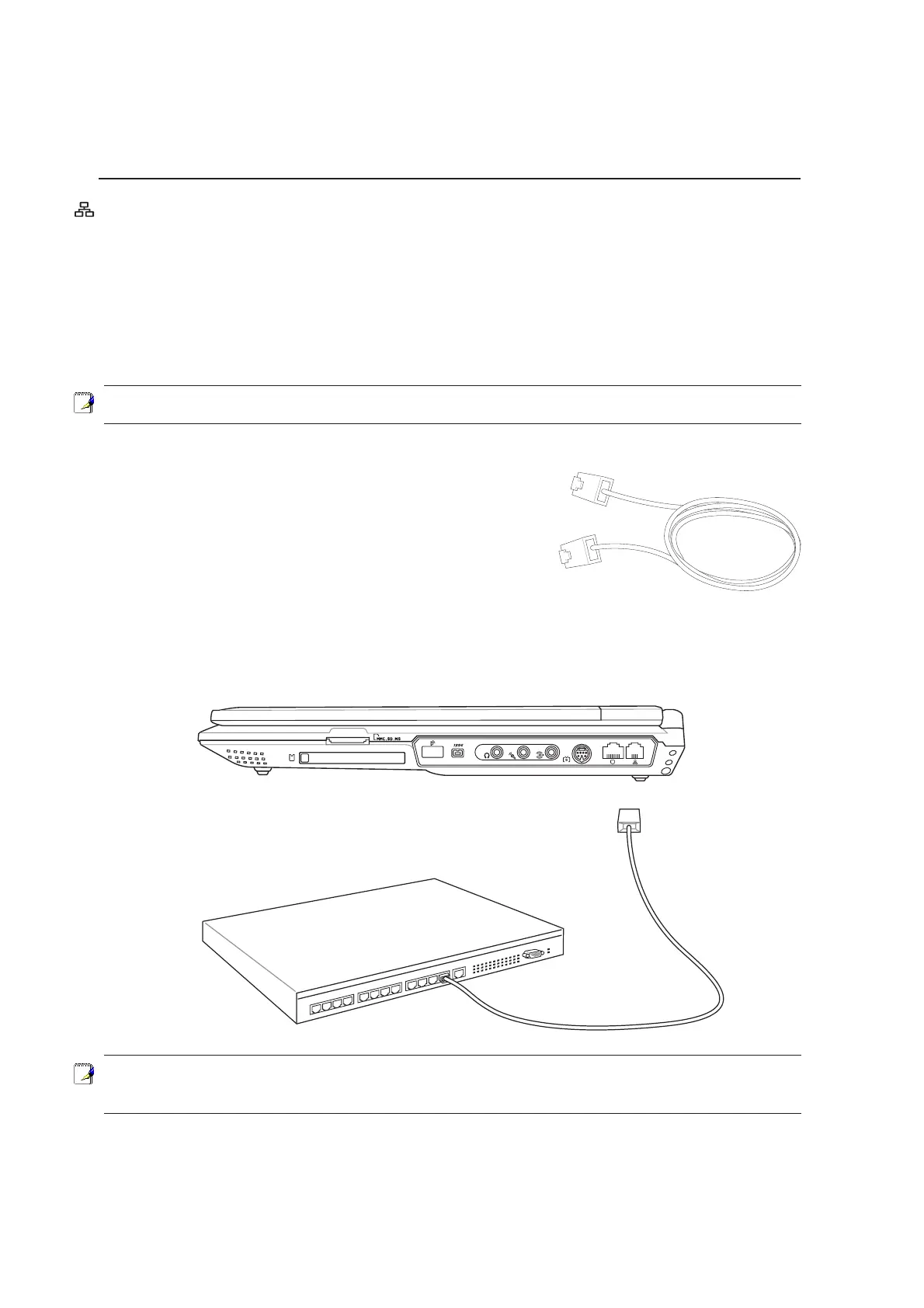
Example of the Notebook PC connected to a Network Hub or Switch for use with the built-in
Ethernet controller.
Network Connection
Connect a network cable, with RJ-45 connectors on each end, to the modem/network port on the Notebook
PC and the other end to a hub or switch. For 100 BASE-TX / 1000 BASE-T speeds, your network cable
must be category 5 or better (not category 3) with twisted-pair wiring. If you plan on running the
interface at 100/1000Mbps, it must be connected to a 100 BASE-TX / 1000 BASE-T hub (not a BASE-
T4 hub). For 10Base-T, use category 3, 4, or 5 twisted-pair wiring. 10/100 Mbps Full-Duplex is supported
on this Notebook PC but requires connection to a network switching hub with “duplex” enabled. The
software default is to use the fastest setting so no user-intervention is required.
1000BASE-T (or Gigabit) is only supported on selected models.
Twisted-Pair Cable
The cable used to connect the Ethernet card to a host (generally
a Hub or Switch) is called a straight-through Twisted Pair Ethernet
(TPE). The end connectors are called RJ-45 connectors, which
are not compatible with RJ-11 telephone connectors. If connecting
two computers together without a hub in between, a crossover
LAN cable is required (Fast-Ethernet model). (Gigabit models
support auto-crossover so a crossover LAN cable is optional.)
Network Hub or Switch
Network cable with
RJ-45 connectors
LAN connector is the
larger of the two.



 To Next Page