
 Need help?
Do you have a question about the Asus Notebook PC and is the answer not in the manual?
Introduction to the manual's structure and content.
Guidelines for proper care and maintenance to prolong notebook life.
Instructions for safe handling and transport of the notebook.
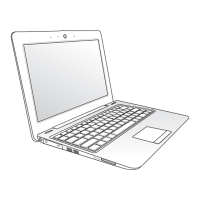
Identifies components on the top surface of the notebook.
Identifies components on the front edge of the notebook.
Identifies components on the left side of the notebook.
Identifies components on the right side of the notebook.
Identifies components on the rear side of the notebook.
Procedures for installing and removing the notebook battery.
Information on charging and using the notebook battery.
Overview of supported operating systems for the notebook.
Instructions for connecting the notebook to AC power.
Steps for turning on the notebook and understanding the boot process.
Explanation of the Save-to-Disk partition for hibernation.
Methods for restarting or rebooting the notebook system.
Procedures for safely shutting down the notebook.
Explains LED status lights and quick launch function keys.
Details on the notebook's CD control buttons and indicator light.
Details on using the notebook's keyboard, including hot keys.
Information on the included support CD for drivers and utilities.
Guide to using the integrated touchpad for cursor control.
Connecting external mice and keyboards to the notebook.
Information on the CD/DVD-ROM drive and its usage.
How to connect external monitors, TVs, and audio devices.
Information on PC Card slots for system expansion.
Connecting the notebook to telephone and network lines.
Details on managing AC and battery power for the notebook.
Explanation of system power saving features and modes.
Information on upgrading the notebook's system memory.
Information on the notebook's hard disk drive and its handling.
Methods for securing the notebook against theft.
Usage instructions for the optional vehicle/air power adapter.
Procedures for saving, updating, and managing BIOS software.
Guide to accessing and using the BIOS setup utility.
Configuration options for system time, date, and primary drives.
Settings for the primary IDE hard disk drive configuration.
Settings for the secondary IDE drive configuration.
Configuration options for advanced system features and devices.
Settings for serial, parallel, and IR ports.
Options for setting user and hard drive passwords.
Configuration of power saving features and modes.
Options for configuring the boot device sequence.
Information on modem compliance with international standards.
Definitions of technical terms used in the manual.
Section for recording personal and system information for reference.



 To Next Page


 General