238 Tires and wheels
Occupant loading and distribution for vehicle normal load for various designated seating
capacities
Designated seating capacity,
number of occupants
Vehicle normal load, number Occupant distribution in a nor-
of occupants _____ mally loaded vehicle
5
3 2 in fro nt, 1 in back seat
Cold tire inflation pressure
Tire pressure affects the overall handling, performance and safety of a vehicle.
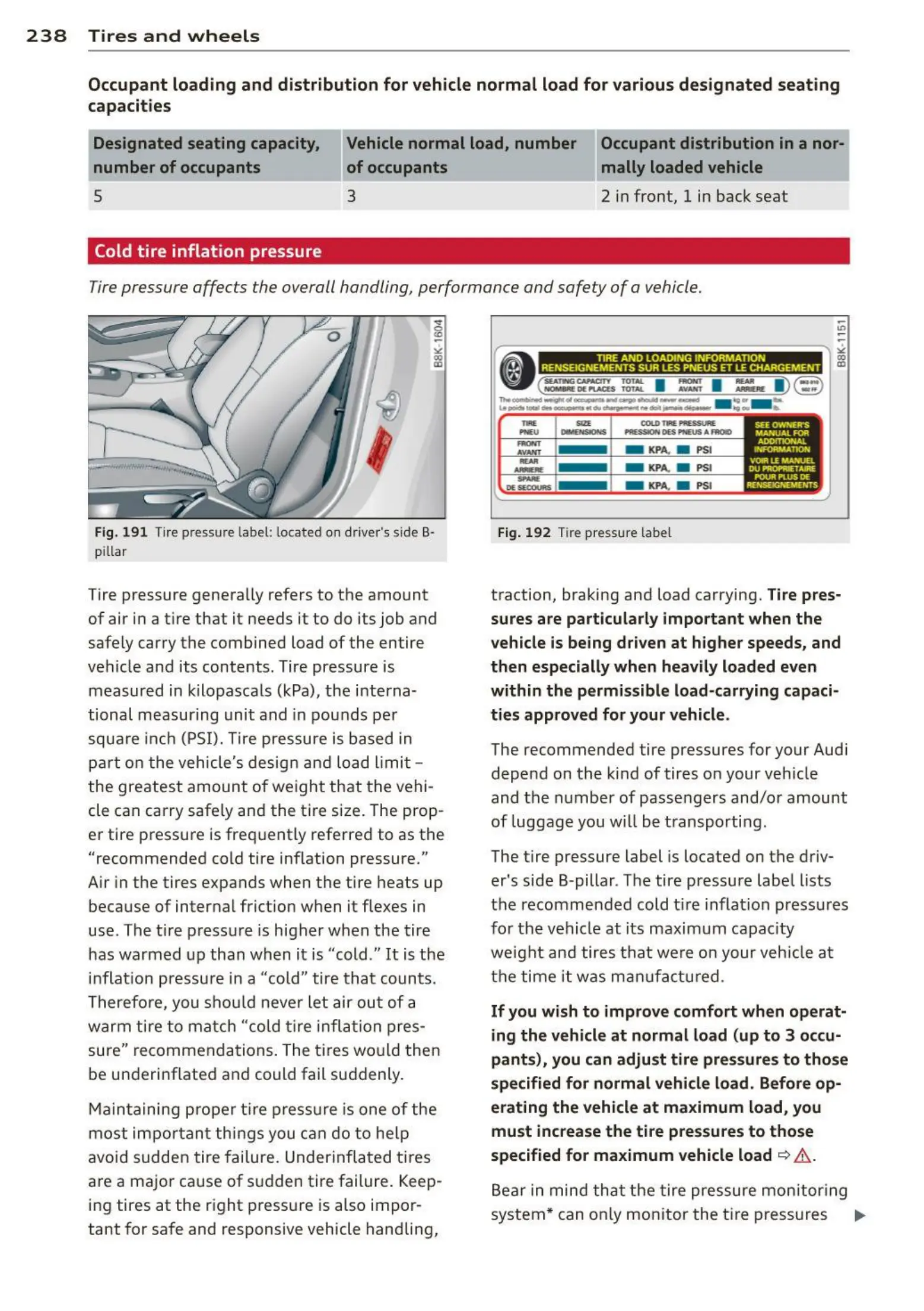
Fig. 19 1 Tire pressure label : located on driver's side B·
pillar
Tire pressure generally refers to the amount
of air in a t ire that it needs it to do its job and
safely carry the combined load of the entire
vehicle and its contents . Tire pressure is
measured in kilopasca ls (kPa), the interna·
tional measur ing unit and in pounds per
square inch (PSI). Tire pressure is based in
part on t he vehicle's desig n and load limit -
the greatest amoun t of weight that the vehi·
cle can carry safely and the t ire size. The prop·
er tire pressure is freq uently referred to as the
" recommended cold tire inf lation pressure."
Air in the tires expands when the tire heats up
because of internal frict ion when it flexes in
use. The t ire pressure is higher when the tire
has warmed up tha n when it is "cold ." It is the
inflat ion pressure in a "cold" tire that counts.
Therefore, you shou ld never let air out of a
warm tire t o match " cold ti re infl at ion pres-
sure" recommendations . The t ires wo uld then
be underinflated and could fail suddenly.
Maint aining proper t ire pressure is one of the
most im port ant th ings you can do t o help
avoid sudden t ire f ailure. Underin f lat ed t ires
are a maj or cause of sudden tire failure. Keep·
ing tires at the right pressure is also impor-
tant for safe and responsive vehicle handling,
-U'>
-
-
--------------------- ,;
• (=~= I : I ::... 1)§ :l!:
n-...,....,....,~ ...... ~-...,..., . .... _ ...
U ........ ~-·~N.-..-.we..... .... lllt-
-
AVANT
...,.
-
......
.. _
- KPA. a PSI
- KPA. a PSI
- KPA. a PSI
Fig. 192 Tire pressure labe l
SEE OWNEJICS
MANUA1 FOA
A,DOITl<>N.IU.
INfORMATlON
VOIR
L£ MANUll
DUPR0ftlET"""
P"OUR i-t.US DE
RENSEIGMEMENfS
traction, braking and load carrying. Tire pres-
sures are particularly important when the
vehicle is being driven at higher speeds, and
then especially when heavily loaded even
within the permissible load-carrying capaci-
ties approved for your vehicle .
The recommended tire pressures f or your Audi
depend on the kind of tires on your vehicle
and the numbe r of passengers and/o r amount
of luggage you w ill be t ransporti ng.
The tire pressure label is located on the driv-
er's side B-pillar . The tire pressure label lists
the recommended cold t ire inflat ion pressures
for the vehicle at its maximum capacity
weig ht and t ires t hat were on your vehicle at
t he time it was manufa ct ured.
If you wish to improve comfort when operat-
ing the vehicle at normal load (up to 3 occu-
pant s), you can adj ust tire pressures to tho se
specified for normal vehicle load . Before op-
erating the vehicle at maximum load, you
must increase the ti re pressures to those
specified for maximum vehicle load
~ ,&..
Bear in min d t hat t he tire pressure mon itor ing
system * can only monitor the t ire pressures .,.


 To Next Page