DL06 Micro PLC User Manual, 3rd Edition, Rev. E
5-160
Chapter 5: Standard RLL Instructions
1
2
3
4
5
6
7
8
9
10
11
12
13
14
A
B
C
D
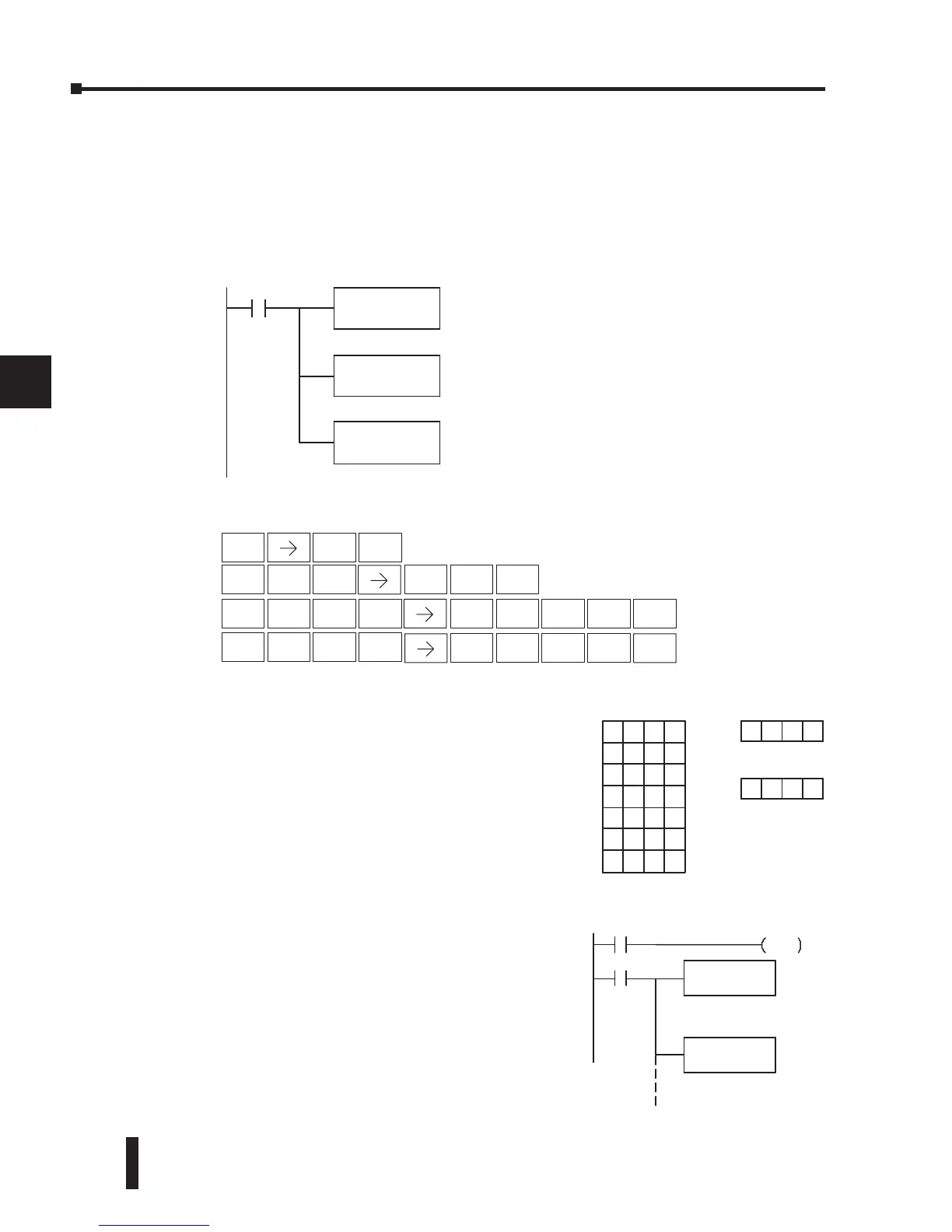
In the following example, when X1 is on, the constant value (K6) is loaded into the accumulator
using the Load instruction. This value specifies the length of the table and is placed in the first
stack location after the Load Address instruction is executed. The octal address 1400 (V1400)
is the starting location for the source table and is loaded into the accumulator. The destination
location (V1500) is specified in the Remove from Table instruction. The table counter will be
decreased by “1” after the instruction is executed.
DirectSOFT32 Display
LD
K
6
X1 Load theconstant value6
(Hex.) into thelower 16 bits
of theaccumulator
LDA
O 1400
RFT
V1500
Copy thespecifiedvalue
from thetabletothe
specifiedlocation(V1500)
Convertoctal 1400 to HEX
300 and load thevalue into
theaccumulator
Handheld Programmer Keystrokes
STR
$
SHFT
ANDST
L
3
D
SHFT
ORN
R
5
F
MLR
T
PREV
1
B
ENT
6
G
0
A
0
A
ENT
SHFT
ANDST
L
3
D
1
B
4
E
0
A
ENT
0
A
1
B
5
F
0
A
ENT
V1401
050 0
V1402 999 9
V1403
307 4
V1404
898 9
V1405
101 0
V1406
204 6
V1407
XXX X
S
0
PD
Load theconstant value6
(HEX) into thelower 16 bits
of theaccumulato
r
LDA
O1400
Conver toctal 1400 to HEX
300 and load thevalue into
theaccumulator. This is the
table pointer location
.
DirectSOFT
Since the table counter specifies the range of
data that will be removed from the table, it is
important to understand how the table locations
are numbered. If you examine the example table,
you’ll notice that the data locations are numbered
from the top of the table. For example, if the table
counter started at 6, then all six of the locations
would be affected during the instruction execution.
Also, our example uses a normal input contact
(X1) to control the execution. Since the CPU
scan is extremely fast, and the pointer decrements
automatically, the data would be removed from
the table very quickly. If this is a problem for your
application, you have an option of using a one-
shot (PD) to remove one value each time the input
contact transitions from low to high.


 To Next Page