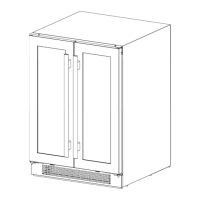
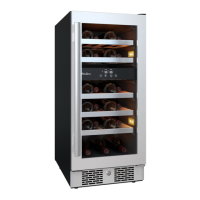
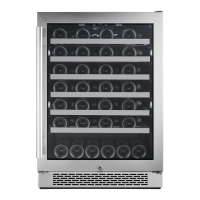
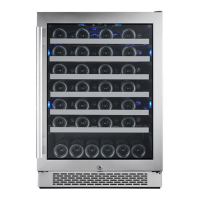
This document is the owner's manual for the Avallon AWBC242GGFD Undercounter Wine and Beverage Refrigerator. It provides comprehensive instructions for installation, operation, maintenance, and troubleshooting, ensuring safe and efficient use of the appliance.
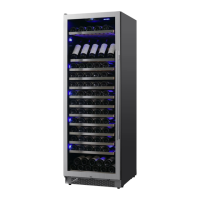
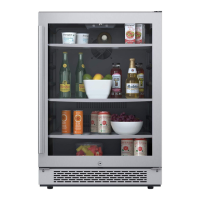
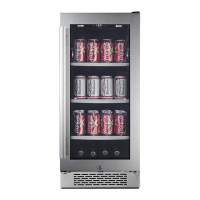
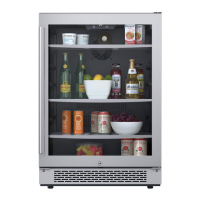
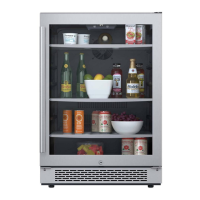
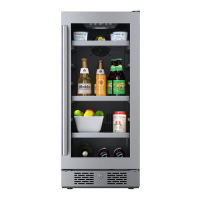
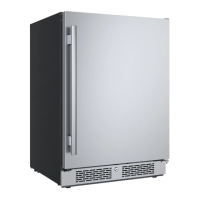
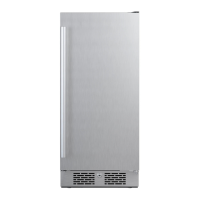
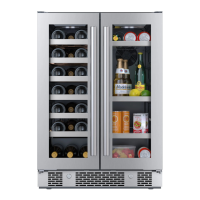
The Avallon AWBC242GGFD is an undercounter wine and beverage refrigerator designed for domestic indoor use. It features two distinct temperature zones: a right (beverage) zone with a temperature range of 34°F to 65°F, and a left (wine) zone with a temperature range of 40°F to 65°F. This dual-zone capability allows for optimal storage of both wines and various beverages at their ideal temperatures. The unit is equipped with a stainless steel door and a black cabinet, offering a sleek and modern aesthetic suitable for various kitchen or entertainment area designs. A front vent ensures proper air circulation, and leveling legs allow for stable installation on uneven surfaces. The refrigerator also includes a door lock for security.
For internal organization, the unit features shelves for storing wine bottles and beverage cans. A built-in carbon filter helps protect contents from harmful odors by acting as a natural barrier. This filter should be replaced every 3-6 months, with more frequent replacement (every 3 months) recommended if the unit is placed in a kitchen environment due to increased odor exposure. An internal fan maintains a consistent temperature throughout the unit, ensuring even cooling.
The refrigerator can be installed as either a freestanding or built-in unit, offering flexibility in placement. For both types of installation, adequate ventilation and access for service are crucial. When installing under a counter, specific clearance requirements must be met to ensure proper service access and ventilation. These include allowing 1-2 inches of clearance at the back, 1/4 inch at the top, and 1/4 inch at the sides. If the door side is against a wall, a minimum of 2 1/16 inches of clearance is required. The unit must be installed on a firm, level surface capable of supporting its full weight when loaded. Leveling feet are provided to adjust the refrigerator's height and ensure stability.
Electrical safety is paramount. The refrigerator requires a standard 115V, 60Hz electrical supply, properly grounded in accordance with the National Electrical Code and local ordinances. It is recommended to connect the refrigerator to its own dedicated circuit with a 15 Amp fuse or circuit breaker. The power cord features a 3-pronged grounding plug to minimize shock hazards. Extension cords or power strips should not be used with this appliance.
The control panel, located inside the unit, allows users to manage various settings. It includes a power button to turn the unit on and off, an up button to increase temperature, and a down button to decrease temperature. Users can switch between Celsius and Fahrenheit temperature displays by pressing and holding both the up and down buttons simultaneously for approximately 3 seconds. A "Run Light" indicates when the unit is in cooling mode.
A notable feature is the internal lighting system, which offers three color options: blue, white, and amber. These lights can operate in two modes: Automatic Light Mode and Constant Light Mode. In Automatic Light Mode, the lights illuminate when the door is opened and fade off when closed, triggered by a sensor on the front vent. In Constant Light Mode, the lights remain continuously illuminated regardless of door position. Users can cycle through the light colors and switch between modes using the light button on the control panel.
The refrigerator also includes a Sabbath Mode, which disables all lights, displays, indicators, and alarms while maintaining cooling functionality. This mode is activated by holding the power button and pressing the up button twice. To exit Sabbath Mode, the same action is performed.
Safety alarms are integrated into the unit. A temperature alarm sounds continuously if the interior temperature is too high (above 73°F/23°C for one hour) or too low (below 25°F/-4°C for fifteen minutes). A door ajar alarm activates if a door remains open for more than three minutes, reminding users to close it to prevent poor cooling performance and potential damage to the refrigerator's lifespan.
The unit features an automatic defrost system under most ambient conditions. However, in colder or more humid environments, some frost buildup may occur. If frost prevents the door from closing properly, the unit may need to be powered off until the frost melts, then dried with a soft towel. Sharp objects should never be used to remove frost.
Regular cleaning and maintenance are essential for the refrigerator's efficiency, performance, and longevity. Exterior cleaning involves using a mild detergent and lukewarm water solution on the door and cabinet, avoiding solvent-based or abrasive cleaners. For stainless steel surfaces, a cloth dampened with mild detergent and warm water is recommended. Interior cleaning requires disconnecting power, removing contents and shelves, allowing the unit to defrost, wiping down the interior with a clean cloth, and then reassembling and reconnecting power.
Before initial use, it is important to remove all packaging materials and allow the unit to stand upright for at least 24 hours to allow cooling components to settle. The door handles must be installed by carefully pulling back the door gasket, inserting screws, aligning the handle, and tightening the screws. Care should be taken not to over-tighten the screws to avoid damage. The beverage and wine shelves are designed for easy installation and removal, requiring the door to be fully open and specific lifting/pulling motions to engage or disengage them from their tracks.
Troubleshooting guidance is provided for common issues such as frequent on/off cycling, failure to turn on, inability to reach desired temperature, strange noises, electrification of the body, frost formation, and doors not shutting properly. Solutions often involve checking room temperature, door closure, gasket sealing, ventilation, power supply, and proper grounding. Normal operational sounds are also described to differentiate them from potential issues.


 To Next Page
 General