18 (30)
.
6.4 Operating on inclined terrain
Extra caution is needed when using the equipment on inclined terrains and slopes. Drive slowly especially on
inclined, uneven, or slippery surfaces, and avoid sudden changes in speed or direction. Operate the controls
of the loader with careful and smooth movements. Watch out for ditches, holes on the ground, and other
obstacles, as hitting an obstacle may cause the loader to tip over.
Maximum lifting capacity can not be achieved on inclined terrain. On horizontally tilted terrain the load must
not be lifted high. The loader frame articulation should be kept straight when lifting heavy loads; turning the
load during lifting operation will affect the stability of the loader and may lead to overturning of the machine.
Mow slopes by driving straight up and down, not across. Avoid starting or stopping on a slope. Exercise
extreme caution when changing direction on slopes.
If the tyres lose traction, stop the mower blades and proceed slowly straight down the slope. Do not mow near
drop-offs, ditches or embankments. The loader could suddenly turn over if a wheel is over the edge of a cliff,
ditch, or if an edge caves in.
6.5 OptiFloat®
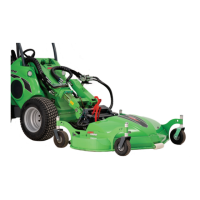
The attachment is equipped with a mechanical floating system, which enables efficient operation on uneven
terrains. Floating refers to a linkage that allows the attachment to follow the contours of the ground surface
without moving the loader boom. OptiFloat® allows the attachment to tilt sideways as well and eliminates the
need for floating of the loader boom.
Adjusting to correct operating position:
Floating is adjusted by using
the controls of the loader boom
from the driver's seat, when
ready to begin use.
To set the optifloat linkage to
correct initial position:
Position the loader boom
and its quick coupling plate
to about in the middle of the
extreme positions of the
floating linkage.
The middle position in the
adjacent figure indicates
the correct initial setting.
The operation of floating is
greatly affected by its setting. If
the floating has been set too
high, the attachment is easily
left hanging in the air. When it is
too low, the loader's front
wheels are easily raised off the
ground.


 To Next Page