Chapter 3: Exploring Rigs 27
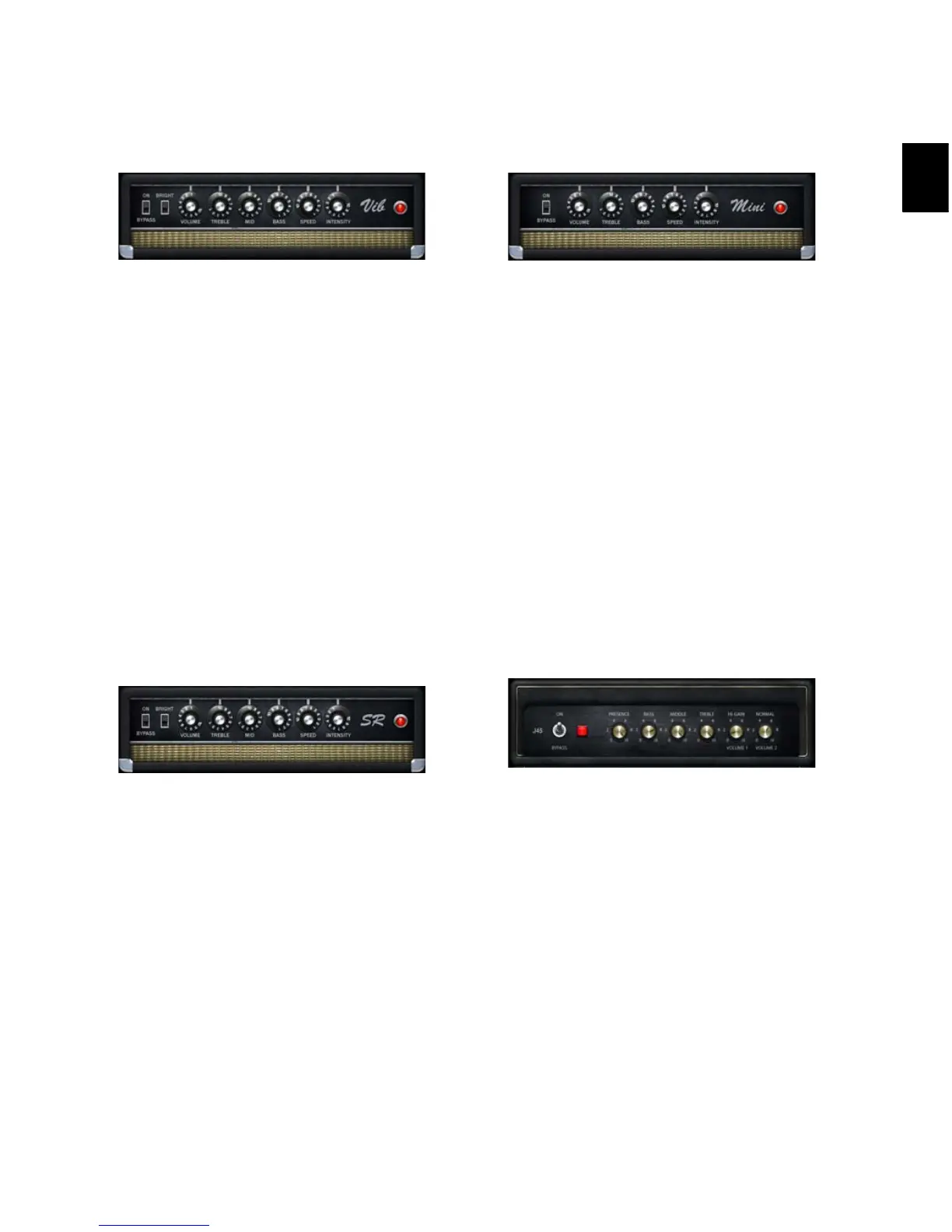
‘64 Black Vib
Produced for a short time in the mid-60s, the
amp we based the ‘64 Black Vib model on is an-
other one of the all-time great US-made smaller
club amps. With an easy-to-overdrive but still
not over-loud 40-watt 6L6GC-based power sec-
tion and a single 15-inch speaker in an open-
back cabinet, this amp strikes a great compro-
mise between the crunch of the smaller models
in the line and the hall-filling clean tones of the
larger models.
We added a midrange control for further tonal
versatility. Set it to ~7 to match the flat response
of the original amp.
‘65 Black SR
This amp model is based on a US-made 60s-era
40-watt combo amp, with four 10-inch speakers
in an open-back configuration. This amp offered
both tremolo and spring reverb effects. Known
for chiming clean tones at comparatively high
volumes, this amp is a favorite of country pick-
ers, blues players, and other aficionados of high-
volume clean tones.
Toggle the Bright switch on and off with the
SW2 button.
‘65 Black Mini
The ‘65 Black Mini amp model is based on a US-
made 60s era 6-watt tube combo amp, with a
single eight-inch speaker in an open-back con-
figuration.
Though small both in stature and volume, this
amp offers sweet gently driven tones and
straight-ahead spank in droves. Its ability to pro-
duce classic tube amp sounds at low volumes
has made this amp a studio standard for de-
cades.
Toggle the Bright switch on and off with the
SW2 button.
’65 J45
This amp model is based on a British-made 60s
era 45-watt tube head, the very first amp made
by this company. It was known for its then-fresh
take on a classic US-made bass amp (which was
used primarily by guitarists). It features two
bridged input channels, each with its own vol-
ume setting.
Those two channels, which can be blended to-
gether using the Volume1 and Volume 2 con-
trols, have different tonalities. Channel 1 has a
fairly flat tonal response, while Channel 2 is
somewhat darker-sounding.


 To Next Page