Chapter 3: Exploring Rigs 29
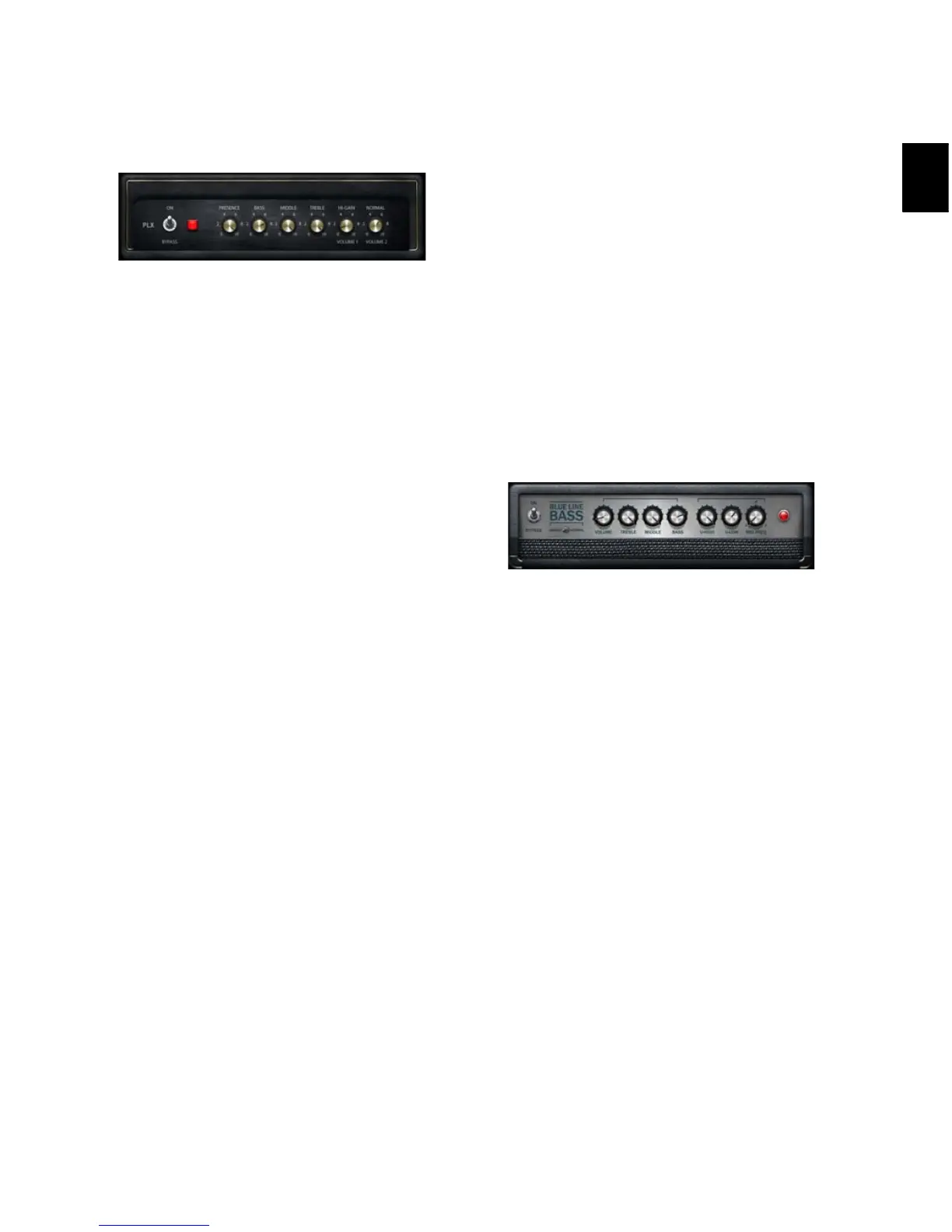
‘67 Plexiglas Vari
This amp model is based on a British-made,
1967-vintage 100-watt tube head, similar to the
1969-vintage amp we used as the basis for our
‘69 Plexiglas 100w model. This new model sim-
ulates that amp having its voltage reduced by a
variable transformer called a Variac. The voltage
reduction changes the amp’s tone and sustain
characteristics dramatically, producing the
much-loved Brown tone some famous users of
this amp were known for.
The amp’s two channels, which can be blended
together using the Volume1 and Volume 2 con-
trols, have different tonalities. Channel one has
a fairly flat tonal response, while Channel two is
somewhat darker-sounding.
‘68 Plexiglas 50w
This amp model is based on a British-made, 60s
era 50-watt tube head, the lower-wattage ver-
sion of the amp that was the basis for our Plexi-
glas model. This amp was designed with a lower
power tube plate voltage, and thus is known to
break up at lower levels than its 100-watt coun-
terpart.
For our model, we’ve based it on the legendary
50-watt 1968 version. We’ve also “jumped”
both channels, for further gain.
‘69 Plexiglas 100w
Based on one of the most highly sought-after
high-volume amplifiers of the late 1960s, our
‘69 Plexiglas model delivers no-nonsense British
crunch. The original amp's dual 4x12 cabinets
and 100-watt head offered unprecedented vol-
ume and power for the time, helping to usher in
the era of the Guitar God.
For our model, we’ve based it on the legendary
100-watt 1968/69 version. We’ve also “jumped”
both channels, for further gain.
‘69 Blue Line Bass
This amp model is based on a US-made, late-60s
300-watt tube bass head. This amp originally
sold with a pair of 8x10 speaker cabinets, and
was known for its massive volume and wide
range of usable tones.
The U-Lo and U-Hi controls add low or high har-
monics to the signal. On the original amp, these
controls were on-off switches. Here, the U-Lo
and U-Hi controls are continuously variable.
The Mid Freq control, which selects the center
frequency affected by the Mid control, was a
three-way switch on the original amp. Here, the
frequency setting is continuously variable.


 To Next Page