Need help?
Do you have a question about the Avios C-130V2 and is the answer not in the manual?
Key safety guidelines for operating the model, including reading the manual, pilot experience, and avoiding hazards.
Steps to join the main fuselage, rear section, and attach the vertical stabilizer.
Procedure for installing the wing spar, attaching wings, and securing propellers to the model.
Connecting control linkages for flaps and elevators, and connecting UBEC cables.
Detailed procedure for setting up and adjusting flap controls and travel endpoints.
Instructions for configuring the cargo bay door servo and its end points for operation.
Procedure for radio setup of the retractable landing gear and door sequencer.
Guide to installing the scale windshield wipers, pitot tubes, antennas, and dew point sensor.
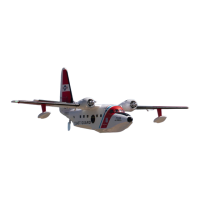
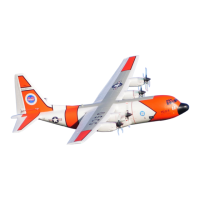
The Avios C-130 V2 is a highly detailed, 1:25 scale replica of the iconic C-130 turboprop aircraft, designed for intermediate to advanced pilots. This plug-and-play model comes pre-assembled with many features that enhance its scale realism and flight performance. It is available in two distinct color schemes: the classic US Coast Guard hi-viz orange and white, and a civilian cargo plane scheme in red, white, and blue, both designed for excellent visibility in the sky.
The primary function of the Avios C-130 V2 is to provide an authentic and engaging remote-controlled flying experience for enthusiasts of scale aircraft. It accurately mimics the flight characteristics and operational features of the full-scale C-130, which has served in various roles, including troop and cargo transport.
One of the standout usage features is the electronic retractable scale landing gear. This system includes pre-programmed sequencing gear doors that operate in a manner similar to the full-scale aircraft, adding a significant touch of realism during take-offs and landings. The landing gear is fully assembled and tested by factory technicians, ensuring reliable operation. For optimal performance, the landing gear requires a specific setup procedure. When replacing a depleted battery, the system needs to re-learn its program sequence by cycling the retract switch once, ensuring smooth operation of the landing gear (extend and retract).
The model is equipped with scale-like operating fowler flaps, which are crucial for achieving short take-offs and controlled landings, just like the real C-130. These flaps require careful setup to ensure even travel and proper deployment. The flap control linkages should not be attached until the radio setup is complete. The radio should be configured for a 2-aileron and 2-flap setup, with a 2-way switch assigned for the flap channel and an auxiliary channel for operating the outboard and inboard flaps. Initial flap values should be set to 40% of total travel, and servo travel and direction must be checked and adjusted. The servo arm should be set to approximately a 20-degree angle using sub-trim, with the Z link installed on the second hole from the servo output shaft and the ball link socket attached to the flap control horn. The retracted flap position needs to be adjusted to eliminate any buzzing from the servo. For full deployment, the outboard flaps should travel about 45mm down, and the mid-flap position should be 30mm down. Inboard flaps should be set to 22mm for full-flap and 11mm for mid-flap. It is important not to exceed the recommended throws to avoid control difficulties at low flying speeds.
Powering the Avios C-130 V2 are four powerful brushless motors, which provide tremendous thrust for short take-offs and steep climb-outs. The model utilizes iconic 4-blade propellers (2 CW and 2 CCW), which are highly efficient, powerful, and true to scale. Propeller adapters are factory fitted, but it's recommended to check their tightness. The propellers are secured with Hex screws, and thread lock should be applied for added security.
A unique and engaging feature is the working C-130 cargo door, which can be operated via an auxiliary channel on a computer radio. This feature is perfect for "candy drop" events at flying fields. A cabin light is also integrated, which automatically switches on/off when the cargo door is opened or closed. The cargo door also requires a specific radio setup. A 2-way or 3-way switch can be assigned to a free channel for its operation. End points should be adjusted to approximately 30% of total travel on either side. For a 2-way switch, the door should be flush with the fuselage when closed and just miss the ground when open. For a 3-way switch, an additional halfway open position should be set where the door is level to the fuselage main axis. Careful adjustment is crucial to prevent the servo from stalling and draining the battery excessively or burning out.
For enhanced realism and visibility, the model is equipped with super bright navigational lights and landing lights, which are visible even in bright sunlight.
The wings feature special connectors built-in for quick and easy setup at the flying field. Assembly involves sliding the carbon fiber main wing spar through the fuselage, then sliding both wings onto the spar. Electrical connectors on the wings must align and plug in correctly. The wings are secured to the fuselage wing roots with four 3mm x 10mm screws, tightened with a Hex key with a ball end. Care must be taken not to dent the fuselage during tightening.
Scale detailed accessory plastic parts, such as windshield wipers, pitot tubes, and dew point sensors, are included in the kit and can be fitted to further enhance the model's appearance. The fitting of these parts is illustrated with detailed pictures in the manual. The cargo door ramp is also included, but it is for display purposes only on the ground and should not be used during flight.
Maintenance features include clear instructions for propeller installation and checking. The propeller adapters are factory fitted, but pilots should verify their tightness. Propellers are installed onto the shaft and spinner backplate, secured with supplied Hex screws, and thread lock is recommended for security.
The manual provides crucial safety instructions, emphasizing that the airplane is not a toy and is suitable only for experienced pilots. It advises against flying in thunderstorms, strong winds, or wet weather, and warns against flying near power lines, automobiles, airports, railway lines, highways, crowds, or organized games. A flat landing and take-off area clear of obstacles is required. Pilots are reminded that safety is their responsibility and should not attempt to catch the plane while flying.
For optimal throttle response, the ESCs should be calibrated to the radio system. This involves setting throttle end points on the transmitter (0% at zero throttle, 100% at full throttle), powering on the transmitter with the throttle stick at 100%, connecting the flight battery, listening for "W V" tones from the motors, and then immediately moving the throttle stick to 0%. It is safer to have assistance when performing this calibration.
The Avios C-130 V2 also features an improved rudder pushrod system with a rear-mounted servo, making it lighter and more direct. The rudder control horn and pushrod are installed as shown in the manual, with the Z link going to the servo horn and the ball link to the rudder horn. Similarly, the elevator pushrod linkage is installed, ensuring the Z link goes to the servo horn and the ball link to the elevator horn.
The assembly process begins with selecting the main fuselage body, installing metal rods into carbon sleeves at the rear, and then sliding the rear fuselage/horizontal stabilizer section onto these rods, ensuring a snug fit. The vertical stabilizer spigots are then installed into corresponding slots and secured with 3mm x 20mm and 3mm x 25mm screws, with the longer screw at the front, just behind the cargo bay door.
Overall, the Avios C-130 V2 offers a comprehensive and realistic RC flying experience, combining scale aesthetics with advanced operational features, all designed for the discerning intermediate to advanced pilot.
 General
| Channels | 6 |
|---|---|
| Material | EPO Foam |
| Skill Level | Intermediate |
| Wingspan | 1600mm |
| Motor | 3536-KV850 |
| ESC | 40A |
| Servos | 9g x 6 |

 To Next Page